BIOL 105 Lecture 5 9/2/26
Overview
Jonathan Montgomery connects chemistry fundamentals to biology by tracing how atomic structure determines electron behavior, bonding, polarity, and ultimately hydrophobicity and hydrophilicity. The review covers elements and isotopes, electron shells and the octet rule, Avogadro’s number and molarity calculations, then introduces electronegativity as the basis for understanding polar bonds.
Key takeaways
- An atom’s proton count determines its element, while its valence electrons largely determine how it bonds and reacts.
- Isotopes are atoms of the same element with different neutron counts, so periodic-table atomic masses are averages rather than necessarily the mass of a single atom.
- One mole always represents approximately 6.022 × 10²³ particles, and its mass in grams has the same numerical value as the substance’s molar mass in grams per mole.
- To prepare 150 mL of a 6 M sodium chloride solution, use the molar mass of about 58.5 g/mol and calculate 6 mol/L × 0.15 L × 58.5 g/mol, or about 52.7 g NaCl.
- The octet rule is a useful introductory biology model: most course-relevant atoms form bonds in ways that help fill an outer shell to eight electrons.
- Electronegativity differences cause unequal electron sharing and molecular polarity, a key foundation for predicting interactions between water and biological molecules.
Chapters
- An element is defined by its characteristic properties, and its smallest unit is an atom.
- Combining elements can produce compounds with properties distinct from either ingredient; sodium and chlorine form salt.
- Emergent properties arise when interacting components produce a property not present in the components separately.
- Protons are positively charged, electrons negatively charged, and neutrons neutral; protons and neutrons account for nearly all atomic mass.
- An element is identified by its proton count, while neutron and electron counts can vary without changing the element’s identity.
- Atomic mass in daltons or atomic mass units is approximately the number of protons plus neutrons.
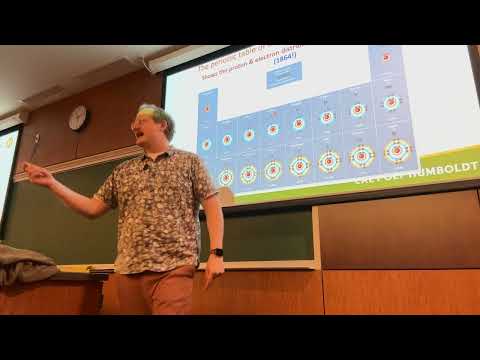
- The periodic table orders elements by proton number and provides information such as average atomic mass and electron arrangement.
- A neutral atom with six protons, such as carbon, has six electrons: two in the innermost orbital and four in the next shell.
- Electron orbitals are probability models rather than fixed paths; Montgomery emphasizes that useful scientific models need to support accurate predictions.
- An element’s atomic number gives its proton count, while its relative atomic mass reflects the average mass of its naturally occurring isotopes.
- Hydrogen has one proton, and hydrogen isotopes with additional neutrons are heavier; carbon has six protons and an average atomic mass near 12.
- Oxygen’s atomic number is 8 and its common mass number is 16, so an oxygen atom has a mass of approximately 16 daltons.
- Carbon, hydrogen, oxygen, and nitrogen make up most of the mass of living organisms; roughly 3% comes from other elements.
- SPONCH helps recall sulfur, phosphorus, oxygen, nitrogen, carbon, and hydrogen, while magnesium, calcium, and potassium are also important nutrients.
- The review focuses on biologically common elements rather than the full periodic table.
- One mole contains approximately 6.022 × 10²³ particles, whether those particles are atoms or molecules.
- A mole of carbon and a mole of hydrogen contain the same number of atoms but have different masses.
- The mole lets chemists relate particle counts to measurable quantities; methane, CH₄, requires a 1:4 ratio of carbon to hydrogen atoms.
- Molarity is the number of moles of solute per liter of solution; a 6 M solution contains 6 moles per liter.
- For sodium chloride, adding sodium’s approximate atomic mass of 23 to chlorine’s 35.5 gives a molar mass near 58.5 g/mol.
- A 6 M NaCl solution requires 6 × 58.5 = 351 g per liter; for 150 mL, scale the amount by 0.15 L.
- Use daltons for a single atom or molecule, grams for a mole, and grams per mole for molar mass.
- Valence electrons occupy the outermost shell and determine an atom’s bonding and chemical reactivity.
- For the elements emphasized in this course, the innermost shell holds two electrons and outer shells are approximated as stable with eight.
- Neon, argon, and xenon have full valence shells and are relatively chemically inert; incomplete outer shells tend to participate in bonding.
- Calculate compound molar mass by multiplying each element’s atomic mass by its count and adding the totals; glucose, C₆H₁₂O₆, uses 6 carbon, 12 hydrogen, and 6 oxygen atoms.
- Chemical reactions break or form bonds, converting reactants into products; some reactions are reversible and others are not.
- Electronegativity generally increases toward the upper right of the periodic table, making oxygen, nitrogen, and chlorine strongly electron-attracting.
- When bonded atoms differ in electronegativity, they share electrons unequally, creating polar bonds that lead into the study of hydrophilicity and hydrophobicity.
Transcript excerpt
0:01 Okay, recording begins. Biology 105. It is September 2nd and here we are ready to talk about chemistry review topics. Okay, I know we're all just as excited as you are. Uh, so chemistry review, why do we have to talk about it? Why do we talk about chemistry in a biology class? All right, I'm going to tell you the secret here is that a lot of this is just going to boil down to trying to get you to understand hydrophobicity and hydrophilicity, which requires an understanding of polar versus nonpolar molecules, which requires an understanding of basic atomic structure and leads to an understanding of chemical reactions. So, you'll be kind
0:49 of shocked how much of this is going to come down to what is hydrophobic and what is hydrophilic. If you don't know what those terms mean yet, you will by the end of our discussion on Chemistry Review. Here we go. Let's get right into it. Start with some standard definitions. Okay. Elements, compounds, emergent properties. We'll look at a periodic table of the elements later, right? An element it's basically the an element is something with distinct characteristics. The smallest unit of it is a single atom of a given element. And when you combine elements together, you can make molecules, all right, or compounds that have properties that are distinct from either component element. All right? So,
1:37 we've got sodium right here, which is like a soft metal. We have chlorine which is a poisonous gas and when you combine them together you get a salt. Okay. So emergent properties that means a property that wasn't there with any of the components but when the components all interact you get some new property. And that's a general term that you'll hear applied to all sorts of different
This is the start of the transcript. Save this video free for the whole transcript, searchable and time-coded.
In this course
Related notes
Summary, takeaways, and chapters were generated by AI from the video's transcript and may contain errors. The video belongs to its creator, Jonathan Montgomery.