BIOL 105 Lecture 6 9/4/26
Overview
Jonathan Montgomery reviews how electronegativity differences determine ionic and covalent bonding, molecular polarity, and intermolecular attractions, emphasizing that intermolecular forces are weaker than bonds within molecules. He then explains isotopes and their uses in tracing photosynthetic carbon pathways and studying bird migration, before introducing water’s polarity and hydrogen bonding as the basis for its distinctive properties.
Key takeaways
- Electronegativity differences determine how electrons are distributed: sodium transfers an electron to chlorine to form ions, while carbon and hydrogen share electrons relatively evenly in nonpolar methane.
- A molecule’s polarity depends primarily on its bonds in the lecture’s examples, but geometry can cancel bond dipoles, as in symmetrical carbon dioxide.
- Intramolecular bonds hold atoms together within molecules, while intermolecular forces attract separate molecules; boiling water separates molecules without breaking their oxygen-hydrogen covalent bonds.
- Isotopes retain the same number of protons but differ in neutrons and mass, making carbon-14 useful for tracing carbon through photosynthesis and for estimating the age of once-living material.
- Water’s highly polar oxygen-hydrogen bonds produce strong hydrogen bonds between water molecules, underpinning properties such as cohesion, adhesion, and solvent behavior.
Chapters
- The Week 2 quiz and review worksheet are due Sunday at 11:59 p.m.
- Late submissions lose 10% for each day, including work submitted just after midnight Monday.
- Montgomery plans to finish chemistry review before beginning biological macromolecules the following week.
- Electronegativity increases toward fluorine at the upper-right of the periodic table.
- In an oxygen-hydrogen bond, shared electrons spend more time near oxygen, creating an uneven charge distribution.
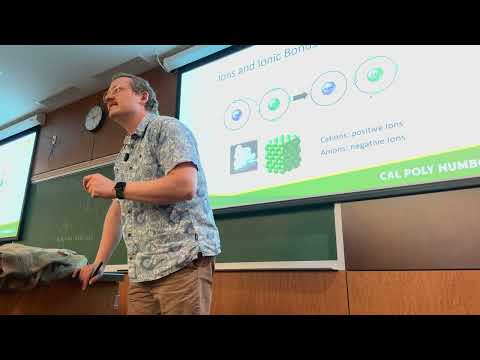
- In sodium chloride, chlorine gains an electron from sodium, producing negatively charged chloride and positively charged sodium ions.
- The attraction between oppositely charged ions forms an ionic bond.
- A neutral carbon atom has 6 protons and 6 electrons, with 4 electrons in its outer shell.
- Carbon forms four covalent bonds in methane, sharing electrons so carbon reaches an octet and each hydrogen fills its 2-electron shell.
- Carbon-hydrogen bonds share electrons relatively evenly, making methane a nonpolar molecule.
- Polar covalent bonds, such as oxygen-hydrogen bonds, share electrons unevenly without transferring them completely.
- Carbon dioxide has polar carbon-oxygen bonds, but its symmetrical arrangement cancels the molecule’s overall polarity.
- Montgomery emphasizes bond type as the main course focus, while noting that molecular shape can also affect polarity.
- Intramolecular forces act within a molecule, including the covalent bonds in water and ionic attractions in sodium chloride.
- The prefixes intra and inter mean within and between, respectively, as in intraspecific versus interspecific competition.
- Dipole-dipole interactions attract the partially positive and partially negative ends of polar molecules.
- Water and molecules with nitrogen-hydrogen bonds can form strong hydrogen-bond interactions because their bonds are highly polar.
- Van der Waals interactions arise from temporary electron-distribution patches and can help geckos adhere to surfaces through their high-area foot pads.
- The lecture’s relative-strength comparison sets Van der Waals forces at 1, dipole-dipole forces at 10, and hydrogen bonds at 50.
- Isotopes are atoms of the same element with the same proton count but different neutron counts, so their masses differ.
- Carbon-12 is the most common carbon isotope; naturally occurring carbon also includes heavier isotopes.
- Isotopes generally participate in the same chemical pathways because they share an element’s proton count and, when neutral, electron count.
- Some isotopes are radioactive and decay, while isotope measurements can identify the forms present in a sample.
- Researchers traced photosynthetic carbon by supplying algae with carbon dioxide containing carbon-14, then stopping growth at timed intervals and identifying labeled molecules.
- The carbon-14 tracing experiments helped establish the sequence of reactions associated with the Calvin cycle, credited to Melvin Calvin.
- Carbon-14 enters plants from atmospheric carbon dioxide and passes into animals through feeding; after an organism dies, its carbon-14-to-carbon-12 ratio declines as carbon-14 decays into nitrogen-14.
- The lecture also describes isotope ratios in bird feathers as a tool for investigating migration patterns associated with feeding at different elevations.
- Water is polar because oxygen is much more electronegative than hydrogen.
- The partial charges on neighboring water molecules create strong hydrogen bonds between molecules.
- Montgomery previews cohesion, adhesion, temperature behavior, and solvent properties as consequences of water’s polarity and intermolecular hydrogen bonding.
- The class is scheduled to continue the water-properties topic on Wednesday after the Monday holiday.
Transcript excerpt
0:00 Okay, the recording begins. It's biology 105. The date is September 4th, 2026. All right, so we're about to wrap up week two. Congratulations, everybody. It's very exciting. I hope you're all stoked for a 3-day weekend coming up already. Pretty cool. So, don't show up to class on Monday unless you really want to. I won't be here, but uh you know, the room will be available, I suppose. Anyway, uh here's where we are in week two. Okay, don't forget that this week you have two assignments due by Sunday at 11:59 p.m. Both of them need to be due by then. Need to be turned in by then. If you turn them in later, there's a 10% deduction for each day. So, if you turn it in at 12:05 a.m. on Monday, 10% automatically comes off of that assignment. All right, so knock
0:50 those things out. Get them all done. They're all embedded in or not embedded, they're all available in the week 2 module right here. There's the quiz, there's the review worksheet. Any questions about those assignments for you? All right. Sick. As I've said before, if something comes up and you're unable to turn in the assignment by the, you know, by the due time, the due date, please communicate with me prior to missing the due date. All right. Solid. anyway, or just communicate with me about it after, whatever. It's it's fine. Let's go ahead and we can get back into our material. We're going to keep doing our chemistry review PowerPoint and then next week when we come back, we'll be able to get into biological macroolelecules. And this is really when
1:37 the biology sort of starts uh in earnest. Let's get this up and throw the laser pointer on there. There it is.
This is the start of the transcript. Save this video free for the whole transcript, searchable and time-coded.
In this course
Related notes
Summary, takeaways, and chapters were generated by AI from the video's transcript and may contain errors. The video belongs to its creator, Jonathan Montgomery.