BIOL 105 Lecture 1 8/24/26
Overview
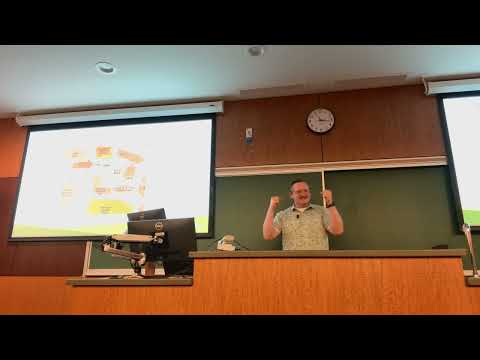
Jonathan Montgomery outlines BIOL 105’s Canvas organization, weekly schedule, lab preparation, grading, and support resources, emphasizing regular course check-ins and completing assignments on time. Key requirements include Sunday 11:59 p.m. deadlines with a 10% daily late penalty, Thursday labs with printed protocols and closed-toe shoes, and an open-notebook lab final that requires printed materials; lecture exams are closed-resource and account for 28% of the grade.
Key takeaways
- BIOL 105 assignments are due Sundays at 11:59 p.m.; work submitted late loses 10% for each day past the deadline, so students should contact Jonathan Montgomery promptly if they need an accommodation.
- Thursday lab preparation means printing and reviewing the weekly protocol, bringing a lab notebook, and wearing closed-toe shoes; the first lab includes culturing, micropipette practice, and Euglena microscopy.
- A printed, organized protocol binder is permitted for the comprehensive in-person lab final, while digital notebooks must be printed before the final; protocol notes and worked calculations can make the binder especially useful.
- Lecture exams account for 28% of the grade, while online lab assignments collectively carry substantial weight, making consistent lab participation and assignment completion important to the final grade.
- Students who earn 70% or below on a midterm can report on missed questions to recover half the points lost, capped at a 70% exam score.
- Campbell Biology is the source for reading quizzes; the 11th edition or newer is recommended, but Montgomery says the 9th and 10th editions remain usable.
Chapters
- Canvas is the main place to find assignments, grades, messages, the syllabus, and the course schedule.
- Weekly modules organize lecture slides, lab materials, reading quizzes, and lab assignments; the semester's content is already uploaded.
- Jonathan Montgomery recorded audiobook-style readings of assigned Campbell Biology chapters for students who prefer listening.
- Lectures meet Monday, Wednesday, and Friday from 11:00 to 11:50 a.m.; associated labs meet Thursdays in Science B 132.
- Montgomery holds office hours in Brookens House 2011 on Tuesdays from 11:00 to 11:50 a.m. and Wednesdays from noon to 1:00 p.m., with appointments available.
- The class includes students from biology, botany, wildlife, kinesiology, zoology, marine biology, engineering, fisheries, fire science, prehealth, and other majors.
- Montgomery earned a botany bachelor's degree from Humboldt State University in 2013.
- After graduate study at the University of California, Riverside, he earned a PhD focused on plant physiology, plant ecophysiology, and turfgrass science.
- He has taught at the institution since 2019 and teaches BIOL 105 alongside ecology and environmental science courses.
- Canvas provides lecture slides, learning objectives, exam study guides, lab handouts, and grade tracking; Montgomery says study guides are available for midterms and the final.
- Every lecture or lab assignment is due Sunday at 11:59 p.m.; submissions after the deadline lose 10% per day.
- Students facing technical problems or other circumstances that require an adjustment should contact Montgomery rather than silently missing a deadline.
- The first lab meets Thursday in Science B 132 and includes culturing samples from a cough or thumbprint, micropipette practice, and microscopy with Euglena.
- Students should print and review the weekly lab protocol before attending, bring a lab notebook, and wear closed-toe shoes.
- Avoid flip-flops and clothing that could be damaged by stains; lab coats are optional, while goggles are available, and long hair must be tied back for Bunsen burner activities.
- Each weekly module's lab materials include a prelab video, protocol, and related resources; the first microscopy video by Mark Wilson is about 16 minutes long.
- The week-one protocol is approximately 18 pages, or nine pages printed double-sided, and covers the lab activities and microscopy procedures.
- Montgomery recommends a three-ring binder with printed protocols and notes; digital notebooks are allowed during the term but must be printed for the in-person lab final.
- The comprehensive lab final is open notebook, permits printed materials, and can be prepared for by recording protocol answers and calculation steps in the binder.
- The syllabus lists four lab sections, instructor contacts, and SI details; lab attendance is recorded, and students should promptly notify their instructor if they arrive late or need to discuss a missed lab.
- Lecture exams together make up 28% of the course grade; the lecture final and lab final are each 12%, and the online lab midterm is 6%.
- Reading quizzes allow two attempts and use Campbell Biology; online lab assignments collectively carry substantial weight and may include quizzes or Excel-based work.
- Students who score 70% or below on one of the three midterms can complete a report on missed questions to recover half the points lost, up to a maximum score of 70%.
- The week-one module includes a reading quiz but no lab assignment; quiz answers are based on Campbell Biology.
- Montgomery recommends the 11th edition or newer, noting that the 13th edition is current while the 9th or 10th editions can still work and may cost less used.
- He advises checking the Canvas module each week to review due dates, points, drop deadlines, and exam dates.
Transcript excerpt
0:00 All right, recording begins. This is biology 105 first lecture for fall of 2026. All right, I see some familiar faces out there. I see some new faces. I'm very excited to get to work with all of you this semester. Let's go ahead and get right into standard first day stuff, right? where we're going to be able to we're going to be talking about the course structure, tips for success, where all your points come from, how the Canvas page works. You're going to get to know me a little bit. I'm going to get a, you know, we're going to do a little survey about which major people are in. That's always a fun ice breaker. And then we'll get into probably like, you know, 10 minutes of actual lecture where we'll just talk about like what is biology and the stuff that you'd expect
0:48 for day one. Okay, cool. So, first of all, uh let's go ahead and do the Canvas page orientation because the Canvas page orientation is really important nowadays. Everything, you know, you interact with all your classes through Canvas. I'll have assignments up here. You'll be able to check your grade up here. You can communicate with me through Canvas messages. You can check the syllabus, the course schedule. I've got everything broken down into weekly modules to try to make it as easy as possible for you to keep up with the material. So, looking at the Canvas page is a great place to start. Did everybody receive the welcome to biology 105 email? It should have sent you an email
1:36 as well. I'm seeing nodding heads. Yes. Good, good, good. Okay. So, if I need to change anything in Canvas at all or in the course at all, I'm going to be
This is the start of the transcript. Save this video free for the whole transcript, searchable and time-coded.
In this course
Related notes
Summary, takeaways, and chapters were generated by AI from the video's transcript and may contain errors. The video belongs to its creator, Jonathan Montgomery.