BIOL 105 Lecture 7 9/9/26
Overview
Jonathan Montgomery connects water's polarity and hydrogen bonding to cohesion, adhesion, high specific heat, ice's lower density, and water's solvent behavior. The lecture also introduces amphipathic phospholipids and soap micelles, then begins pH calculations with the relationship [H+][OH-] = 10^-14; course logistics include an Excel-only graphing assignment and an open-notebook lab final.
Key takeaways
- Water's polarity comes from both polar O-H bonds and its bent shape, allowing partial charges to form hydrogen bonds between neighboring molecules.
- Cohesion keeps water molecules connected in plant vascular columns, while adhesion explains water's attraction to polar surfaces such as glass.
- Water's high specific heat buffers temperature change, and evaporation cools a surface by removing its higher-energy molecules.
- Ice is less dense than liquid water, so floating surface ice insulates lakes and helps aquatic life persist through winter.
- The rule 'like dissolves like' explains why water surrounds ions and polar regions but does not freely dissolve nonpolar oils.
- Soap's amphipathic molecules gather oil into micelles, with hydrophobic regions associating with oil and hydrophilic regions interacting with water.
Chapters
- A Chapter 5 reading quiz is due Sunday at 11:59 p.m.
- The carbohydrate graphing assignment requires Excel, and Google Sheets is not accepted because Excel use is a course learning objective.
- The submitted lab figure must include a caption and be saved as a PDF; embedded tutorials walk through graphing and formatting.
- Lab protocol handouts do not need to be submitted, but completing and annotating them helps prepare an organized lab notebook.
- The 100-point lab final is an open-notebook, paper-based exam with short answers, math, multiple choice, and one true-or-false question.
- Students have three hours for the final; organized notes can also reduce the time needed for the online lab midterm.
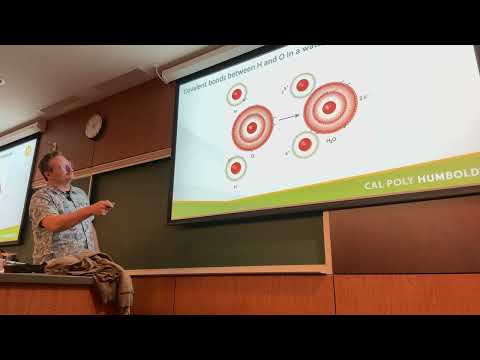
- Oxygen is more electronegative than hydrogen, making each O-H bond polar covalent.
- Water's bent shape places the hydrogen atoms on one side, producing partial positive and negative regions across the molecule.
- Hydrogen bonds form between water molecules as intermolecular attractions, rather than as covalent bonds within a molecule.
- Cohesion is attraction between molecules of the same substance, while adhesion is attraction between water and another surface.
- Water adheres more strongly to polar glass than to relatively nonpolar plastic, producing a more noticeable meniscus in a glass graduated cylinder.
- Cohesion helps maintain continuous water columns in plant vascular tissue and contributes to surface tension.
- The water column cats pull up with their tongues when drinking depends on cohesive attraction between water molecules.
- Specific heat is the energy needed to raise one gram of a substance by one degree Celsius; water requires about one calorie per gram per degree.
- Hydrogen bonds stabilize water molecules, so added energy is needed before their motion increases substantially.
- Water's high specific heat lets oceans and other bodies of water store and redistribute heat, while evaporation cools skin as high-energy molecules escape.
- Water expands and becomes less dense as it freezes, so ice rises to the surface instead of sinking.
- Surface ice insulates the liquid water below, helping lake ecosystems remain habitable during cold months.
- Freezing can damage cells because expanding ice can disrupt cellular structures; Montgomery also mentions vitreous ice and other ice forms used in microscopy research.
- Water's partial charges surround sodium and chloride ions, separating them from solid salt and keeping the ions in aqueous solution.
- Water can surround polar regions on large covalent molecules, forming a hydration shell without breaking the molecule's covalent bonds.
- The rule 'like dissolves like' predicts that polar substances interact well with water, while nonpolar oils and fats do not dissolve freely in it.
- Amphipathic molecules contain both hydrophilic polar regions and hydrophobic nonpolar regions.
- A phospholipid has a polar head and carbon-hydrogen-rich nonpolar tails; in water, phospholipids can assemble into bilayers or micelles.
- Soap molecules are amphipathic: their nonpolar regions associate with oily grime while their polar regions interact with water, allowing oil to be washed away.
- Montgomery summarizes water's ability to stick to surfaces, resist rapid temperature change, and bring many substances into solution as consequences of polarity and hydrogen bonding.
- The introductory pH model tracks hydrogen ions and hydroxide ions; an excess of either can disrupt molecular interactions.
- Square brackets denote concentration, and the lecture uses [H+][OH-] = 10^-14 as an introductory relationship.
- If [H+] = 10^-1, then [OH-] = 10^-13 because multiplying powers with the same base adds their exponents.
Transcript excerpt
0:01 Okay, the recording begins. It is September 9th. This is biology 105. Thank you all for making it again to another lecture. I hope you had a lot nice three-day weekend. Um let's get back into it. It's Wednesday, right? Here we go. So, this is week three. You can always check the schedule, but always look in these, you know, modules this week. We're going to get into biological macromolecules. It's going to be great. And we are all set. We're going to have labs, you know. There's a reading assignment. There's a reading quiz for chapter five due on Sunday 11:59 p.m. There's a carbohydrate graphing assignment where you will have to use Excel for your labs using the data that you generate in that lab. And just to preempt some questions about that. Uh if
0:50 you don't have Excel on your computer, you should figure that out. Because you will need it in all your classes going forward. And I know it's frustrating cuz there is there's steps, but you have free ex- a free Excel license, free, paid for with your tuition, right? So, get Excel on your own computer so you can do your own Excel work. Excel's not going to go away. And Google Sheets is just not sufficient for the applications in the biological sciences and the other sciences as well, right? Excel can do statistics. Excel can do a lot. And all the professional organizations use Excel. So, we're going to try to make you do some Excel work. If you just can't get that to work or you don't want Excel on your computer, I run into that
1:37 sometimes. The library has a bunch of computers for you. You can check a computer out. [clears throat] You can use a computer
This is the start of the transcript. Save this video free for the whole transcript, searchable and time-coded.
In this course
Related notes
Summary, takeaways, and chapters were generated by AI from the video's transcript and may contain errors. The video belongs to its creator, Jonathan Montgomery.