BIOL 105 Lecture 3 8/28/26
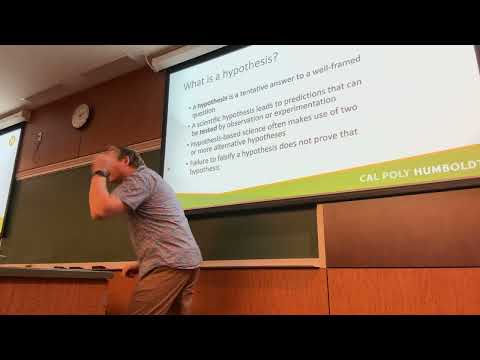
Overview
Jonathan Montgomery introduces the scientific method as a cycle of observation, testable and falsifiable hypotheses, experiments, interpretation, and independent repetition. He applies that framework to fruit-fly development and experimental design, explaining variables, controls, data types, and null hypotheses through examples including plant nitrogen treatments and antimicrobial discs.
Key takeaways
- A hypothesis should be testable and falsifiable; an experiment that fails to disprove it provides support but does not prove it true.
- Independent researchers can expose weaknesses that the original experiment missed, as when a follow-up test of the imagined radio uses a vacuum rather than submerging it.
- Writing hypotheses as “if explanation and experiment, then expected result” forces researchers to specify the idea, test, and prediction.
- The dependent variable is the outcome proposed to depend on the independent variable, whether that independent variable is manipulated or observed as natural variation.
- Negative controls exclude the tested treatment, while positive controls use a known effective treatment to verify that an experiment can detect an effect.
- A null hypothesis states that the independent variable has no effect on the dependent variable; in antimicrobial disc testing, it can predict no effect on zone-of-inhibition size.
Chapters
- Jonathan Montgomery reminds students that the Campbell Biology Chapter 1 reading quiz is due Sunday at 11:59 p.m., the recurring course deadline.
- Lecture recordings are linked through Canvas and a YouTube playlist, with recordings from a previous semester available as backup.
- After checking in about the first lab, Montgomery begins the lecture on how science investigates questions about the world.
- Montgomery defines science as one way of knowing, while noting that people also gain knowledge outside the scientific method.
- The process centers on forming and repeatedly testing hypotheses, supported by observations, discovery, and community analysis.
- Scientific communities influence which questions and findings receive attention and research funding.
- A hypothesis is a tentative answer to a well-framed question and should be both testable and falsifiable.
- Russell’s teapot illustrates an unfalsifiable claim: its proponent can keep revising the teapot’s size to evade detection by telescopes.
- The burden of proof rests on the person making an assertion; failing to falsify a hypothesis does not establish that it is true.
- Montgomery’s radio thought experiment shows why replication matters: a second researcher tests the idea that a tiny band inside a music-playing device explains its sound.
- Montgomery recommends structuring a hypothesis as: if a proposed explanation is true and an experiment is performed, then a specific result is expected.
- For the imagined radio, the prediction is that submerging a box containing a tiny band for two minutes will stop its music because the band drowns.
- This format makes the proposed explanation, experimental design, and expected result explicit, helping researchers communicate and spot mistakes.
- After an experiment, results may support or contradict a hypothesis, inspire a revision, or lead to a new hypothesis.
- A fruit-fly example tests whether rearing temperature affects the roughly 30-day life-cycle length.
- Montgomery predicts that flies at 18°C will develop more slowly than flies at 29°C because lower temperatures slow metabolic reactions.
- A study could compare 100 fruit flies at each temperature, measure life-cycle duration, and analyze averages and variation.
- A confound such as temperature making food less digestible could explain slower development, so researchers could repeat the study with a food source whose consistency does not change with temperature.
- Montgomery describes scientific laws and theories as categories whose boundaries are abstract, and informally characterizes a law as a well-supported result used to develop new hypotheses.
- A variable is a measurable or categorizable feature, such as temperature, plant height, soil location, or the prevalence of antibiotic-resistant bacteria.
- The dependent variable is the outcome proposed to depend on the independent variable; stating “plant height depends on nitrogen application rate” identifies both.
- In a manipulative experiment, researchers change the independent variable, as when they apply different fertilizer rates to plants.
- In an observational study, researchers measure natural variation, such as redwood diameter at breast height (DBH) across elevations, without manipulating elevation.
- In a nitrogen-and-plant-height experiment, plants receiving water without nitrogen can serve as a negative control, while other groups receive different nitrogen rates.
- A control group may not make sense for observational comparisons, such as measuring redwood DBH across an elevation gradient where every tree experiences an elevation.
- Experiments need replicates, such as 100 fruit flies per temperature rather than one, and repetition across time or locations can test whether findings recur.
- Qualitative data describe categories or qualities, while quantitative data use measurements such as a chimpanzee’s heart rate or a wall’s hue, saturation, and brightness.
- Researchers often quantify observations to compare variables statistically, but correlation alone does not establish causation.
- A negative control keeps conditions consistent while excluding the independent variable, helping rule out alternative causes of an observed result.
- A positive control uses a treatment known to produce an effect; restoring an enzyme to gene-knockout flies can test whether its absence explains a wingless phenotype.
- In a disc-diffusion assay, bacteria grow across a Petri dish while antimicrobial-loaded paper discs create zones of inhibition.
- The independent variable is the antimicrobial compound, and the dependent variable can be measured as the zone-of-inhibition size.
- A plain paper disc is a negative control for disc-related effects, while a known effective antibiotic is a positive control confirming that the bacteria can respond.
- A null hypothesis states that the independent variable does not affect the dependent variable.
- For disc-diffusion testing, a specific null hypothesis is that the antimicrobial agent does not affect zone-of-inhibition size.
- Other examples are that nitrogen application rate does not affect plant height, or elevation does not affect redwood DBH.
- Montgomery closes by previewing an informal introduction to statistics in the following week.
Transcript excerpt
0:00 Recording begins. This is biology 105. The date August 28th, 2026. Okay. So, I'll start doing this less as we get more comfortable with the semester, but I'm just popping up the Canvas page, showing you the week, reminding you that you've got a reading quiz based on chapter 1 of Campbell Biology due Sunday at 11:59 p.m. All right? And that's your due date for everything through the semester, right? It's always going to be Sunday 11:59 p.m. Um, I encourage you to try to get it done before the weekend, but that's fine. I won't I won't harp on that too much. Remember, reading recordings are posted and if I continue to record the lectures, they're all going to be linked
0:48 right here under welcome. Okay? If you follow this link, it'll link you again to a YouTube playlist where I'll be uploading the recorded lectures. I'm going to keep doing it. Um, and I'm going to keep doing it for a while, but in case I stop, I have backup lectures from the last semester I taught the course recorded. So, if you want to get ahead in the schedule or whatever, you just can't get enough of Bio 105, you can watch this whole playlist if you want. Okay. Any Oh, you all had your first lab yesterday. How did it go? What's the overall vibe? I'm seeing thumbs in the air. I'm seeing a couple wiggly thumbs. Okay, we got some new TAs. Please be nice to them. Of course, they're doing their best, you know. Um, and I'll keep meeting with meeting with
1:35 them today after this. I'll get their feedback. And if you have any specific, you know, concerns, questions, comments, things that you think could go better in their labs, uh, you can always email me.
This is the start of the transcript. Save this video free for the whole transcript, searchable and time-coded.
In this course
Related notes
Summary, takeaways, and chapters were generated by AI from the video's transcript and may contain errors. The video belongs to its creator, Jonathan Montgomery.