BIOL 105 Lecture 2 8/26/26
Overview
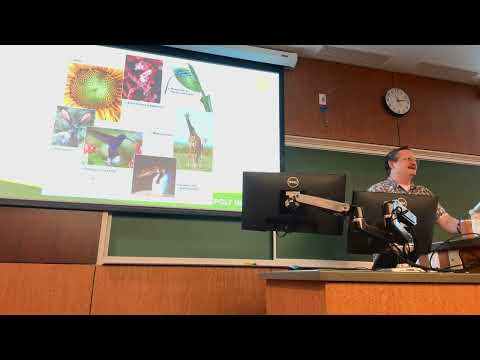
Jonathan Montgomery introduces BIOL 105 as a course focused largely on cell biology and genetics, then establishes how biologists define life through traits such as homeostasis, metabolism, reproduction, and adaptation. He connects cell theory and the distinction between prokaryotes and eukaryotes to the three domains of life, using viruses, bacterial quorum sensing, extremophile archaea, and ribosomes to show where biological definitions and classifications need careful interpretation.
Key takeaways
- Living things maintain internal conditions, process energy, respond to their surroundings, and reproduce; population-level adaptation over generations differs from an individual’s lifetime acclimation.
- Cell membranes establish the internal environment central to cell theory, while viruses challenge the definition of life because they reproduce only through host cells.
- A nucleus is the key distinction between prokaryotic and eukaryotic cells; eukaryotes also have membrane-bound organelles, whereas all cells require non-membrane-bound ribosomes to make proteins.
- The accepted three-domain classification is Bacteria, Archaea, and Eukarya, and phylogenetic trees show relatedness through shared ancestry at branch points.
- Bacteria can use quorum sensing to coordinate population-level behavior, including biofilm formation and, in some cases, changes that damage a host.
- Surface area relative to volume helps explain biological structures such as elephant ears for heat loss and folded intestinal surfaces for nutrient absorption.
Chapters
- Thursday lab sections meet in Science B132 to review microscopy and micropipetting and examine microbial growth on exposed Petri dishes.
- Students should print the Week 1 lab handout, bring it to lab, and begin a lab notebook for later lab midterms and finals.
- The only assignment due this week is an online reading quiz on Chapter 1 of Campbell Biology; the weekly modules also include audiobook recordings of assigned readings.
- Jonathan Montgomery defines biology as the scientific study of life and cautions that defining life simply as “being alive” is circular.
- Common traits of living things include responding to the environment, reproducing, growing and developing, regulating internal conditions, and processing energy through metabolism.
- Acclimation happens within an individual’s lifetime, such as sweating in heat; adaptation describes changes in a population over generations, such as shifts in hair coverage.
- Large elephant ears help regulate body temperature because their broad, thin surfaces allow heat to dissipate from blood near the surface.
- Surface area relative to volume is a recurring biological principle: intestinal folds increase nutrient-absorbing area, and structures in mitochondria and chloroplasts support their functions.
- Biological study scales from molecules and organelles to cells, tissues, organs, organ systems, organisms, populations, communities, ecosystems, and the biosphere.
- Cell theory identifies the cell as life’s fundamental unit, with a membrane separating internal conditions and chemical reactions from the external environment.
- All known living things are made of one or more cells, while viruses lack cells and reproduce only by using a host cell to produce more viruses.
- Whether viruses count as alive depends on the definition used, illustrating why scientific definitions should be checked against edge cases rather than treated as universal.
- The defining difference is the nucleus: eukaryotic cells have one, while prokaryotic cells do not enclose their genetic material in a nucleus.
- Eukaryotic cells also contain membrane-bound organelles that compartmentalize chemical reactions; this organization generally allows them to grow larger, though size alone does not define either cell type.
- Mature human red blood cells lack nuclei despite belonging to a eukaryotic organism, showing that cell features can vary within an organism.
- The three recognized domains are Bacteria, Archaea, and Eukarya; Bacteria and Archaea are prokaryotic, while Eukarya contains eukaryotes.
- In a phylogenetic tree, branching points represent common ancestors, and species with a more recent shared ancestor are more closely related.
- Phylogenetic relatedness is one way to classify life, but Montgomery notes it does not by itself determine priorities such as which species to protect in conservation.
- Bacteria are single-celled prokaryotes, but signaling molecules used in quorum sensing let them detect how many members of their species are nearby.
- At high population density, some bacteria can coordinate changes in behavior, including becoming pathogenic and harming a host.
- A biofilm on a pet’s water bowl is an example of bacteria coordinating to produce sticky polysaccharides that hold a community together.
- Archaea are prokaryotes without nuclei or membrane-bound organelles; many are extremophiles adapted to environments such as hot, acidic pools or extreme cold.
- Specialized cell structures and enzymes help some archaea function under harsh conditions, and the enzymes used in laundry detergents can come from organisms adapted to extreme conditions.
- Archaea are not limited to extreme habitats; those environments can make them more abundant by suppressing other microbial populations.
- Eukarya includes animals, plants, fungi, amoebas, and single-celled organisms such as diatoms; its members have nuclei and membrane-bound organelles.
- Cells across all three domains need ribosomes to use genetic instructions to synthesize proteins; ribosomes are cellular structures but are not membrane-bound.
- The next lecture will cover the scientific method and the difference between theories and hypotheses, topics included in the Week 1 reading quiz.
Transcript excerpt
0:00 All right, this is biology 105. The date August 26th. Uh here we are. All right, we're right here in week one. It's only day three of the semester, day two for us. We're going to be able to get into, you know, real course material today, which I'm sure excited about. I'll tell you that much. So, you can always check the course schedule, see what's going on this week. You're going to have your first labs tomorrow, right? Everybody in this lecture is in a Thursday lab section. So, make sure you're there at science B132 right across the hall where you're going to be reviewing um some you're going to be reviewing microscopy and micro pipetting and also standard issue like take some petri dishes,
0:47 expose them to the air, put your thumb on them, see what all the bacteria and fungi that grow. It's kind of just nice and fun. But the microp pipe heading, the microscopy stuff, you got to make sure you're on top of that now so that you're uh you know able to do it throughout the semester. Any qu Oh, also you have one assignment due this week. There's no lab assignment. I'm trying to start you off nice and mellow, but there is a reading quiz. It covers material in chapter one of Campbell Biology, your assigned textbook. You can use whatever resources you want to complete that online uh reading quiz. Solid. Any questions? Okay. Yeah. What's up?
1:36 >> Um you do need to have a print out for the lab tomorrow. >> Thank you so much for reminding me. You do need to have a print out for the lab tomorrow. Make sure that you print out the lab handout for lab tomorrow. It is right there in the week one module
This is the start of the transcript. Save this video free for the whole transcript, searchable and time-coded.
In this course
Related notes
Summary, takeaways, and chapters were generated by AI from the video's transcript and may contain errors. The video belongs to its creator, Jonathan Montgomery.