BIOL 105 Lecture 32 11/13/26
Overview
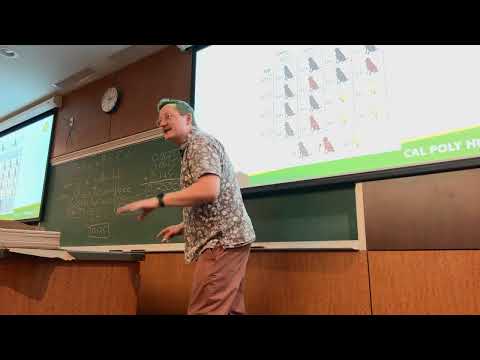
Jonathan Montgomery explains how epistasis, polygenic inheritance, environmental effects, and pleiotropy alter simple Mendelian expectations, then connects chromosome behavior to sex-linked inheritance and gene linkage. Examples include Labrador coat-color probabilities, Thomas Hunt Morgan's fruit-fly eye-color crosses, X-linked hemophilia and color blindness, X-inactivation, and nondisjunction causing aneuploidy such as trisomy 21.
Key takeaways
- In Labrador retrievers, homozygous recessive ee blocks pigment deposition and produces yellow fur regardless of the B-locus genotype, so a BbEe cross yields yellow offspring with probability 1/4.
- For X-linked recessive traits, an unaffected father cannot pass the affected allele to a daughter, while a carrier mother has a 50% chance of passing it to each son.
- A probability question phrased as the chance of an affected son is conditional on the offspring being male; for a carrier mother, half of her sons inherit the affected X chromosome.
- Polygenic inheritance produces continuous variation, as in height, while environmental conditions such as hydrangea soil pH can also change phenotype by affecting nutrient availability.
- X-inactivation creates cellular mosaics because different cell groups can express different X chromosomes; tortoiseshell fur shows patches expressing orange or black alleles.
- Nondisjunction in meiosis can create gametes with missing or extra chromosomes, leading to aneuploidy such as trisomy 21.
Chapters
- The Monday exam covers material since the previous exam and has 25 questions worth 3 points each, using a Scantron 882E form.
- An optional SI study session with May is scheduled for Saturday, 12 to 2 p.m., in the library fishbowl.
- The lecture moves from familiar 3:1 and 9:3:3:1 Mendelian ratios to inheritance patterns that can change expected phenotypes.
- Epistasis occurs when one gene determines whether another gene can affect the phenotype; albinism illustrates how pigment-deposition failure masks pigment genes.
- In Labradors, the B gene distinguishes black from brown pigment, while homozygous recessive ee prevents pigment deposition in hair and produces yellow fur.
- For a BbEe cross, yellow offspring occur with probability 1/4 because only the ee genotype matters; the B locus can be ignored for this outcome.
- When calculating a phenotype through multiple possible genotypes, use the product rule for independent events and the sum rule when alternative genotypes produce the same phenotype.
- Polygenic inheritance occurs when several genes contribute to one trait; human height is a classic example of a phenotype varying along a spectrum.
- Environmental influences such as embryonic developmental conditions, toxins, or nutrient deprivation can alter phenotype independently of genotype.
- Hydrangea flower color can change with soil conditions: pH affects nutrient availability, including aluminum needed in pigment production.
- Pleiotropy describes one gene affecting multiple phenotypic traits, contrasting with polygenic inheritance, where multiple genes affect one trait.
- A disease with several symptoms but a straightforward inheritance pattern may result from one mutation with broad effects.
- Cystic fibrosis is discussed as an example involving altered mucus properties that can affect multiple body functions.
- Sutton and Boveri independently supported the chromosome theory of inheritance by connecting chromosome behavior during meiosis and fertilization with inheritance.
- Thomas Hunt Morgan tested chromosome-based inheritance using fruit flies and eye-color crosses, finding that white-eye inheritance differed between male and female offspring.
- The eye-color gene is on the X chromosome; XX flies have two copies, while XY flies have one and are hemizygous for X-linked genes.
- A father passes his X chromosome to every daughter and his Y chromosome to every son, helping explain why Morgan's offspring ratios depended on sex.
- X-linked traits include many forms of color blindness, some muscular dystrophy, and hemophilia; people with two X chromosomes can carry a recessive allele without showing the disorder.
- In the Russian royal-family example, Alexandra was a carrier of hemophilia and her son Alexis had a 50% chance of inheriting the affected X chromosome.
- For a carrier mother and unaffected father, an affected daughter has probability 0 because the father supplies a normal X chromosome.
- Conditional on having a son, the probability of color blindness is 50%; the son receives a Y chromosome from his father and his only X chromosome from his mother.
- Dosage compensation balances X-linked gene expression: one X chromosome is often inactivated during embryogenesis in individuals with two X chromosomes.
- The inactivated X forms a Barr body, and different cell populations can express different X chromosomes, creating mosaic traits.
- Tortoiseshell cat fur illustrates X-inactivation: cell patches express either the orange or black X-linked fur-color allele.
- Genes on the same chromosome tend to be inherited together, unlike genes on different chromosomes that assort independently.
- Crossing over during meiosis can separate linked alleles and generate recombinant chromosomes.
- Recombination frequencies and linkage maps are advanced genetics topics; the key introductory idea is that chromosomal location affects inheritance patterns.
- Nondisjunction occurs when homologous chromosomes fail to separate in meiosis I or sister chromatids fail to separate in meiosis II.
- The resulting gametes may carry an extra chromosome or lack one, producing aneuploid offspring after fertilization.
- Monosomy means one copy of a particular chromosome, while trisomy means three copies; these terms describe an individual chromosome rather than a full chromosome set.
- Trisomy 21, with three copies of chromosome 21, is associated with Down syndrome.
Transcript excerpt
0:01 Recording begins. This is November 13th, 2026. This is biology 105. All right, starting with a reminder everybody. We've got an exam on Monday. That exam covers material since the previous exam. That is 25 questions, three points each. Scantron 882E form. Standard issue exam for us, right? Cool. Uh Saturday, uh May is holding uh the SI instructor is holding a study session if you'd like to go to that. There's an announcement on Canvas. It's 12 to 2:00 p.m. on Saturday and it's in the library fishbowl. All right. Um
0:49 yeah, people have been saying that these have been working for them. Success success. So, uh, any any questions about any of that stuff? You don't have to sign up for that. You just show up. Okay. Awesome. Let's let me have some more coffee real fast. All right. There we go. Um, let's go ahead and finish up our discussion of complex patterns of inheritance. Right. Cool. Cool. Cool. Cool. Uh, just another reminder, you know, we have that exam on Monday, but then there's no no class next Friday. So, the Friday before fall break is still a day off. Let's just get through Monday and Wednesday uh powerfully. Okay,
1:39 so folks, we've been talking about inheritance. Did you do corn labs uh this week? Right, awesome. So you've seen kind of inheritance patterns in practice, at least Mandelian inheritance patterns with the corn, the 3:1 ratios and I to 3 to 3:1 ratios. I really hope that that kind of cemented these concepts a little better. Um because they're important, but now we're moving past that into complex patterns of inheritance or the sort of things that would break those expected 3:1 ratios. We've been talking so far about complete, incomplete, and co-dominance. All right, we did our examples right
This is the start of the transcript. Save this video free for the whole transcript, searchable and time-coded.
In this course
Related notes
Summary, takeaways, and chapters were generated by AI from the video's transcript and may contain errors. The video belongs to its creator, Jonathan Montgomery.