BIOL 105 Lecture 33 11/18/26
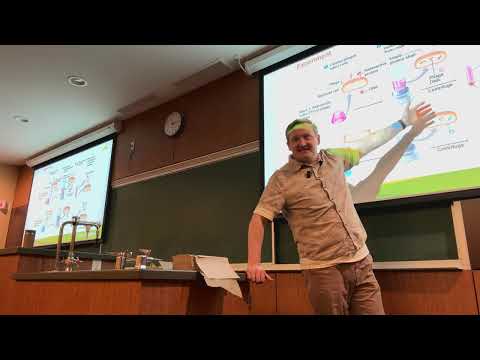
Overview
Jonathan Montgomery connects evidence that DNA carries hereditary information to the molecular steps of DNA replication, covering Griffith’s transformation experiment, Hershey and Chase’s bacteriophage study, DNA structure, and semiconservative copying. He explains how replication-fork enzymes work and how PCR uses temperature cycles, primers, and heat-stable Taq polymerase to amplify selected DNA regions.
Key takeaways
- Griffith’s mouse experiments showed that material from heat-killed pathogenic S bacteria could transform living nonpathogenic R bacteria into the pathogenic type.
- Hershey and Chase found radioactive phosphorus from phage DNA in infected bacterial pellets, while radioactive sulfur from phage protein remained mainly outside the bacteria.
- Semiconservative replication produces two DNA molecules, each containing one original parental strand and one newly synthesized complementary strand.
- DNA polymerase can extend a DNA strand only at its 3′ end, so every new strand is synthesized in the 5′ to 3′ direction and requires a primer.
- PCR uses heat to separate DNA, cooling to anneal target-specific primers, and polymerase-friendly temperatures to extend DNA; about 30 cycles amplify the selected region.
- Taq polymerase withstands PCR’s repeated high-temperature steps, unlike typical cellular DNA polymerases that denature under those conditions.
Chapters
- Jonathan Montgomery notes there is no BIOL 105 lecture during next week’s fall break.
- The cumulative lecture final has 33 multiple-choice questions and is worth 100 points; the lab final takes place during the last week of class.
- The lecture shifts from inheritance patterns to the molecular basis of inheritance: how DNA is copied and how genotype produces phenotype.
- Griffith compared pathogenic smooth (S) bacteria with nonpathogenic rough (R) bacteria in mouse experiments.
- Heat-killed S bacteria alone did not kill mice, but mixing them with living R bacteria did.
- Recovering S-type bacteria from the mice showed that a heritable substance from dead S cells transformed living R cells.
- Hershey and Chase tested bacteriophages, which inject genetic instructions into bacteria, to distinguish DNA from protein as the hereditary molecule.
- They labeled viral protein with radioactive sulfur and viral DNA with radioactive phosphorus, then let the phages infect bacteria.
- After agitation removed viral coats and centrifugation pelleted bacteria, phosphorus label in the pellet showed DNA entered the cells; sulfur label remained mainly in the supernatant.
- A predicted experimental outcome depends on the label: if protein carried inheritance, sulfur-labeled material should enter the bacterial pellet.
- Rosalind Franklin’s X-ray diffraction image helped reveal DNA’s double-helical structure; James Watson and Francis Crick are also associated with the structure’s discovery.
- Each DNA nucleotide contains a sugar, phosphate group, and nitrogenous base, and the two strands pair through hydrogen bonds.
- Complementary base pairing follows A with T and C with G.
- Eukaryotic DNA wraps around histone proteins and can be compacted; condensed DNA is less accessible to the machinery that reads genes.
- Semiconservative replication separates the original DNA strands and uses each as a template for a complementary new strand.
- Each resulting double helix contains one parental strand and one newly synthesized strand.
- DNA strands have directionality: the 5′ end exposes a phosphate, while the 3′ end has a hydroxyl group.
- New nucleotides can be added only to a strand’s 3′ end, so DNA synthesis proceeds in the 5′ to 3′ direction.
- DNA replication occurs during S phase of interphase, when the genome is copied before cell division.
- Replication begins at an origin, where the template strands separate; each active replication fork is a site of new DNA synthesis.
- A circular bacterial chromosome can form a replication bubble with two forks that expand until they meet.
- Larger eukaryotic chromosomes use multiple replication origins and bubbles, which expand and merge along the linear DNA.
- Helicase separates the two DNA strands at the replication fork, while topoisomerase relieves twisting tension by briefly cutting and allowing DNA to unwind.
- Single-strand binding proteins keep separated templates from pairing back together.
- Primase builds short RNA primers that provide the 3′ hydroxyl needed to start DNA synthesis.
- RNA primers contain ribose and uracil rather than DNA’s deoxyribose and thymine, so they must later be removed or replaced.
- DNA polymerase reads a template and adds complementary nucleotides to the primer’s 3′ end: A pairs with T, and C pairs with G.
- The enzyme requires a template, a primer, and free nucleotide building blocks, and extends DNA only in the 5′ to 3′ direction.
- Free nucleotides carry phosphate groups whose cleavage provides energy for forming the DNA strand.
- Because the two templates run in opposite directions, one new strand is synthesized continuously while the other forms in Okazaki fragments, a topic reserved for after fall break.
- PCR replaces cellular strand-separation machinery with repeated heating and cooling: heat separates DNA strands, cooling lets primers anneal, and an appropriate temperature allows DNA polymerase to extend them.
- A PCR mixture contains template DNA, primers, free nucleotides, and DNA polymerase; roughly 30 cycles can produce many copies.
- Primer sequences target the regions to be amplified, so screening 50 genomic regions requires 50 primer sets.
- Ordinary DNA polymerase denatures at PCR’s high temperatures, so PCR uses heat-stable Taq polymerase from thermophilic bacteria.
Transcript excerpt
0:00 recording begins. It is November 18th, 2026. This is biology 105. We're getting right up to the end, folks. We're getting real close. So, next week's fall break, as I've mentioned, no lecture Friday. I'll publish an announcement to remind everybody, but there's no bio 105 on Friday. So, don't come here. Do something else. Have do something a little more fun. So, that's difficult to imagine something more fun than bio 105. I know. All right. You got a PCR lab this week. PCR super important important technique. If you stay in bio, you're probably going to spend some point at some point in your career, you will be spending time just running PCRs. Okay. This is a really good skill to learn. So, you put it on your CV, be ready to
0:49 go. All right. Um, we did the exam on Monday. Your grades are all input unless you're taking unless you took your uh exam at the testing center like today or tomorrow. Obviously, I won't have those in. Um otherwise, we got a few more weeks left, then the lab final. So, we have this week of lab, fall break, another week of lab, and then the lab final. All right. Then lecture final is during finals week. So, the lab final is the last week of class during your lab time. And technically, you have the whole three hours to uh complete it, but uh I I'll have a practice final available for you on Canvas and all sorts of resources for you to look at or you can always drop by my office and
1:37 meet with me if you want some additional help preparing for that. Can I answer any other questions? Yeah, please. Is the lecture final cumulative? >> The lecture final is cumulative. It'll
This is the start of the transcript. Save this video free for the whole transcript, searchable and time-coded.
In this course
Related notes
Summary, takeaways, and chapters were generated by AI from the video's transcript and may contain errors. The video belongs to its creator, Jonathan Montgomery.