BIOL 105 Lecture 27 10/30/26
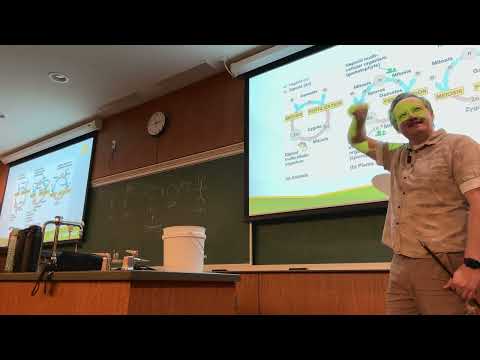
Overview
Jonathan Montgomery explains how meiosis produces four haploid gametes from one diploid cell, reducing chromosome-set number while generating genetic variation. The lecture distinguishes homologous chromosomes from sister chromatids and shows how crossing over in prophase I and random homolog alignment create genetically different products, then compares meiosis with mitosis and describes variation in life cycles.
Key takeaways
- Meiosis I reduces ploidy by separating homologous chromosomes, while meiosis II separates sister chromatids without changing ploidy.
- Chromosome duplication does not increase ploidy: a haploid cell can contain duplicated chromosomes and still have only one copy of each chromosome type.
- Crossing over during prophase I exchanges DNA between homologous chromosomes at chiasmata, producing recombinant chromosomes with maternal and paternal segments.
- Random orientation of homologous pairs at metaphase I creates different maternal and paternal chromosome combinations in gametes through independent assortment.
- One diploid cell produces four haploid cells through meiosis, and crossing over plus independent assortment make those products genetically nonidentical.
- Life cycles differ among organisms: humans are diploid-dominant, mosses have a prominent haploid gametophyte, and some fungi and protists spend most of their life cycle haploid.
Chapters
- Mitosis makes two daughter cells, while meiosis uses two divisions to produce four gametes.
- Diploid parents produce haploid gametes; fertilization restores diploidy in the zygote, which grows through mitosis.
- Sexual reproduction generates variation that can help populations respond to pathogens and environmental change, a rationale connected to the Red Queen hypothesis.
- Homologous chromosomes come one from each parent and carry the same genes at corresponding locations, though versions of those genes can differ.
- A diploid cell with 2N = 6 has six chromosomes arranged as three homologous pairs.
- DNA replication occurs during S phase: chromosomes are unduplicated in G1 and duplicated by G2, without changing ploidy.
- In the human life cycle, the diploid organism is the major free-living stage, while haploidy is brief in sperm and egg cells.
- Mosses have a prominent haploid gametophyte; after fertilization, a diploid sporophyte produces spores by meiosis.
- Some fungi and protists have a dominant haploid stage and a brief diploid zygote that quickly undergoes meiosis.
- Meiotic germ cells replicate their DNA during interphase before entering meiosis I and meiosis II.
- Meiosis I separates homologous chromosomes, reducing a diploid cell to haploid cells even though each chromosome is still duplicated.
- Ploidy counts copies of each chromosome set, not chromatids: a haploid chromosome may be duplicated or unduplicated.
- In the simplified 2N = 2 example, the cell begins with one homologous pair, one red and one blue chromosome.
- Meiosis I separates the red and blue homologs; meiosis II separates the sister chromatids, much like mitosis.
- A duplicated chromosome contains two copies of the same chromosome, but those sister chromatids do not count as two homologous chromosome copies.
- During prophase I, homologous chromosomes pair in synapsis and exchange corresponding DNA segments.
- The exchange occurs at crossover sites called chiasmata and produces recombinant chromosomes containing maternal and paternal DNA.
- The synaptonemal complex and enzymes help align homologs and facilitate exchange; crossover frequency varies across chromosomes.
- Crossing over creates chromosome combinations that were not present in the original parent cell.
- After meiosis I, each daughter cell is haploid but still contains duplicated chromosomes; meiosis II separates the sister chromatids.
- Meiosis II proceeds through chromosome alignment and chromatid separation, producing four haploid cells from one diploid starting cell.
- Recombinant chromatids can carry different gene variants, while the genes themselves generally remain present even if a mutation makes a version nonfunctional.
- At metaphase I, each homologous pair aligns randomly, so maternal and paternal chromosomes can be distributed into different combinations.
- Independent assortment makes gametes genetically varied even apart from the DNA exchanges created by crossing over.
- Meiosis I separates homologous chromosomes; meiosis II separates sister chromatids, the key distinction between the two divisions.
- Both processes begin after DNA replication, but mitosis separates sister chromatids once to make two diploid daughter cells.
- Meiosis includes crossing over and random homolog alignment in meiosis I, then chromatid separation in meiosis II, yielding four nonidentical haploid cells.
- For a starting cell with 2N = 6, meiosis I produces haploid cells with N = 3, and meiosis II completes formation of four gametes.
Transcript excerpt
0:01 This is October 30th, 2026, biology 105. All right, cool. So, folks, we've finished up discussing mitosis. Remember, mitosis is that replicative division, right? Where you take one mother cell, you divide it, you make two daughter cells. There's a interphase and then the Mphase. The interphase has G1s and G2 phases. The Sphase is where the DNA gets duplicated. The Mphase has prophase, metaphase, anaphase, then tilophase, and cytochinis. Just running you through all those sorts of, you know, all those sorts of key points. Let's go ahead and look at what meiosis looks like right here.
0:52 Okay. So essentially in meiosis we're going to have two rounds of proase metaphase anaphase and tilophase. They're going to be called prophase 1 and prophase 2 and metaphase 1 and metaphase 2 and anaphase 1 and anaphase 2 and so on and so forth. Okay? But they're going to be really similar in that the chromosomes align and then they separate and then they align and then they separate. But the big difference here is that the daughter cells that you produce after meiosis, they are not equivalent to one another. They are not the same. All right? They're meant to be different. That's the purpose of this is to design different gameamtes. Okay? Or to produce different gameamtes. And also there's four of them because there's two
1:40 rounds of division. You go from one to two and two to four. Cool. So sexual reproduction, right? Meiosis exists to make gameamtes. The whole process is meant to, right? You got two individuals. Boom. Boom. Boom. There's an individual. [clears throat] There's an individual. All right. They're both diploloyid. All right. They both produce hloid gametes [snorts] via meiosis. And then these fuse together and that generates a diploid zygote which then
This is the start of the transcript. Save this video free for the whole transcript, searchable and time-coded.
In this course
Related notes
Summary, takeaways, and chapters were generated by AI from the video's transcript and may contain errors. The video belongs to its creator, Jonathan Montgomery.