BIOL 105 Lecture 26 10/28/26
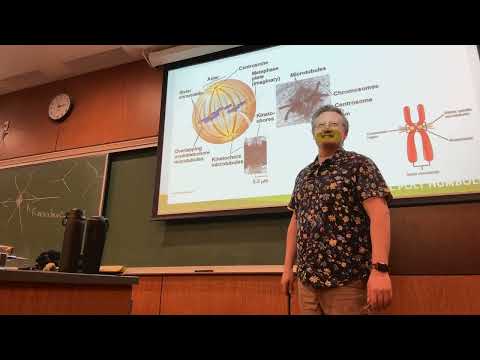 Watch on YouTube →
Overview
Jonathan Montgomery explains how the cell cycle preserves a complete set of chromosomes in each daughter cell, tracing mitosis from chromosome condensation and spindle attachment through chromosome separation and cytokinesis. He connects cell-cycle checkpoints and cyclin-dependent kinases to growth signals, plant and animal cell division, and cancer, including how paclitaxel (Taxol) disrupts mitosis by stabilizing microtubules.
Key takeaways
- S phase, not mitosis, duplicates DNA; cells enter mitosis with replicated chromosomes that condense and are later separated into daughter-cell sets.
- Spindle microtubules attach to chromosome kinetochores, align chromosomes at metaphase, and enable sister-chromatid separation at anaphase.
- G1 checks cell size, resources, and DNA condition; G2 additionally verifies DNA replication; the M checkpoint checks spindle attachment before chromosome separation.
- Cyclin levels regulate CDK activity: cyclin binding activates CDKs, and the resulting MPF activity helps drive the transition into mitosis.
- Paclitaxel (Taxol) disrupts mitosis by stabilizing microtubules and preventing their normal dynamics, making spindle function a target in cancer treatment.
- Cancer can undermine checkpoints, density-dependent inhibition, and anchorage dependence, enabling uncontrolled growth and spread while disrupting normal tissue function.
Chapters
- DNA replication occurs during S phase of interphase, so chromosomes are duplicated but uncondensed by G2.
- In prophase, chromosomes condense; in prometaphase, the nuclear envelope breaks down and spindle microtubules attach at kinetochores.
- Metaphase aligns duplicated chromosomes at the metaphase plate, an imaginary plane rather than a physical structure.
- During anaphase, sister chromatids separate and become individual chromosomes; telophase and cytokinesis help form two daughter cells.
- The mitotic spindle is made of microtubules that move chromosomes; centrosomes organize spindle formation.
- Microscope views of onion root tips can show cells in different mitotic stages, although the process occurs in three dimensions.
- During cytokinesis, animal cells form a contractile band largely composed of actin microfilaments, which constricts the cell.
- Plant cytokinesis builds a new partition: vesicles gather at the center and form a cell plate that develops into a new cell wall.
- The metaphase plate is an imaginary chromosome-alignment plane; the cell plate is a real structure formed during plant cytokinesis.
- Cell-wall loosening enables plant cells to expand after division rather than becoming progressively smaller.
- Paclitaxel, originally isolated from the Pacific yew genus Taxus, disrupts mitosis by stabilizing microtubules and interfering with their normal dynamics.
- Without functional spindle microtubules, chromosomes cannot attach properly through kinetochores or move into position for separation.
- Paclitaxel’s interference with spindle function can halt cell division, which is why the drug is used in cancer treatment.
- The class discussion links the drug’s effect most directly to spindle formation and chromosome movement, rather than to S-phase DNA replication.
- The G1 checkpoint evaluates cell size, resources, and DNA damage before replication; repair machinery can correct some DNA mismatches.
- The G2 checkpoint checks for adequate resources, DNA damage, and completion of chromosome replication before mitosis.
- The M checkpoint verifies that spindle attachments have formed across the chromosomes before separation proceeds.
- Checkpoint signals can originate inside or outside the cell and determine whether the cycle can advance.
- Cyclin-dependent kinases (CDKs) are enzymes that require cyclin binding to become active; kinases transfer phosphate groups from ATP to target molecules.
- The cyclin-CDK complex is described as maturation-promoting factor (MPF), which helps drive entry into M phase.
- CDK levels remain relatively steady while cyclin levels rise during G2 and fall after entry into mitosis, regulating CDK activity.
- CDK activity can also be inhibited, including by molecules that prevent cyclin from binding.
- Growth factors are extracellular signals that bind cell receptors and can encourage cells to divide.
- Density-dependent inhibition slows division when cells are crowded; removing cells, as in a wound, can release this inhibition so tissue can fill the gap.
- Anchorage dependence normally requires many animal cells to attach to an appropriate surface before dividing.
- These controls help coordinate cell division with available space and the cell’s surroundings.
- Cancer cells can lose density-dependent inhibition, anchorage dependence, and normal checkpoint regulation, allowing continued division.
- Changes in gene expression or damage to genes can impair receptors and other proteins that normally restrain cell division.
- Many tumors contain poorly differentiated cells that no longer perform the specialized work of their original tissue; detached cells can spread and form tumors elsewhere.
- Montgomery closes the mitosis unit, previews meiosis and gamete formation for the next class, and announces no class on the day before Thanksgiving break.
Transcript excerpt
0:00 Recording begins. It's October 28th, 2026. This is biology 105. Thank y'all for making it again. All right, we're in the cell cycle talk, folks. And I know I've already oriented you to this quite a bit, but when we're talking about the cell cycle, we're going to be focusing a lot on what happens with the genetic material because one of the main things in the cell cycle, okay, is that uh when you divide both of the daughter cells have the same genetic amount of genetic material as the mother cell. Okay? Now, I'll say they have the same amount of genetic material might be a little bit of a misstatement. It's not that they have the same quantity of DNA because it's dividing, right? Each daughter cell will have will have 1/ half the quantity of DNA that was in the mother cell. If
0:49 there were 10 nanogs of DNA here, when you split it, there's five nanogs in each one of the cells that you produce. Right? The key thing is that all of the chromosomes are represented. Okay? So that all of the genetic instructions are available. We talked a little bit about chromosome replication and about all the terminology with like the sister chromatids and the nonsister chromatids and the homologous chromosomes and all that stuff. Okay. All that DNA replication occurs during the Sphase of interphase. I have a stick or something my left my the receiver for my for my uh clicker in the other room. So during the Sphase of interphase, right? I'm going to angle this camera so that if you're watching, you'll be able to see me
1:36 pointing at the things. Is the screen legible at all? Yeah. Okay, good. So during Sphase of interphase, remember interphase, the cell is doing its thing.
This is the start of the transcript. Save this video free for the whole transcript, searchable and time-coded.
Related notes
Summary, takeaways, and chapters were generated by AI from the video's transcript and may contain errors. The video belongs to its creator, Jonathan Montgomery.