BIOL 105 Lecture 28 11/2/26
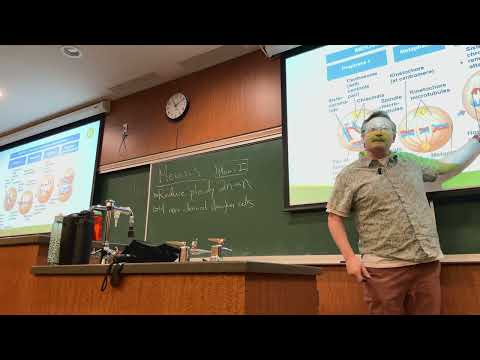 Watch on YouTube →
Overview
Jonathan Montgomery explains how meiosis produces haploid gametes and genetic variation through homologous chromosome separation, independent assortment, crossing over, and random fertilization. He connects these mechanisms to Mendel's laws of segregation and independent assortment, explains how linkage can make inheritance differ from predictions, and introduces genotypes and phenotypes ahead of the class's upcoming genetics work.
Key takeaways
- Meiosis I separates homologous chromosomes and reduces ploidy from diploid to haploid; meiosis II separates sister chromatids, yielding four haploid, nonidentical cells.
- Independent assortment results from the independent alignment of homologous chromosome pairs at metaphase I, and applies directly to genes on different chromosomes.
- Crossing over during prophase I recombines DNA between homologous chromosomes, allowing genes on the same chromosome to be reshuffled.
- Independent assortment, crossing over, and random fertilization combine to create genetic variation that natural selection can act on.
- Mendel's law of segregation reflects homologous chromosome separation in meiosis I, while his law of independent assortment reflects the independent behavior of different chromosome pairs.
- When inheritance outcomes depart from independent-assortment predictions, linkage between genes on the same chromosome is one possible explanation.
Chapters
- The week 11 focus is meiosis and sexual reproduction; the next midterm is scheduled for two weeks later and covers material since exam two.
- The final exam is cumulative, and its study guide is already posted.
- Meiosis supports sexual reproduction, which increases offspring variation compared with clonal reproduction.
- Crossing over and recombinant chromosomes were introduced as sources of that variation.
- Both meiosis I and meiosis II proceed through prophase, metaphase, anaphase, and telophase.
- In meiosis I, homologous chromosomes pair and align at metaphase I, then separate at anaphase I while sister chromatids remain attached.
- Meiosis I reduces ploidy from diploid to haploid; meiosis II separates sister chromatids, producing four haploid daughter cells.
- Unlike mitosis, which usually yields two genetically identical cells, meiosis produces four nonidentical cells.
- An allele is a different form of the same gene; diploid individuals can carry up to two alleles for a gene.
- Meiosis places only one allele for each gene into a gamete, illustrated with hypothetical eye-color alleles and lactase-function alleles.
- A heterozygous lactase example produces gametes with either the functional or nonfunctional allele; two nonfunctional copies mean every gamete carries a nonfunctional version.
- Montgomery identifies independent assortment, crossing over, and random fertilization as three mechanisms that create variation each generation.
- At metaphase I, each homologous chromosome pair aligns independently of other pairs, creating different possible chromosome combinations in gametes.
- The example uses a diploid cell with 2N = 4, containing two homologous chromosome pairs and multiple possible alignments.
- Independent assortment applies to genes on different chromosomes; genes on the same chromosome may be linked and inherited together.
- The resulting gametes can carry different combinations of alleles, such as hypothetical eye-color and lactase alleles.
- During prophase I, homologous chromosomes exchange DNA, producing recombinant chromosomes that contain a mix of maternal and paternal material.
- Crossing over can reshuffle genes located on the same chromosome, adding variation beyond independent assortment.
- Random fertilization combines one of many genetically distinct sperm with an egg, increasing the number of possible offspring genotypes.
- The lecture distinguishes this genetic explanation from unrelated references to the television show Crossing Over.
- Evolution is a change in allele frequencies across generations; natural selection is one process that can cause such a change.
- Montgomery's beetle example shows that repeatedly removing blue beetles would reduce blue alleles and increase the relative frequency of red alleles.
- Natural selection acts on phenotypes, while changes in allele frequencies describe the resulting evolution.
- Variation produced by sexual reproduction gives natural selection differences among individuals to act on.
- The upcoming genetics material will cover genotypes, phenotypes, homozygous and heterozygous individuals, and dominant and recessive alleles.
- Punnett squares are presented as visual aids for probability, not as the underlying rules of inheritance.
- Probability methods scale better than Punnett squares for complex crosses, such as trihybrid crosses that would require a 64-cell square.
- The genetics sequence is planned for upcoming class meetings and will build on the meiosis concepts from this lecture.
- Homologous chromosomes carry genes at corresponding locations, called loci, though the alleles at those loci can differ.
- The law of segregation means each gamete receives one allele per gene because homologous chromosomes separate in meiosis I.
- The law of independent assortment means alleles of genes on different chromosomes are inherited independently.
- Mendel's pea-plant observations led to these laws, which meiosis later helped explain mechanistically.
- If offspring do not match predictions based on independent assortment, one possibility is that the tracked genes lie on the same chromosome.
- Linked genes do not assort independently in the basic model, although crossing over can recombine them.
- A phenotype is an observable characteristic, such as plant height or flower color, generally arising from genotype and other influences.
- Mendel tracked offspring phenotypes in pea plants, whose breeding was easy to control because their flowers contain both gamete-producing structures.
Transcript excerpt
0:00 Go. Recording begins. It is November 2nd, 2026. This is biology 105. Thank you all for making it another lecture. Here we go. Let's take a look at the schedule. We're in week 11. Did you ever think it would happen? 11 out of 15. That's pretty far through the semester. Here we go. Week 11. We're talking meiosis and sexual reproduction this week. Okay. You have a reading quiz as usual. You have a lab with an associated assignment as usual. Next week, uh you're going to have Wednesday off. It's a holiday, right? Um but we'll be moving forward again. And then in two weeks from today is your next exam, okay? Your last midterm of the semester. It's going to cover material since exam two. The
0:49 study guidees already posted for you, so check it out. you know, start prepping now. Why not? Right? It's fun. It's so fun to study for exams. Then it's a break, a welldeserved, well-needed break. And then we come back for two weeks and it's finals. So before you know it, we'll be all wrapped up. Pretty great. Final exam is comprehensive. That's not the word I'm looking for. It is cumulative. Okay. Final study guide is already posted and available. If you want to be looking at that already, you can. Any questions about the remainder of your course of biology 105? Cool. Let's get back into our meiosis discussion because last week we crushed mitosis, you know, which normally only happens at
1:35 the gym. Thank you. Thank you so much. Thank you so much. Okay, folks. We were talking about meiosis and how your dang old generating variability here. Remember, meiosis exists for sexual reproduction and sexual reproduction exists to generate variability in offspring. If it wasn't for that, then clonal reproduction would
This is the start of the transcript. Save this video free for the whole transcript, searchable and time-coded.
Related notes
Summary, takeaways, and chapters were generated by AI from the video's transcript and may contain errors. The video belongs to its creator, Jonathan Montgomery.