AU26 CHEM 2310 - Lecture 9 - September 22 - Quiz 4 - Addition Reactions
 Watch on YouTube →
Overview
Dr. Jennifer Walters introduces Quiz 4's alkene and alkyne addition reactions after reviewing IUPAC naming, leaving-group stability, and alkene stereochemistry. The lecture connects four reaction mechanisms, carbocation, anti, syn, and oxidative cleavage, to reagent patterns, and explains that quizzes 4 and 5 cover alkenes/alkynes and aromatic reactions respectively.
Key takeaways
- A good leaving group is a stable weak base after departure: in the reviewed ranking, H2O > Cl− > CF3O− > HO− > NH2−.
- The degree-of-unsaturation formula, (2C + 2 + N − H − X)/2, counts rings and pi bonds without identifying their arrangement; oxygen does not change the calculation.
- Alkene geometry is locked because rotating the sp2 carbon framework breaks the side-on p-orbital overlap that forms the pi bond.
- Reagent recognition predicts the main mechanism family: strong acids give carbocations, Br2/Cl2 and Hg2+ give anti addition, and O3 or KMnO4 signals oxidative cleavage.
- In a carbocation addition, the pi bond attacks the acid's hydrogen and the resulting anion attacks the carbocation; hydrohalogenation is Markovnikov, lacks stereoselectivity, and can rearrange.
Chapters
0:00
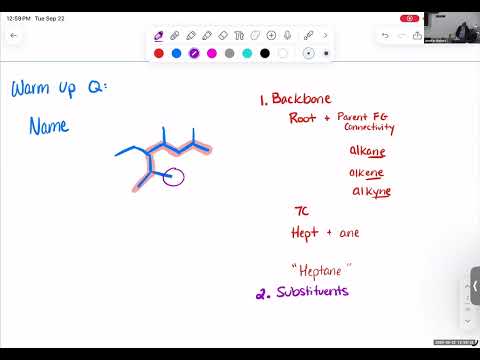
Classroom Setup and Warm-Up: Naming a Branched Alkane
- After resolving an audio-capture issue, Walters asks students to name a branched carbon skeleton as a warm-up.
- Students identify a seven-carbon parent chain and practice selecting substituent names and locations before the Quiz 4 material.
10:40
IUPAC Naming: Choose the Chain, Number It, and Alphabetize
- The parent chain is the longest continuous carbon chain; the example follows a seven-carbon path to avoid treating a branch as the parent, giving heptane.
- Identify branches as methyl and ethyl substituents, then compare numbering from both directions using the smallest first point of difference.
- The example's preferred locants are 3-ethyl and 2,4,6-trimethyl; alphabetize ethyl before methyl and use commas between numbers and hyphens between numbers and words.
19:00
Quiz 2 Review: Rank Leaving Groups by Stability
- A good leaving group is stable after departure, making it a weak base and weak nucleophile; neutral water ranks ahead of the anions.
- For the charged species, Walters ranks chloride next, followed by CF3O−, HO−, and NH2−, using conjugate-acid strength, size, electronegativity, and induction.
- Chloride is a strong leaving group because its conjugate acid HCl is strong; fluorines in CF3O− inductively withdraw electron density and stabilize the anion.
30:00
Quiz Retakes, Mastery Credit, and Deadlines
- The first retake period unlocks Quizzes 1, 2, and 3; attempts one and two can earn partial mastery credit, while 80% or higher earns full credit on any attempt.
- Students should review their quiz answers before Friday at 5:00 p.m., when answers become unavailable during the retake window.
- Quiz 4 is available October 2 through 4, following homework due October 1.
34:00
Quiz 4 Scope: Pi-Bond Addition Reactions
- Quizzes 4 and 5 introduce organic reactions: Quiz 4 focuses on alkenes and alkynes, while Quiz 5 covers aromatic reactions.
- The central transformation consumes a carbon-carbon pi bond, and the alkene or alkyne pi bond acts as the nucleophile that initiates the curved-arrow sequence.
- Walters emphasizes comparing reagent patterns across reactions to predict products, including cases with multiple double bonds or triple bonds.
37:00
Unsaturation and Hydrogen Deficiency Formulas
- Each ring or pi bond is one degree of unsaturation and corresponds to two fewer hydrogens than the matching acyclic alkane.
- For three carbons, the saturated formula is C3H8; one double bond gives C3H6, while one triple bond gives C3H4.
- The index of hydrogen deficiency compares maximum alkane hydrogens, 2n + 2, with the actual count and divides the difference by two.
- The fuller degree-of-unsaturation formula is (2C + 2 + N − H − X)/2; oxygen does not affect the count, and two unsaturations could represent two double bonds, a double bond plus a ring, one triple bond, or two rings.
42:00
Alkene Geometry: Pi Bonds Lock Rotation
- Alkene carbons are sp2-hybridized and trigonal planar, with approximately 120-degree bond angles and one sigma plus one pi bond in the double bond.
- The pi bond forms through side-on overlap of parallel unhybridized p orbitals; rotation would destroy that overlap, locking the double-bond geometry.
- Cis means same side and trans means opposite sides, defined relative to the ring for cyclic compounds or the double bond for alkenes.
45:00
Assigning Cis, Trans, E, and Z to Double Bonds
- Compare the two groups directly attached to each alkene carbon; higher atomic number gives higher priority, and tied atoms require comparing outward until a difference appears.
- Place a line through the double bond and compare the two high-priority groups: same side corresponds to cis or Z, while opposite sides corresponds to trans or E.
- Use cis/trans for disubstituted alkenes with two nonhydrogen substituents; use E/Z when three or four nonhydrogen groups are attached across the double bond.
50:00
Practice: Identify Alkene Stereochemistry and Exceptions
- In the bromine/chlorine example, Br and Cl outrank hydrogen and lie on the same side, so the disubstituted alkene is cis.
- A double bond with identical substituents on one carbon, such as H and H, has no assignable geometric isomer because high and low priorities cannot be distinguished there.
- For the trisubstituted example, comparing carbon groups outward reveals ethyl outranks methyl; same-side high priorities make the alkene Z.
1:01:00
Naming Alkene Stereochemistry and Mixed Unsaturation
- Put stereochemical descriptors at the front of the alkene name; the examples include trans-but-2-ene and (E)-3-ethylhex-2-ene.
- When a molecule has multiple stereochemical double bonds, use E/Z for all of them rather than combining E/Z with cis/trans.
- A parent chain containing both an alkene and an alkyne includes both suffixes; number for the smallest combined locants, then list -en before -yne alphabetically.
1:05:00
Four Mechanism Families for Alkene and Alkyne Additions
- Addition reactions attach two atoms or groups across a pi bond, converting it to a bond with fewer pi components.
- Walters groups reactions into carbocation, anti addition through an onium ion, syn addition, and oxidative cleavage.
- Students must draw mechanisms for the first three families; oxidative cleavage requires product prediction but not mechanism drawing.
1:06:30
Strong-Acid Addition: The Carbocation Mechanism
- Strong acids such as HCl, HBr, HI, and H2SO4 trigger the carbocation mechanism, with the alkene pi bond acting as a base and nucleophile.
- The pi bond attacks the acid's hydrogen, the H−A bond breaks to A−, and the resulting carbon carries a positive charge.
- The anion then attacks the electron-poor carbocation directly, forming the second carbon-substituent bond.
1:09:00
Anti Addition: Onium-Ion Intermediates
- Anti addition occurs when the electrophilic atom has a lone pair; the alkene attacks that atom as its bond to the leaving group breaks.
- The electrophilic atom uses a lone pair to form a three-membered onium ion, such as a bromonium, chloronium, iodonium, or mercuronium ion.
- Because the onium atom has a full octet, the nucleophile attacks an adjacent carbon and opens the strained three-membered ring, giving opposite-side addition.
1:13:00
Syn Addition and Oxidative Cleavage Reagent Clues
- In syn addition, the electrophile attaches to the alkene and the bond electrons return to form a bond on the more substituted carbon, placing both added groups on the same side.
- Ozone, O3, or potassium permanganate, KMnO4, signals oxidative cleavage: split the alkene at its double bond and add as many oxygen atoms as possible to the former alkene carbons.
- Walters' quick reagent guide is strong acid for carbocation, Br2/Cl2 or Hg2+ for anti, O3/KMnO4 for cleavage, and other addition reagents for syn.
1:17:00
Hydrohalogenation: Markovnikov Addition Begins
- Hydrohalogenation adds H and a halogen across an alkene using a hydrogen halide such as HCl, HBr, or HI.
- Its carbocation mechanism starts with the alkene attacking H; the halide anion then attacks the carbocation, while sulfuric acid follows the same strong-acid pathway.
- Walters previews Markovnikov regioselectivity, no stereoselectivity, and possible carbocation rearrangements; the energy diagram and remaining alkene reactions continue in the next class.
Summary, takeaways, and chapters were generated by AI from the video's transcript and may contain errors. The video belongs to its creator, Dr. Jennifer Walters.