AU26 CHEM 2310 - Lecture 1 - August 25 - Syllabus
 Watch on YouTube →
Overview
Dr. Jennifer Walters explains the structure of Ohio State’s accelerated CHEM 2310 course, which covers Organic Chemistry I and II in one semester, and outlines its 12-credit mastery grading system. Students earn credit through weekend quizzes, spaced retakes, homework practice, and optional attendance and final-exam rewards, with course support available through recitation, Microsoft Teams, office hours, and Pearson resources.
Key takeaways
- CHEM 2310’s grade is built from 12 mastery credits, with 80% on a quiz earning a full credit and 60% earning half credit only on the first two attempts.
- Quiz attempts are deliberately spaced across the semester, allowing up to five attempts while encouraging students to revisit material instead of repeatedly clicking through a quiz in one sitting.
- Homework scoring of at least 60% earns 4, 6, or 8 extra minutes on the related quiz, and the Thursday deadline allows staff to adjust quiz time before the weekend window.
- Attendance rewards can add one mastery credit total: half for attending at least 24 lectures and half for attending at least 12 recitations.
- The optional cumulative final has 50 questions and 100 minutes; at least 82% earns an extra mastery credit, while a score below 22% incurs a half-credit penalty.
- Walters permits AI and collaboration for homework but requires quizzes to be closed-book, device-free, and completed without outside help.
Chapters
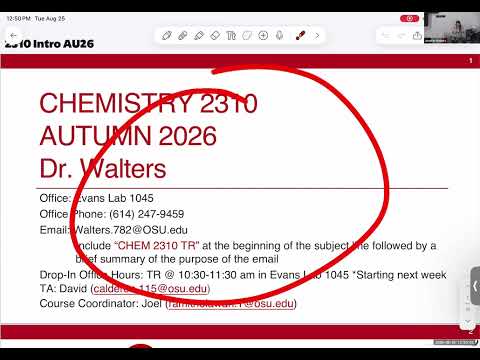
- Dr. Jennifer Walters introduces CHEM 2310 as an accelerated course covering Organic Chemistry I and II in one semester.
- Walters says annotated lecture notes will be uploaded by the end of the day or before the next class.
- Office hours begin the following week in Evans Lab, room 1045, from 10:30 to 11:30 before lecture.
- Walters asks students to include the course and meeting-day information in email subject lines so Outlook can prioritize their messages.
- Walters explains that Fishpaw may appear in university systems, but she prefers students to call her Dr. Walters.
- She earned a bachelor’s degree in chemistry and a master’s degree in forensic science from Arcadia University, followed by a chemistry PhD from Temple University.
- After a COVID-related end to her postdoctoral position, she taught chemistry at multiple institutions before joining Ohio State as a lecturer in fall 2021.
- Top Hat uses Bluetooth and location services to verify classroom attendance; students should photograph the attendance code with the date if the app fails.
- Walters recommends switching between the Top Hat app and website if one fails, and says she can manually correct attendance from a photo.
- Attending at least 24 lectures can earn half a mastery credit toward extra credit.
- The course Microsoft Teams page is intended for questions and shared study resources, with Walters and TA David promising a response within 12 hours.
- For private matters, students should email Walters with the exact CHEM 2310 meeting-day wording in the subject line; her stated email response window is 48 hours.
- Walters prefers in-person conversations, followed by Microsoft Teams and then email; she asks students to resend messages if she has not replied within 48 hours.
- Students spend time introducing themselves and exchanging contact details so they can help one another obtain class notes after absences.
- Course logistics such as recitation-section changes go to coordinator Joel, while course-content questions can go to Walters or TA David.
- The course assesses 12 fundamental topics, and the final course grade depends on the total number of mastery credits earned rather than conventional exam percentages.
- Quizzes 1 through 11 assess chemistry topics; quiz 12 can be replaced by a writing assignment relating organic chemistry to a student’s career goals.
- A quiz score of at least 80% earns one full mastery credit; at least 60% earns half credit on attempts one and two only.
- Each quiz typically has about 10 questions and 20 minutes, with extra time for students who have SLDS accommodations.
- Initial quizzes are available Friday at 5 p.m. through Sunday at 11:59 p.m., usually one week after the relevant lecture material.
- Students can earn up to five attempts per quiz, with later attempts unlocked in spaced retake periods about every three weeks.
- Retake windows remain fixed even if lecture pacing changes; the first example window is September 25 to 27 for quizzes completed by then.
- The December 15 final is an in-person, cumulative Canvas assessment with 50 questions and 100 minutes; students with SLDS accommodations should arrange proctoring for it.
- A zero on the optional final costs one mastery credit, while at least 11 correct answers reduces the penalty to half a credit and at least 82% earns one extra credit.
- The final permits a 3-by-5-inch index card, which Walters recommends creating as a way to summarize material and prepare for cumulative application questions.
- Lecture attendance of at least 24 classes earns half a mastery credit, and attending at least 12 recitations earns the other half.
- Friday recitations provide individualized practice on the topic of the upcoming quiz; students must get approval before attending a different section because of room-capacity limits.
- Walters uses universal accommodations, so students do not need to explain why they miss a lecture or recitation.
- Students have four lecture absences available while remaining eligible for lecture attendance credit, and may miss one recitation while retaining its attendance credit.
- Absences function like paid time off: documented circumstances do not create extra absence allowances beyond the stated limits.
- Students can still earn an A without attendance credit by mastering quiz content and completing the final.
- Homework is due Thursday before each quiz, and scoring at least 60% earns 4, 6, or 8 extra quiz minutes depending on a student’s time accommodation.
- Homework cannot be submitted late for the time reward because staff must update quiz time limits before the weekend.
- Walters estimates roughly 3 to 6 hours for homework, noting that it can take longer when students use it to learn material rather than check prior study.
- Students can use hints, unlimited homework attempts, and the built-in AI tutor; drawing questions can be worked on paper if Pearson’s drawing interface is frustrating.
- The Pearson ebook is included in course fees and can be opened through Canvas by selecting Access Pearson, Open Pearson, and Pearson eText; students should not buy another access code.
- Pearson Study Prep offers extra practice, AI-guided feedback, customized questions, and accessible instructional videos.
- Walters recommends obtaining a molecular model kit by quiz 3, when models begin to be useful, and particularly before quiz 6 on stereochemistry.
- Model kits may be used for quizzes, the final, homework, and recitations to help represent molecular structures in three dimensions.
- Students calculate their standing by counting mastery credits toward 12; Canvas will also be updated weekly with the corresponding grade.
- Seven full credits alone still correspond to an E, while partial quiz credits and attendance rewards can raise the total, as in Walters’s example reaching a C or C+.
- A student’s mastery score never decreases: a later lower quiz score does not erase earlier partial credit, while an 80% on a later attempt can earn full credit.
- Students can continue taking later attempts for practice after earning full credit, and can review prior attempts and answers once the quiz window closes.
- Recitation activities are the closest practice for quiz format, while Mastering homework ranges from easier questions to harder challenges.
- Quizzes are closed-book and must be completed without AI, notes, phones, other devices, friends, or outside resources.
- Walters says quizzes remain unproctored because she wants students to retain flexible weekend scheduling, and asks them to preserve that arrangement through honest work.
- Homework is different: students may use AI, classmates, Walters, or the TA because it is designed for learning and practice.
- Checking in on Top Hat and then leaving is academic misconduct; students may arrive up to 10 minutes late or leave up to 10 minutes early, but not both.
- If an emergency requires leaving early, students must email Walters so she can remove the attendance credit; false attendance reports may be referred to Ohio State’s Committee on Academic Misconduct.
- Walters recommends reading chapters before lecture, reviewing prepared note outlines, summarizing notes after class, and practicing with recitation packets and end-of-chapter problems.
- Students should seek help early and avoid falling behind, since the accelerated course compresses material that would normally take much longer.
- Students may attend any chemistry TA’s office hours, generally available weekdays from about 9 a.m. to 4 p.m.; coordinator Joel maintains the tutor list.
- Walters encourages joining Microsoft Teams, attending office hours, and using the OSU Counseling Center, which she notes is free to students.
- She recommends eating and sleeping regularly, washing hands, and considering masks during the first weeks of the semester when illnesses spread.
- Students should contact Student Life Disability Services early because accommodations are confidential and apply from the date they are arranged, not retroactively.
Transcript excerpt
2:31 How about now? Better. Okay. Well, hey, it can now hear me though. Sorry, that was too much. Okay. Well, if you can't hear me, uh, please let me know and I will, uh, speak louder. I'm glad the captions are finally working. That means that the audio is actually being captured on the recording. Uh, so we are ready to finally get started. Thank you for your patience with this day one technical difficulties. Always seems to happen even though I use this room. the room seems to be like let's do some fun things at the beginning of every semester. All right, so hopefully you are here for organic chemistry chem 2310. This is the accelerated organic chemistry course. It is orgo one and two
3:20 in one semester. Uh that is a big challenge that is going to hopefully be mitigated by the way that you're going to be graded. So when we get to that hopefully that'll ease a lot of anxieties because I know it is a hard course. Organic chemistry in itself is a hard course but uh I have set up the class to hopefully make it uh manageable which I believe I have because usually about at least 80% of my students get A's. So hopefully that is true for this class as well. So I am Dr. Walters and all of my lectures are going to be presented in this sort of format where we're going to have slides projected. Um, I'm going to annotate on them. I will upload the annotations. Not
4:06 immediately after lecture because I actually have another class right after this to teach. But by the end of the day, I should definitely by the next class, you will have uh the annotated notes. My office is in Evans Lab 10:45.
This is the start of the transcript. Save this video free for the whole transcript, searchable and time-coded.
Related notes
Summary, takeaways, and chapters were generated by AI from the video's transcript and may contain errors. The video belongs to its creator, Dr. Jennifer Walters.