AU26 CHEM 2310 - Lecture 20 - Nov 3 - Quiz 8 & 9 - Ethers, Aldehydes & Ketones (needs transcript)
 Watch on YouTube →
Overview
Dr. Jennifer Walters connects ether chemistry to carbonyl chemistry, covering organometallic reagents, ether synthesis and cleavage, epoxide reactions, and quiz 8 review before introducing aldehyde and ketone nomenclature and reactivity. The lecture emphasizes that carbonyl additions begin with nucleophilic attack at the electrophilic carbon, then distinguishes oxygen, carbon, and hydrogen nucleophiles and explains how hemiacetals and acetals form and protect aldehydes.
Key takeaways
- Grignard and organolithium reagents behave as strong carbon nucleophiles and bases, so ether solvents stabilize them through oxygen lone-pair coordination without reacting with them.
- Epoxide regioselectivity depends on conditions: acidic opening directs the nucleophile to the more substituted carbon, while basic SN2 opening targets the less substituted carbon; both pathways give anti addition.
- The carbonyl carbon is electrophilic because the C=O bond is polarized and has a resonance contributor with positive charge on carbon, so nucleophiles attack it and move the pi electrons onto oxygen.
- Aldehydes outrank ketones and alcohols in the naming priority described: aldehydes take the -al suffix, ketones take -one, and secondary ketone and alcohol groups use oxo and hydroxy prefixes.
- Acetals protect aldehydes during reactions that would otherwise target the carbonyl; concentrated acid and water remove the protecting group and restore the aldehyde.
- Grignard and organolithium additions form carbon-carbon bonds and require aprotic conditions, while LiAlH4 and NaBH4 add hydrogen to carbonyls to produce alcohols.
Chapters
- Ether oxygen is sp3-hybridized, has lone pairs, and acts as a Lewis base; the carbons bonded to oxygen are partially positive.
- Grignard reagents form when magnesium inserts into a carbon-halogen bond, while organolithium reagents form through halogen-lithium exchange.
- The polarized carbon-metal bond gives Grignard and organolithium reagents carbanion-like character, making them strong nucleophiles and strong bases.
- Ether oxygen coordinates to magnesium through its lone pairs, stabilizing the reagent without consuming it.
- Acid-catalyzed dehydration of two alcohols can produce a symmetrical ether; the mechanism may be SN1 or SN2 depending on the alcohol-derived electrophile.
- Alcohols can also add to alkenes in reactions such as acid-catalyzed hydration, oxymercuration-demercuration, and hydroboration-oxidation to form ethers.
- Williamson ether synthesis combines an alkoxide, commonly made with NaH, and a primary alkyl halide in an SN2 reaction.
- With a secondary alkyl halide, cold conditions favor SN2, while room temperature or heat increases competing E2 elimination.
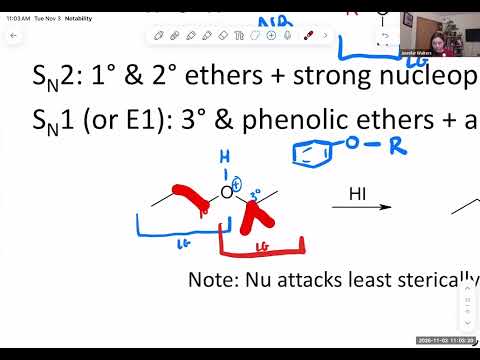
- Strong acid protonates ether oxygen, converting a poor leaving group into a better one and enabling cleavage by a nucleophile.
- Strong nucleophiles such as iodide favor SN2 attack at the less hindered side of an unsymmetrical ether.
- Tertiary ether carbons can undergo SN1 cleavage, while an aryl carbon bonded directly to oxygen cannot undergo ordinary SN1 or SN2 substitution.
- For aryl ethers, cleavage therefore occurs on the non-aromatic side, leaving the oxygen attached to the sp2-hybridized benzene carbon.
- Epoxides are three-membered cyclic ethers whose ring strain makes them especially prone to nucleophilic ring opening.
- Peroxy acids transfer oxygen to an alkene in a syn addition, forming an epoxide without opening the newly formed ring.
- MCPBA, or m-chloroperoxybenzoic acid, is a common reagent for alkene epoxidation.
- The oxygen-oxygen bond in the peroxy acid provides the electrophilic oxygen incorporated into the epoxide.
- Under acidic conditions, epoxide oxygen is protonated first and the nucleophile attacks the more substituted carbon, giving SN1-like regioselectivity in a concerted ring opening.
- Epoxide ring opening places the nucleophile and the original epoxide oxygen on opposite faces, producing anti addition.
- Under basic conditions, a strong nucleophile attacks the less substituted epoxide carbon through a true SN2 mechanism.
- In both pathways, ring strain drives cleavage of a carbon-oxygen bond as the nucleophile forms a new carbon-nucleophile bond.
- In the first practice problem, strong acid and ethanol lead to attack at the more substituted epoxide carbon, leaving the epoxide oxygen on the other carbon.
- In the second problem, acid-generated iodide attacks the less substituted, non-aromatic side; the oxygen remains bonded to the benzene ring and becomes phenol after workup.
- A product containing an added OEt group can be traced backward to an epoxide by removing the nucleophile and reconnecting the adjacent oxygen to close the three-membered ring.
- Quiz 9 homework was due November 12, with the quiz open November 13 through 15.
- Quizzes 9 through 11 focus on carbonyl chemistry: quizzes 9 and 10 treat carbonyl compounds as electrophiles, while quiz 11 develops alpha-carbon nucleophilicity.
- A carbonyl group has an sp2-hybridized, trigonal planar carbon with bond angles near 120 degrees and a polar carbon-oxygen double bond.
- Resonance places partial positive character on the carbonyl carbon, explaining why nucleophiles attack that carbon and push electrons onto oxygen.
- The carbonyl oxygen is basic, while an alpha carbon can act as a nucleophile and an alpha hydrogen is acidic because its conjugate base is resonance-stabilized.
- Aldehydes use the suffix -al and outrank ketones, which use -one; alcohols rank below both as primary functional groups.
- When an aldehyde is secondary, it can be named with the prefix formyl or oxo; a secondary ketone uses oxo.
- A secondary alcohol uses the prefix hydroxy, and the highest-priority functional group determines the suffix and numbering direction.
- For a chain containing an aldehyde, ketone, and alcohol, the aldehyde is the suffix, with the ketone named oxo and the alcohol named hydroxy.
- Formaldehyde, whose IUPAC name is methanal, is produced from methanol over a metal catalyst such as silver at high temperature and is used to preserve biological specimens.
- Acetaldehyde, or ethanal, is a precursor to acetic acid and is also a toxic intermediate formed during ethanol metabolism.
- Acetone is propan-2-one, a common solvent; industrial carbonyl production can use oxygen and metal-catalyzed processes.
- In laboratory synthesis, PCC and Jones reagent oxidize alcohols to carbonyl compounds; Jones oxidation of primary alcohols continues to carboxylic acids.
- Aldehydes and ketones cannot undergo ordinary SN1 or SN2 attack at the sp2 carbonyl carbon, so their reactions begin with nucleophilic addition.
- The common first step is nucleophilic attack at the carbonyl carbon with the carbon-oxygen pi electrons moving onto oxygen.
- When the second step is proton transfer, the product is an addition product; nitrogen nucleophiles can instead lead to condensation with loss of water.
- Carbonyl derivatives with a leaving group undergo addition followed by elimination, producing net substitution and restoring the carbonyl.
- Addition of water to a carbonyl can form a geminal diol, with two OH groups attached to the same carbon.
- Addition of one alcohol gives a hemiacetal, which has one OH group and one OR group on the same carbon; adding another alcohol can convert it to an acetal with two OR groups.
- Hemiacetals are generally unstable in open-chain form, but five- and six-membered cyclic hemiacetals are stable, as illustrated by glucose and fructose.
- Acetal formation uses acid to convert the hemiacetal OH into a leaving group, followed by attack from a second alcohol and deprotonation.
- An acetal can mask a reactive aldehyde so another functional group, such as a primary alkyl halide, can react selectively.
- A diol can convert an aldehyde into a cyclic acetal before carrying out a desired Grignard-mediated reaction elsewhere in the molecule.
- After the intended reaction, concentrated acid and water deprotect the acetal and regenerate the aldehyde.
- Water supplies the oxygen needed to restore the carbonyl during acidic deprotection.
- Grignard reagents, organolithium reagents, and acetylide ions form carbon-carbon bonds by attacking a carbonyl carbon; acid workup then protonates the resulting alkoxide.
- Grignard reagents require an aprotic solvent such as an ether because a protic solvent would protonate and destroy the strong base before it reached the carbonyl.
- Cyanohydrin formation uses cyanide as a carbon nucleophile; the lecture notes that generated water can help protonate the alkoxide during the reaction sequence.
- LiAlH4 and NaBH4 deliver hydride to aldehydes and ketones, reducing the carbonyl to an alcohol; LiAlH4 requires an acidic workup, while the lecture describes DIBAL-H as a milder, less basic hydride reagent compatible with alcoholic solvent.
Transcript excerpt
0:01 everyone. So, uh I hope if you are able to get out and vote that you do get out and vote. Uh if you uh are not, then whatever. Yep. No going back. This is an awkward beginning. I'm really sorry. Anyway, okay. [laughter] So, this is why I don't like doing this asynchronous stuff. I always feel like I it's so much worse than just a real video or real in front of you. Let's begin. We left off we were talking about our uh ethers and so we had already discussed the importance of ethers. We talked about their role as solvents and we were then getting into the ethers recognizing that that oxygen is sp3 hybridized. It's our uh nucleophilic atom. It is a Louis base uh
0:49 because it has those lone pairs of electrons. The carbon is going to be our electrophilic site because that is the polar bond. So the carbon is delta positive and we already reiterated that the ethers are typically going to be really low boiling point uh liquids and um they're generally colorless. So their benefit as a solvent is seen largely with our organometallic reagents which is really going to be important in quiz 9. So at the moment we're talking about synthesizing these reagents. Quiz 9 we're going to talk about using them. So our gyard reagents are organo metallic. Organo metallic meaning we have an organic part and a metallic part. So we see this carbon organic and the metal being you know the left side of the periodic table. So this carbon metal bond is
1:38 highly polarized because it actually is nearly ionic. It should be ionic because you have a metal and a non-metal. But what we see with organo metallic reagents is that even though our true
This is the start of the transcript. Save this video free for the whole transcript, searchable and time-coded.
Related notes
Summary, takeaways, and chapters were generated by AI from the video's transcript and may contain errors. The video belongs to its creator, Dr. Jennifer Walters.