AU26 CHEM 2310 - Lecture 18 - October 27 - Quiz 7 - Sub vs Elim (needs updated transcript)
 Watch on YouTube →
Overview
Dr. Jennifer Walters reviews a decision process for predicting substitution and elimination reactions: classify the reagent, assess the substrate, then use solvent or temperature only when needed. She applies the framework to an SN2 reaction in DMSO and guided practice problems, emphasizing product regiochemistry, stereochemistry, competing minor pathways, and how steric bulk affects E2 outcomes.
Key takeaways
- A reliable reaction-selection order is reagent first, substrate second, and solvent or temperature last; this prevents conditions from obscuring what the reagent and substrate already determine.
- Chloride is treated as a nucleophile-only reagent, so in the secondary sulfonate example it gives substitution; DMSO, a polar aprotic solvent, favors SN2 and backside attack inverts the stereocenter.
- Strong, small reagents such as hydroxide can compete between SN2 and E2 on secondary substrates, while bulky tert-butoxide is base-only and favors E2.
- Room temperature is assumed when no temperature is listed; in the course's decision rule, that favors elimination over substitution when both pathways remain possible.
- E2 is concerted: a base removes a beta hydrogen as the C-H electrons form a double bond and the leaving group departs, so the product cannot contain an extra carbon.
- Bulky-base E2 favors Hofmann regiochemistry, while alkene geometry favors the E or trans arrangement when the substrate allows that choice.
Chapters
- Dr. Jennifer Walters keeps Quiz 7 homework on Thursday and the quiz open for the weekend to prepare students for Quiz 8.
- The problem-solving sequence is to identify the reagent, classify the substrate, and check solvent or temperature only if the first steps do not decide the pathway.
- Chloride, bromide, and iodide are treated as nucleophiles only because they are conjugate bases of strong acids.
- Sulfur-containing reagents are strong nucleophiles; hydride is a base-only reagent because deprotonation forms H2 gas.
- Small alkoxides and hydroxide can be both strong nucleophiles and strong bases, while tert-butoxide is bulky and is treated as base-only.
- Classify the carbon bearing the leaving group as primary, secondary, or tertiary after determining the reagent's likely reaction family.
- Primary substrates favor SN2 when steric hindrance is low, while tertiary substrates favor stepwise reactions through stable carbocations.
- Secondary substrates often leave a pathway choice unresolved, making reaction conditions relevant.
- Walters notes that SN1 and E1 both form carbocations, so heat does not cleanly distinguish those pathways.
- For the course's simplified rule, cold conditions favor substitution and room temperature or heat favor elimination.
- The same temperature trend is used to choose between competing SN2 and E2 reactions.
- When a strong reagent can act as both nucleophile and base, SN2 and E2 can compete, so the non-major pathway may produce a minor product.
- Elimination can also produce alternative alkene outcomes, including differences in regioselectivity or E/Z stereochemistry.
- A reaction that is already assigned to a single pathway does not necessarily have a competing substitution-versus-elimination minor product.
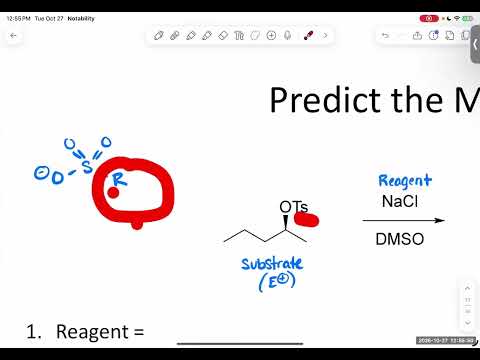
- In the worked example, chloride is the reagent, the substrate bears a sulfonate leaving group, and DMSO appears below the reaction arrow.
- Tosylate, mesylate, and triflate are identified as exceptionally good leaving groups.
- DMSO is a polar aprotic solvent, not a protic solvent that can hydrogen-bond through O-H, S-H, or N-H bonds.
- Chloride is nucleophile-only, so the reaction is substitution rather than elimination.
- The leaving-group carbon is secondary, and the polar aprotic solvent DMSO favors SN2 over SN1 in the example.
- SN2 replaces the sulfonate leaving group with chloride at the alpha carbon and inverts the stereochemistry through backside attack.
- Students work through two practice reactions while Walters and teaching assistant David circulate to discuss pathway choices.
- The later debrief returns to reagent strength, substrate substitution, temperature, base size, and product stereochemistry as the decision points.
- Walters emphasizes explaining why a table applies instead of memorizing reaction outcomes without understanding steric and electronic effects.
- Walters connects the rules to whether a reagent can approach a crowded carbon or more accessible beta hydrogen.
- The final practice discussion identifies a terminal alkene as the answer to one elimination problem.
- Students are encouraged to reason from steric access and reaction mechanism rather than memorize the tables.
- Two drawings of the same five-carbon terminal alkene are equivalent when they differ only by rotation around a single bond.
- The drawings are conformational isomers, not different constitutional products.
- A zigzag arrangement is preferred over an eclipsed conformation, but either drawing represents the same molecule.
- In an E2 reaction, the base removes a beta hydrogen, the C-H bond electrons form the C=C bond, and the leaving group departs in one concerted step.
- The product must retain the starting molecule's carbon count; drawing an extra carbon is an invalid product.
- The leaving group occupies the carbon that loses its bond during elimination.
- The first practice reagent is a bulky oxygen anion, so Walters classifies it as a strong base and favors E2.
- A secondary leaving-group carbon can undergo E2 with this strong base without needing additional reaction conditions to choose the pathway.
- The bulky base favors Hofmann regiochemistry, placing the double bond at the less substituted, terminal position.
- In the second problem, a small O-minus reagent and a secondary substrate leave SN2 versus E2 dependent on temperature.
- With no temperature specified, the reaction is assumed to be at room temperature, which favors E2 as the major pathway.
- The competing SN2 product is the minor product and incorporates oxygen from the nucleophile.
- When beta hydrogens permit a choice, the E2 product is drawn with the larger groups as far apart as possible, favoring the E or trans alkene.
- A terminal alkene with two hydrogens on one alkene carbon has no E/Z designation.
- Quiz 8 begins functional-group chemistry, especially alcohols and ethers, while reusing the substitution and elimination mechanisms.
- Walters previews alcohols, ethers, carbonyl compounds, and amines as major functional-group topics for the rest of the semester.
- Alcohols and ethers feature oxygen, while carbonyl compounds contain a C=O bond and amines contain nitrogen.
- The lecture closes by noting ethanol's varied effects and previewing a return to substitution, elimination, and oxidation.
Transcript excerpt
0:09 How is everybody doing today? >> Good, good, good. I'm doing all right. I'm excited for Halloween this week. Does anyone have any questions before we get started? All right, let's finish out the quiz 7 content. And for the sake of spacing, um, I'm going to leave the quiz 7 homework on Thursday and the quiz 7 open this coming weekend because I think it'll be good for you to get that practice because basically quiz 8 is going to be the same thing. So it it'll
0:58 be a good like force you to study so that then next week it'll be easier. So we're going to leave it um the way that it is in the syllabus. So let's just go through and actually make sure that we understand everything that I already taught you with some practice problems to make sure that we know how to apply when we are picking the product and then drawing our product or sorry picking our reaction pathway and then drawing our product. So I told you you first look at the reagent, right? So when you're looking at the reagent, you're trying to identify is it only a nucleophile? If it's only a nucleophile, then it's only going to do substitution. So our nucleophile only were those things that won't be bases. So therefore, the conjugate base of our
1:45 strong acid, so our Cl minus, Br minus, I minus, also nitrials are also going to be strong acid. So HCN hydro um hydrogen cyanide are you know yeah like cyanide gas. There we go. That is a good acid. And then all of our sulfers sulfur is always going to be a really good nucleophile. So it'll always be a nucleophile. Our base only was those two categories of our bulky base and sodium hydide.
This is the start of the transcript. Save this video free for the whole transcript, searchable and time-coded.
In this course
Related notes
Summary, takeaways, and chapters were generated by AI from the video's transcript and may contain errors. The video belongs to its creator, Dr. Jennifer Walters.