AU26 CHEM 2310 - Lecture 7 - September 15 - Quiz 3 - Alkanes and Cycloalkanes
 Watch on YouTube →
Overview
Dr. Jennifer Walters reviews Quiz 1 errors in formal charge, hybridization, resonance, and converting condensed formulas to Lewis structures, then introduces Quiz 3 topics on alkanes and cycloalkanes. She connects alkane structure to boiling point and solubility through intermolecular forces, and begins Newman projections for comparing the energies of staggered and eclipsed conformations.
Key takeaways
- An oxygen with two bonds and two lone pairs is neutral, while nitrogen with four bonds and no lone pairs carries a positive charge; familiar valence patterns can speed up formal-charge checks.
- Resonance requires adjacent atoms with available p orbitals, so an sp3 atom cannot participate; the example has one additional resonance form beyond the original.
- Acyclic alkanes follow CₙH₂ₙ₊₂, have sp3 tetrahedral carbons, and rotate around carbon-carbon sigma bonds; their lowest-energy chain conformation is staggered.
- For nonpolar pentane isomers, branching reduces molecular contact area and lowers boiling point: pentane boils near 36°C, compared with about 10°C for 2,2-dimethylpropane.
- Hydrogen bonding requires both a donor hydrogen attached to an electronegative atom and an acceptor lone pair on nitrogen, oxygen, or fluorine; an ether can accept but cannot donate.
- A Newman projection represents the front carbon as a dot and the rear carbon as a circle; staggered bonds are separated by 60 degrees and lower in energy than eclipsed bonds at 0 degrees.
Chapters
0:00
Course Questions, Quiz Attempts, and Quiz 1 Results
- Canvas starts each quiz with a first attempt and offers increasing maximum attempts during later retake periods.
- Quiz 1 averaged about 80%, and students completed it in about 16 minutes.
- Dr. Jennifer Walters recommends reviewing incorrect answers even when the quiz felt easy.
3:13
Quiz 1 Review: Formal Charges on Oxygen, Carbon, and Nitrogen
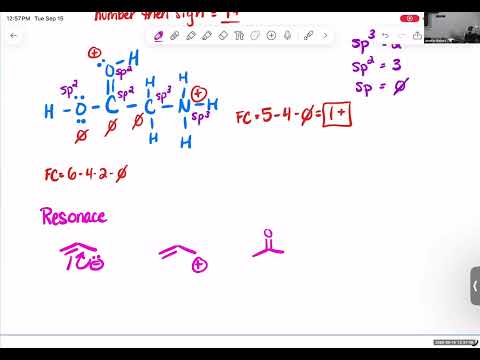
- A neutral oxygen with two bonds has two lone pairs; the double-bonded oxygen shown with one lone pair has a positive charge.
- A carbon with four bonds has no lone pairs and is neutral.
- A nitrogen with four bonds and no lone pairs has a positive charge, since neutral nitrogen typically forms three bonds.
4:19
Assigning Hybridization Around Resonance Systems
- The oxygen next to a pi bond may look sp3, but it is sp2 when its lone pair can participate in resonance.
- The atoms in the carbon-oxygen double bond are sp2, while the separate CH2 carbon and nitrogen are sp3.
- The example contains two sp3 atoms, three sp2 atoms, and no sp atoms.
8:04
Counting Resonance Structures from Adjacent P Orbitals
- Resonance moves electrons through unhybridized p orbitals, so sp3 atoms cannot participate.
- For a lone pair next to a pi bond, start the curved arrow at the lone pair and move electrons toward the pi bond.
- The example has one additional valid resonance structure beyond the structure drawn, for two total.
- Avoid creating adjacent formal charges, and stop when no further adjacent sp2 or sp atoms can participate.
9:59
Reading Condensed Formulas as Lewis Structures
- Read a condensed formula from left to right, attaching grouped hydrogens to the element they follow.
- Build each atom to its usual valency as you go; a terminal CH next to CH2 requires a double bond in the example.
- The example contains 4 carbon-carbon sigma bonds, 3 carbon-oxygen sigma bonds, and 10 carbon-hydrogen bonds.
- Changing how a structure is drawn in space does not change its connectivity or make a new structural isomer.
15:30
Quiz 3 Schedule and Retake Strategy
- The alkane homework is due September 24, and Quiz 3 is available September 25 through 27.
- During the first retake period, Quizzes 1, 2, and 3 each have two attempts available.
- If you know exactly what went wrong, Walters recommends retaking Quiz 3; otherwise, waiting can let you review answers after attempts close.
23:48
Alkane Properties and Fractional Distillation
- Alkanes are saturated hydrocarbons with only carbon-carbon and carbon-hydrogen single bonds; acyclic alkanes follow CₙH₂ₙ₊₂.
- Each alkane carbon is sp3-hybridized and tetrahedral, with bond angles near 109.5 degrees and rotation possible around sigma bonds.
- Fractional distillation separates crude-oil components by boiling point: lighter, lower-boiling molecules travel higher before condensing.
- Heavy fractions can be cracked with a metal catalyst or high heat to produce smaller hydrocarbons, including fuel-range molecules.
34:01
Pentane Structural Isomers and Connectivity
- Linear pentane and its branched forms share the formula C5H12 but have different carbon connectivity.
- The structures discussed include 2-methylbutane and 2,2-dimethylpropane; simply redrawing a chain from the other end does not create a new isomer.
- One-, two-, and three-carbon alkanes each have one connectivity pattern; branching options begin with four carbons.
- The number of possible structural isomers rises rapidly as carbon chains grow.
41:10
Intermolecular Forces Explain Physical Properties
- Stronger intermolecular forces generally raise boiling and melting points because molecules require more energy to separate.
- London dispersion forces arise from temporary dipoles and occur in all molecules; they are the only force in nonpolar alkanes.
- For nonpolar compounds, greater surface area usually provides more contact and stronger dispersion interactions.
- Linear pentane has a higher boiling point than more compact branched pentane isomers because its shape allows more intermolecular contact.
46:20
Dipole, Hydrogen-Bond, and Ionic Interaction Types
- The force sequence discussed runs from London dispersion to dipole-dipole, hydrogen bonding, ion-dipole, and ion-ion interactions.
- Hydrogen bonding requires both a donor, a hydrogen attached to an electronegative atom, and an acceptor, a lone pair on nitrogen, oxygen, or fluorine.
- Water can form two hydrogen-bond donor interactions and two acceptor interactions through its O-H bonds and oxygen lone pairs.
- Ion-dipole attractions help dissolve salts in polar liquids, while ion-ion attractions contribute to ionic crystal lattices.
51:30
Using Force Type and Molecular Shape to Compare Boiling Points
- Pentane boils at about 36°C, while 2,2-dimethylpropane boils at about 10°C, illustrating the effect of branching on dispersion forces.
- A ketone has a carbonyl group, with the carbonyl carbon attached to carbon atoms on both sides; an alkane has no functional group.
- The ketone example has dipole-dipole forces as its strongest interaction: it has an oxygen acceptor but no O-H, N-H, or F-H donor.
- Compare force type first, then consider molecular shape, surface area, and the number of possible interactions.
57:01
Boiling-Point Ranking: Alkane, Ether, Alcohol, and Water
- In the exercise, the alkane relies on London dispersion forces, the ether on dipole-dipole forces, and the alcohol and water on hydrogen bonding.
- The alkane has the lowest boiling point, followed by the ether, because their strongest intermolecular forces are weaker.
- The alcohol has one hydrogen-bond donor and two acceptors, while water has two donors and two acceptors.
- Water's greater number of hydrogen-bonding opportunities puts it above the alcohol in the exercise, despite the alcohol's larger surface area.
1:05:34
Predicting Solubility with the Like-Dissolves-Like Rule
- Polar solutes tend to dissolve in polar solvents, while nonpolar solutes tend to dissolve in nonpolar solvents.
- Solubility describes a solid in a liquid; miscibility describes whether two liquids mix.
- For the exercise's compounds in water, the nonpolar alkane is least soluble, followed by the ether and alcohol.
- The ether has two hydrogen-bond acceptor sites and no donor, the alcohol has three donor-plus-acceptor sites, and water has four.
1:09:32
Newman Projections Show Conformational Isomer Energies
- Conformational isomers, also called conformers or rotamers, are the same molecule viewed after rotation around a sigma bond.
- A Newman projection looks down a carbon-carbon bond; a dot represents the front carbon and a circle represents the back carbon.
- The three spokes from the dot and the three spokes from the circle show the other bonds attached to the two tetrahedral carbons.
- Walters introduces Newman projections as a way to compare the relative energies of conformations.
1:13:31
Staggered and Eclipsed Geometry in Newman Projections
- Staggered conformations have a 60-degree dihedral angle between front- and back-carbon bonds and are lower in energy.
- Eclipsed conformations align front and back bonds, giving a 0-degree dihedral angle and higher energy.
- To convert a line diagram, choose a viewing direction, identify the nearer carbon as the dot, and place the in-plane bonds before adding wedges and dashes.
- Wedges on the same side of the viewed bond remain on the same relative side in the Newman projection; the next class will use models and continue with rings.
Summary, takeaways, and chapters were generated by AI from the video's transcript and may contain errors. The video belongs to its creator, Dr. Jennifer Walters.