AU26 CHEM 2310 - Lecture 23 - Nov 12 - Quiz 10 - Carboxylic Acid Deriv (needs updated transcript)
Overview
Dr. Jennifer Walters explains carboxylic acid derivative substitution as a shared addition-elimination mechanism, then connects reaction direction to electrophilicity, leaving-group stability, and resonance. The lecture covers hydrolysis, saponification, Fischer esterification, lactone formation, transesterification, amide alkylation, and reductions with Grignard reagents and lithium aluminum hydride, with practice in predicting products and reagents.
Key takeaways
- Carboxylic acid derivative substitution follows nucleophilic addition, elimination, and often acid-base adjustment; recognizing this shared sequence simplifies product prediction.
- Acid halides are more reactive than anhydrides, esters, and amides because leaving-group ability and resonance donation both affect carbonyl electrophilicity.
- Basic ester hydrolysis is effectively irreversible because proton transfer forms a stable carboxylate that is no longer an effective electrophile.
- Fischer esterification requires acid activation because neutral alcohol is a weak nucleophile; excess reactant or removal of water or ester shifts its reversible equilibrium toward product.
- Intramolecular esterification forms lactones when a tethered alcohol can close a favorable five- or six-membered ring; numbering the chain helps retain substituents correctly.
- Grignard reagents can add twice to esters through a ketone intermediate, while lithium aluminum hydride generally reduces ester and amide derivatives beyond the carbonyl intermediate.
Chapters
- The central transformation replaces a leaving group attached to a carbonyl carbon with a nucleophile.
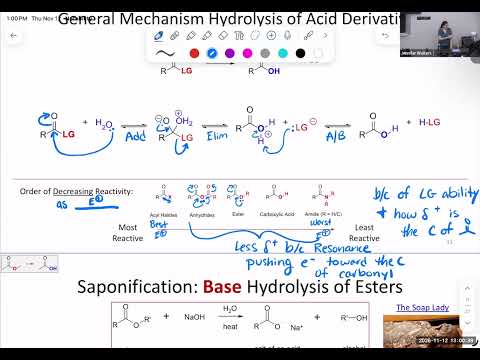
- Because the carbonyl carbon is sp2, substitution does not proceed by SN1 or SN2; nucleophilic addition forms a tetrahedral intermediate, followed by elimination to reform the carbonyl.
- Quiz 9 reactions differ because their carbonyl substituents are hydrogen or carbon groups, which do not leave as stable leaving groups.
- The general electrophile reactivity order runs from acid halides through anhydrides and esters to amides.
- Leaving-group stability helps explain the order: halides are conjugate bases of strong acids, while amide anions are particularly poor leaving groups.
- Resonance donation from an attached oxygen or nitrogen reduces the carbonyl carbon's partial positive charge and makes it less attractive to nucleophiles.
- Water readily hydrolyzes acid halides and anhydrides, while ester hydrolysis can be driven under basic conditions.
- Saponification is base-promoted ester hydrolysis, traditionally used to make soap from animal fats and concentrated sodium hydroxide.
- Soap molecules have polar heads and nonpolar tails that form micelles, surrounding nonpolar dirt so it can disperse in water.
- The soap lady is presented as an example of body fats undergoing saponification in alkaline burial soil, which helped preserve the remains.
- Hydroxide adds to the ester carbonyl, and collapse of the tetrahedral intermediate expels an alkoxide.
- The resulting carboxylic acid transfers a proton to the alkoxide, forming a resonance-stabilized carboxylate and a neutral alcohol.
- Because the carboxylate is a poor electrophile and the alcohol is a weak nucleophile, the acid-base step strongly favors products; acid workup is needed to recover the neutral carboxylic acid.
- Converting a stable amide into a carboxylic acid goes against the derivative reactivity trend and requires stronger conditions.
- Aqueous hydrochloric acid, sulfuric acid, or sodium hydroxide, typically with heat, facilitates amide hydrolysis.
- The reaction summary table links each product to its incoming nucleophile: water supplies an OH group, alcohol supplies OR, and an amine supplies nitrogen.
- Carboxylic acid plus ammonia can form an amide with heat, which helps overcome the initial acid-base reaction that produces a carboxylate and ammonium salt.
- Thionyl chloride converts a carboxylic acid into an acid chloride; phosphorus trichloride and phosphorus pentachloride are alternatives.
- For bromides, the corresponding reagents are thionyl bromide, phosphorus tribromide, or phosphorus pentabromide.
- Heating carboxylic acids can form symmetrical anhydrides as water is removed, shifting the equilibrium toward product under Le Châtelier's principle.
- The mechanism follows addition, elimination, and acid-base steps, with the tetrahedral intermediate collapsing to expel a leaving group.
- An unsymmetrical anhydride can be made by adding the desired carboxylate nucleophile to a more reactive acid halide and displacing its halide.
- Fischer esterification combines a carboxylic acid and an alcohol, usually with sulfuric acid, to form an ester.
- Acid protonates the carbonyl oxygen, increasing electrophilicity so the weak, neutral alcohol can add.
- Proton transfers make water the leaving group; elimination reforms the carbonyl, followed by deprotonation.
- The equilibrium can be driven forward by excess alcohol or carboxylic acid, or by removing water or ester.
- A lactone is a cyclic ester, while a lactam is a cyclic amide.
- A molecule containing both a carboxylic acid and an alcohol can cyclize under the same strong-acid conditions as Fischer esterification.
- Five- and six-membered lactone rings are practical targets when the tether places the alcohol oxygen five or six atoms from the carbonyl carbon.
- The intramolecular mechanism begins by protonating the carboxylic acid carbonyl, followed by attack from the tethered alcohol.
- Proton shuttling transfers a proton to an OH group so it can leave as water; carbonyl reformation closes the ring.
- Numbering the chain before drawing the product helps preserve substituents, such as the methyl group on carbon five, and avoid ring-closure errors.
- Acid halides and anhydrides readily form esters or amides when an alcohol or amine replaces the leaving group.
- Transesterification swaps one ester OR group for another, such as replacing OMe with OEt.
- Amide nitrogen can be alkylated by an SN2 reaction with an alkyl halide, converting a primary amide to a secondary or tertiary amide.
- Primary, secondary, and tertiary amide labels count the substituents on nitrogen together with the carbonyl attachment.
- A Grignard reagent substitutes at an ester carbonyl: addition and elimination first produce a ketone.
- The ketone remains reactive toward Grignard reagent, so a further addition followed by acid workup produces an alcohol.
- The number of carbon groups added depends on the equivalents: one addition can stop at the ketone, while further reagent adds another group.
- Lithium aluminum hydride reduces esters to alcohol products and amides to amines; the lecture emphasizes that these reactions continue beyond intermediate carbonyl compounds.
- For an ester, hydride addition and elimination generate an aldehyde intermediate, which undergoes another hydride addition before acid workup.
- Lithium aluminum hydride reduces carbonyls but not carbon-carbon double bonds; sodium borohydride is presented as capable of reducing acid halides but not the other derivatives covered.
- For product prediction, identify the nucleophile and the leaving group attached to the carbonyl, then replace the leaving group with the nucleophile-derived group.
- Water replacing chlorine on an acid halide gives a carboxylic acid after neutralization.
- Ammonia replacing OH on a carboxylic acid derivative gives an amide with NH2, not NH3, attached to the carbonyl.
- To choose a reagent, identify what new atom or group appears next to the carbonyl in the product; that group comes from the nucleophile.
- For example, forming an anhydride requires an oxygen-containing carboxylate or carboxylic acid partner to replace the acid halide leaving group.
- Groups such as bromide may leave during substitution even though they are omitted from the main organic product, because they do not belong to its carbon scaffold.
Transcript excerpt
1:46 Okay. This is not sharing. Why not? >> Hello everyone.
2:58 Morning. Afternoon. Good day. All right. How is everybody doing today? Good. Good. All right. Turn volume up cuz I feel like you can't hear me very well. Is that better in the back? Can you hear me okay? Yeah. Okay. All right. So uh this temperature is theoretically their fixed temperature. Um we'll see if it stays that way. Uh if it starts getting too hot and you need to leave, please do leave. Like it that's totally okay. We're doing a full like don't worry about the attendance credit. You won't lose it if
3:46 you need to leave because the heat of the room. And if it gets really bad, then we'll just end class early as well. Um so hopefully it is tolerable in here today. All right. Does Does have any questions before we get started? And as a reminder, in case you didn't see any of the messages from David, David is away currently. I don't remember why. Wedding? Something. So you're going to have guest TAs for tomorrow's recitation. They are awesome, fully competent, capable people. No one can replace David, but
4:35 they are really good. So you should still have a very productive recitation tomorrow. But don't be surprised when you see someone who you're like, I've never seen this person before. That's still okay. Cool. All right. So we left off talking about our substitution reactions. And so we are looking at where we are doing this replacement of a leaving group next to our carbonyl. And so we said that this is special because it's an sp2 carbon. sp2 cannot do So the double bond cannot do SN2 or SN1. So the way that we will do our
5:22 substitution instead is through an
This is the start of the transcript. Save this video free for the whole transcript, searchable and time-coded.
In this course
Related notes
Summary, takeaways, and chapters were generated by AI from the video's transcript and may contain errors. The video belongs to its creator, Dr. Jennifer Walters.