AU26 CHEM 2310 - Lecture 22 - Nov 10 - Quiz 10 - Carboxylic Acid Deriv (needs updated transcript)
Overview
The lecture reviews reagent classification and substitution versus elimination, then introduces carboxylic acid derivatives as electrophiles that undergo addition-elimination substitution. It covers naming carboxylic acids, esters, and amides; compares acidity and intermolecular forces; surveys routes to carboxylic acids; and establishes the shared mechanism and reactivity order of acid derivatives.
Key takeaways
- Grignard reagents attack aldehydes and ketones as carbon nucleophiles, but require a separate aqueous or dilute-acid workup because alcohol solvents would protonate the strongly basic reagent.
- For a tertiary alkyl bromide with a weak alcohol nucleophile/base, the lecture uses temperature to break the SN1/E1 tie: warm conditions favor E1, while cold conditions favor SN1.
- Zaitsev analysis compares alkene substitution by counting non-hydrogen groups attached to the double bond; equivalent drawings of the same trisubstituted alkene are one product, not separate products.
- Carboxylic acids are substantially more acidic than alcohols because resonance stabilizes the carboxylate conjugate base, with typical pKa values around 4 to 5 versus 15 to 17 for alcohols.
- Acyl substitution follows addition then elimination: a nucleophile adds to the carbonyl, the oxygen reforms the carbonyl, and the original leaving group departs.
- Carboxylic acid derivative reactivity decreases in the order acid halide, anhydride, ester, carboxylic acid, amide; water or hydroxide provides the OH nucleophile for hydrolysis to an acid.
Chapters
- Grignard reagents, R-MgX, act as strong nucleophiles toward electrophilic carbonyl carbons.
- The carbon nucleophile attacks the carbonyl carbon and moves the C=O electrons onto oxygen, forming an alkoxide.
- A separate water or dilute HCl workup protonates the alkoxide; alcohol solvents are unsuitable because Grignards are strong bases.
- Quiz 7 had an 80% average, with scores ranging from 30% to 100%; its most-missed problem involved methanol and an alkyl bromide.
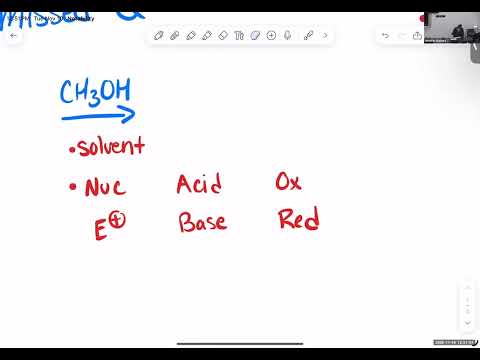
- Classify reagents by paired roles such as nucleophile/electrophile, acid/base, and oxidant/reductant before selecting a reaction.
- Lone pairs, pi bonds, and negative charges suggest nucleophiles; positive or partially positive sites and good leaving groups suggest electrophiles.
- Neutral methanol has oxygen lone pairs, so it can act as a weak nucleophile and weak base.
- Its O-H proton makes methanol a weak acid; protonation can also make its hydroxyl group a better leaving group.
- Methanol is a poor electrophile as it stands because OH is a poor leaving group, but suitable conditions can activate it.
- Oxidation increases bonds to oxygen or decreases bonds to hydrogen; reduction does the opposite.
- The lecture lists KMnO4, PCC, and Jones reagent as oxidants, and Grignard, organolithium, H2, NaBH4, and LiAlH4 among reducing reagents.
- In the quiz example, methanol is a weak nucleophile/base and the carbon bonded to bromine is electrophilic, pointing toward substitution or elimination rather than redox.
- A weak nucleophile and weak base favor the SN1/E1 pathway rather than SN2/E2.
- The tertiary carbon bonded to bromine can form a stable tertiary carbocation, so substrate structure alone does not distinguish SN1 from E1.
- The lecture's simplified temperature rule favors elimination at room temperature or when heated, and substitution at colder temperatures.
- E1 forms an alkene by eliminating a beta hydrogen after the leaving group departs and a carbocation forms.
- Zaitsev selectivity favors the more substituted alkene; count non-hydrogen substituents across the double bond.
- The example gives two equivalent trisubstituted alkene drawings as the major product because they represent the same molecule.
- The quiz 8 problem used the same weak alcohol reagent and tertiary bromide logic; warm conditions favored the E1 product.
- Under cold conditions, the lecture predicts SN1: bromide leaves, the tertiary carbocation forms, and the alcohol oxygen attacks.
- Deprotonation of the oxonium intermediate produces an ether; ethanol gives a product with one more carbon than methanol.
- The class pauses for about five minutes because the room is unusually warm.
- Quiz 10 begins as a continuation of carbonyl electrophile chemistry, shifting from aldehydes and ketones to other carbonyl compounds.
- A carboxylic acid contains a carbonyl and an OH attached to the same carbon.
- Examples include formic acid from fire ant venom, acetic acid in vinegar, and lactic acid.
- The stated naming priority is carboxylic acid, ester, amide, aldehyde, ketone, then alcohol; carboxylic acids take the suffix oic acid.
- Name an ester with the oxygen-side alkyl group first, followed by the acid-derived name ending in oate; the example is methyl ethanoate.
- For amides, identify substituents attached to nitrogen with N- labels, as in N-methylethanamide.
- When the carboxylic acid is primary, its carbon is carbon 1 and its suffix determines the parent chain.
- The primary functional group must be on the parent backbone, even when a ring contains more carbons than the chain bearing the carboxylic acid.
- Secondary ketones use the prefix oxo, aldehydes use formyl, and substituents are numbered from the end nearest the first substituent.
- Quiz naming expectations cover carboxylic acids, esters, and amides as primary groups; other derivative naming rules appear in homework but are not expected on the quiz.
- Acyl halides replace the acid OH with a halogen; anhydrides contain a carbonyl-oxygen-carbonyl linkage, esters contain OR, and amides contain nitrogen.
- Carboxylic acids have pKa values around 4 to 5 because their conjugate bases are resonance-stabilized; alcohols have pKa values around 15 to 17.
- The lecture compares an alcohol's one hydrogen-bond donor and two acceptors with a carboxylic acid's one donor and four acceptors; esters lack a donor and rely on dipole-dipole forces.
- Primary alcohols can be oxidized to carboxylic acids with Jones reagent or KMnO4.
- KMnO4 oxidizes secondary alcohols to carboxylic acids, while Jones reagent typically gives ketones; PCC gives aldehydes from primary alcohols.
- Aldehydes can be oxidized with Jones reagent, KMnO4, or silver oxide; oxidative cleavage with KMnO4 or ozone followed by oxidative workup can also produce acids.
- A Grignard reagent adds to CO2, supplying the one carbon and two oxygens needed for a carboxylic acid.
- Acid workup protonates the carboxylate product, making CO2 addition a way to extend a carbon skeleton by one carbon.
- Hydrolysis of nitriles and carboxylic acid derivatives is introduced as another route to carboxylic acids.
- Carboxylic acid derivatives undergo net substitution because a nucleophile replaces the group attached to the carbonyl carbon.
- The nucleophile attacks the sp2 carbonyl carbon, forming a tetrahedral intermediate; oxygen then reforms the carbonyl and expels the leaving group.
- Unlike SN1 or SN2 at an sp3 carbon, the acyl mechanism starts with addition to a carbonyl and follows with elimination.
- To convert an acid derivative into a carboxylic acid, use water or hydroxide as the nucleophile to install OH.
- After addition and elimination, any required acid-base steps produce the neutral final product.
- The lecture's reactivity order is acid halide greater than anhydride greater than ester greater than carboxylic acid greater than amide, with acid halides easiest and amides hardest to convert.
Transcript excerpt
2:42 All right. How is everyone doing today? Doing all right? It's warm in here, so I'm trying to keep the lights up a little bit brighter than normal so that hopefully we don't fall asleep. Hopefully you can still Can you see this okay still? Okay. All right. So hopefully I don't lose any of you. If we start nodding off, we might take an extra break and stretch or oh, go for a walk, do a lap or something. Okay. All right. Does anyone have any questions before we get started? Yeah. For a Grignard? Yeah, sure. Yeah. So
3:34 Quiz nine was all about having our aldehydes and ketones undergo reactions and trying to figure out what they're going to do, specifically looking at our addition or condensation product. So we picked our Grignard addition. So the Grignard was one of our addition mechanisms. So So is specifically that organometallic reagent where you have that carbon MgX or the R-MgX. So your Grignard is a strong base, strong nucleophile. And so we were unable to use it with any
4:23 alcohol solvents because it's a strong base. But when it's in the presence of our aldehyde or ketones, it's going to act as that strong nucleophile because for both of these, we're looking at the carbonyl is our electrophile. So our mechanism is if you have that Grignard, your carbon is going to be taking those electrons from the Grignard reagent and attacking the carbon to carbonyl, your electrophilic site. So that's the delta positive. So it attacks the carbon, electrons go up onto oxygen. That is our addition so that you now have that R group attached to the carbon.
5:11 And then your magnesium becomes just a counter ion hanging out. So because this is a strong base, it
This is the start of the transcript. Save this video free for the whole transcript, searchable and time-coded.
In this course
Related notes
Summary, takeaways, and chapters were generated by AI from the video's transcript and may contain errors. The video belongs to its creator, Dr. Jennifer Walters.