AU26 CHEM 2310 - Lecture 10 - September 24 - Quiz 4 - Addition Reactions
 Watch on YouTube →
Overview
Dr. Jennifer Walters organizes alkene addition reactions into carbocation, anti, syn, and oxidative-cleavage mechanisms, showing how reagents predict products, regiochemistry, and stereochemistry. She explains Markovnikov selectivity through carbocation stability and rearrangements, contrasts it with halonium-ion and concerted additions, and closes with product-prediction practice and study strategies.
Key takeaways
- Strong acid reagents such as HCl or H2SO4 signal a carbocation pathway, so predict Markovnikov placement and check for rearrangements before nucleophile attack.
- Carbocation stability is determined first by resonance—benzylic and allylic stabilization can outweigh ordinary substitution—then by alkyl-group induction and hyperconjugation.
- Br2/Cl2 halogenation and oxymercuration proceed through three-membered onium ions, giving anti addition without free-carbocation rearrangements; oxymercuration also gives Markovnikov alcohol placement.
- Hydroboration-oxidation is the lecture’s anti-Markovnikov route to an alcohol: BH3 adds syn, placing boron on the less substituted carbon, and oxidation replaces boron with oxygen.
- Cold, dilute KMnO4 gives syn dihydroxylation, whereas regular KMnO4 conditions indicate oxidative cleavage; the words “cold and dilute” distinguish the reaction outcomes.
- For ozonolysis, the workup controls the product: Zn/HCl or dimethyl sulfide is reductive, while H2O2 is oxidative.
Chapters
0:00
Top Hat Attendance Troubleshooting and Addition-Reaction Review
- Students experiencing Top Hat QR-code attendance problems can try a computer or access the website instead of the phone app.
- Alkene and alkyne additions consume a carbon–carbon pi bond, and the lecture groups them into carbocation, anti, syn, and oxidative-cleavage mechanisms.
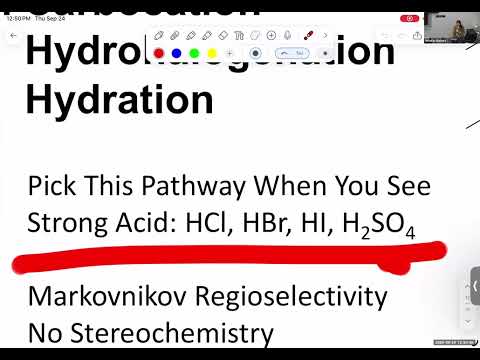
- Strong acids such as HCl, HBr, HI, and H2SO4 indicate a carbocation pathway.
5:27
Hydrohalogenation and the Carbocation Rate-Determining Step
- Hydrohalogenation adds hydrogen and a halogen from HX across an alkene; the pi bond attacks H and the H–X bond breaks.
- The two-step mechanism first forms a carbocation and then has a halide nucleophile attack it.
- Carbocation formation is the slow, endothermic, rate-determining step, even when the overall reaction is generally exothermic.
9:49
Acid-Catalyzed Hydration and the Role of Water
- Acid-catalyzed hydration adds H and OH across an alkene using strong acid, such as HCl or H2SO4, and water.
- Water attacks the carbocation; hydrogen sulfate, HSO4−, is a resonance-stabilized counterion rather than a useful nucleophile or base in this course.
- Water attacks to form an oxonium ion, which is deprotonated to give a neutral alcohol; the carbon-containing substrate is typically carried to a neutral product.
16:53
Markovnikov Regiochemistry and Carbocation Stability
- Markovnikov addition places the new non-hydrogen group on the more substituted alkene carbon and H on the carbon bearing more hydrogens: “what has gets.”
- For propene, adding H to the terminal carbon produces a secondary carbocation rather than a primary one.
- The favored pathway forms the more stable carbocation because it has the lower activation barrier.
21:17
Resonance, Induction, and Carbocation Stability Rankings
- For aliphatic carbocations, the substitution trend is tertiary > secondary > primary; carbocations are sp2-hybridized with an empty p orbital.
- Resonance is the strongest stabilizing factor: benzylic carbocations are more stable than allylic carbocations, which are more stable than aliphatic ones.
- Alkyl groups stabilize carbocations through inductive donation and hyperconjugation; radicals follow a similar substitution trend, while anion substitution trends reverse.
28:45
Carbocation Rearrangements Before Nucleophile Attack
- Hydride or alkyl shifts occur only when they produce a more stable carbocation; a secondary-to-secondary shift without added resonance stabilization is not favored.
- Draw rearrangement arrows from a C–H or C–C bond toward the positively charged carbon—the electrons move, not the carbocation itself.
- Whenever a carbocation forms, check for rearrangement before allowing the nucleophile to attack; secondary-to-tertiary shifts are common.
- A product with the nucleophile on a carbon other than an original alkene carbon signals that a carbocation rearrangement occurred.
36:06
Recognizing Anti Additions from Halogens and Mercury Reagents
- The anti-addition family includes halogenation with Br2 or Cl2 and oxymercuration-demercuration with mercury reagents.
- A three-membered onium-ion intermediate blocks one face of the molecule, directing the incoming nucleophile to the opposite face.
- Anti stereochemistry describes groups added to opposite faces; it does not by itself determine which carbon receives each group.
37:40
Br2 and Cl2 Halogenation: Halonium Ions and Anti Stereochemistry
- An alkene polarizes Br2 or Cl2 and attacks the electrophilic halogen, forming a three-membered bromonium or chloronium ion rather than a free carbocation.
- The halide nucleophile attacks from the opposite face, opening the ring and giving anti addition; it attacks the more substituted carbon because that site is more electrophilic.
- The reaction is concerted with respect to alkene addition and does not undergo carbocation rearrangements.
- Bromine’s brown color can disappear when it reacts with an alkene, making the test a quick screen for unsaturation rather than proof that a sample is a particular drug.
47:40
Oxymercuration-Demercuration: Markovnikov Alcohols Without Rearrangements
- Oxymercuration adds oxygen and mercury using a mercury(II) salt and water or an alcohol; acetate (OAc) is a counterion, while mercury is the key reagent.
- The alkene forms a mercurinium ion, and water attacks the more substituted carbon before deprotonation produces the alcohol-containing intermediate.
- The addition is Markovnikov-oriented and anti in its first step; NaBH4 then replaces the carbon–mercury bond with a carbon–hydrogen bond.
- Unlike acid-catalyzed hydration, this pathway avoids a free carbocation and therefore avoids carbocation rearrangements.
53:50
Recognizing Syn Additions and Hydrogenation
- Syn-addition reagents include H2, BH3, OsO4, and KMnO4 only when the permanganate conditions are cold and dilute.
- Hydrogenation adds H2 across the alkene with a metal catalyst such as Pd/C; platinum, nickel, or rhodium can also serve as catalysts.
- The metal catalyst lowers the activation barrier and is regenerated, so it is not incorporated into the product or ordinary curved-arrow mechanism.
54:57
Hydroboration-Oxidation Makes Anti-Markovnikov Alcohols
- In step one, BH3 adds across the alkene in a concerted syn addition, placing hydrogen and boron on the same face.
- Steric effects place the larger boron-containing group on the less substituted carbon, while electronic effects also contribute to the addition pattern.
- Oxidation converts the carbon–boron bond into a carbon–oxygen bond, yielding an anti-Markovnikov alcohol.
1:00:50
Syn Dihydroxylation with OsO4 or Cold, Dilute KMnO4
- Dihydroxylation adds two oxygen-containing groups to the same face of an alkene, producing a syn vicinal diol.
- OsO4 or cold, dilute KMnO4 forms a cyclic intermediate; the lecture emphasizes the syn-addition step rather than the later workup mechanism.
- Purple KMnO4 can turn into brown-black material in the presence of an alkene, but warmer or longer treatment can trigger other reactions.
1:03:50
Oxidative Cleavage with KMnO4 and Ozonolysis
- Regular KMnO4 conditions or O3 indicate oxidative cleavage, which breaks the alkene and forms carbonyl-containing products.
- KMnO4 cleavage can oxidize alkene carbons to carboxylic acids and may break carbon–carbon bonds.
- Ozonolysis outcomes depend on the second step: reductive workup with Zn/HCl or dimethyl sulfide retains hydrogen at alkene carbons, while oxidative workup such as H2O2 converts those positions toward oxygen-containing products.
1:06:37
Build a Reaction Notebook, Road Map, or Product-Based List
- A reaction notebook can give each reaction its own page with the name, general scheme, curved-arrow mechanism, energy diagrams, rearrangement notes, and examples.
- Reaction road maps organize reagents around a generic alkene, while product-based lists group choices by desired outcomes such as an alcohol, halide, alkane, or carbonyl.
- For an alcohol, compare four options by regiochemistry and mechanism; oxymercuration is useful when avoiding rearrangement matters, while hydroboration gives anti-Markovnikov placement.
- Use the study format that works: Walters recommends trying a notebook but switching strategies if the process becomes unproductive busywork.
1:10:48
Quiz-Style Product Prediction: Choosing the Benzylic Carbocation
- The practice problem’s HCl reagent identifies a carbocation mechanism, after which both possible protonation directions should be compared.
- Both alkene carbons had one hydrogen, so resonance—not hydrogen counting—determines the preferred direction.
- The favored path forms a secondary benzylic carbocation, more stable than the competing secondary aliphatic carbocation; chloride then attacks without a further rearrangement.
- Walters identifies choice D as correct and recommends drawing both candidate carbocations when regiochemistry is uncertain.
1:19:00
Asynchronous Lecture Plan and Quiz 4 Schedule
- The class chose an asynchronous video to finish the remaining Quiz 4 material rather than shifting Quizzes 4, 5, and 6 together.
- The follow-up lesson will cover alkyne reactions, the Diels–Alder reaction, and conjugate additions.
- Quiz 4 remains scheduled for the following weekend.
Summary, takeaways, and chapters were generated by AI from the video's transcript and may contain errors. The video belongs to its creator, Dr. Jennifer Walters.