AU26 CHEM 2310 - Lecture 21 - Nov 5 - Quiz 9 - Aldehydes and Ketones (needs updated transcript)
Overview
Dr. Jennifer Walters reviews CHEM 2310 Quiz 9 reactions of aldehydes and ketones, emphasizing nucleophilic addition and nitrogen-based condensation to form imines, oximes, and hydrazones. She connects carbonyl oxidation and reduction to reagent choice, then applies the reaction patterns to practice problems involving mCPBA, excess ethanol, carbonyl deoxygenation, and substitution.
Key takeaways
- Aldehyde and ketone reactions begin with nucleophilic addition at the carbonyl carbon; subsequent acid-base steps or elimination determine whether the net result is addition or condensation.
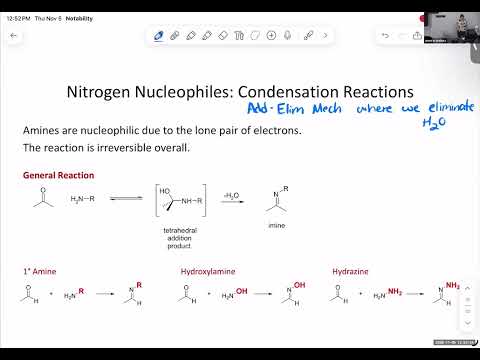
- Primary amines form imines, hydroxylamine forms oximes, and hydrazine forms hydrazones through the same addition-elimination mechanism, with water removal favoring product formation.
- A Dean-Stark trap removes water by distillation while returning a lower-density solvent such as toluene to the reaction flask, shifting condensation equilibrium toward product.
- PCC is milder than Jones reagent and KMnO4: it generally stops at the aldehyde stage, while Jones and KMnO4 oxidize aldehydes to carboxylic acids.
- mCPBA has multiple potential targets: it oxidizes aldehydes to carboxylic acids and epoxidizes alkenes, so functional-group compatibility must guide reagent choice.
- Clemmensen reduction with Zn(Hg)/HCl and Wolff-Kishner reduction through a hydrazone both convert aldehyde or ketone carbonyls to alkanes; unsymmetrical ketone oxidative cleavage can instead produce mixtures of acids.
Chapters
- Walters uses a class poll to decide how much prior material to review, then chooses a medium-length recap.
- Quiz 8 finished ether reactions: acid conditions favor SN1, while base conditions favor SN2.
- Quizzes 9 and 10 treat carbonyls as electrophiles; Quiz 9 focuses on aldehydes and ketones without an adjacent leaving group.
- Quiz 10 covers carboxylic acid derivatives, which have a leaving group and can undergo net substitution.
- Carbonyl reactions begin with nucleophilic attack at the sp2 carbonyl carbon and movement of the pi electrons onto oxygen.
- Acid-base steps after addition give an addition product; elimination of water gives condensation, while elimination of a leaving group gives net substitution.
- An amine nitrogen lone pair attacks the aldehyde or ketone carbonyl, producing a tetrahedral intermediate.
- The overall condensation removes water, and removing that water helps drive the reversible reaction toward product.
- A desiccant such as silica-based drying material absorbs water from the reaction mixture.
- A Dean-Stark trap with a heated reaction flask and a less-dense solvent such as toluene collects water while returning solvent to the flask.
- Physical removal of water shifts the equilibrium toward condensation products by Le Chatelier's principle.
- A primary amine gives an imine, hydroxylamine gives an oxime, and hydrazine gives a hydrazone.
- All three reactions share the same addition-elimination sequence; the nitrogen substituent determines which product class forms.
- After nitrogen attacks the carbonyl, acid-base steps transfer a proton from nitrogen to oxygen through a proton shuttle.
- The shuttle uses two successive proton transfers, allowing a base to move the proton between sites that cannot transfer it directly.
- The intermediate with an amine and an alcohol attached to the same carbon is a hemiaminal, analogous to a hemiacetal.
- Because the hemiaminal is unstable, nitrogen forms a carbon-nitrogen double bond as the oxygen-containing group leaves as water.
- Final deprotonation gives a neutral imine; the same mechanism applies to oxime and hydrazone formation.
- Imine formation can be reversible in aqueous biological environments because water is not continually removed by heating or drying.
- Reversible imine bonds can temporarily link an enzyme and substrate, then hydrolyze to release the components.
- Oxygen, carbon, and hydrogen nucleophiles add to aldehydes or ketones and leave an OH group on the former carbonyl carbon.
- Nitrogen nucleophiles instead replace the carbonyl oxygen through condensation, producing imines, oximes, or hydrazones.
- Carbonyl reduction decreases bonds to oxygen and can produce alcohols or, under stronger conditions, an alkane.
- Zn(Hg) with HCl, the Clemmensen reduction, removes a ketone or aldehyde carbonyl to give a methylene group.
- Hydrazone formation followed by excess base, the Wolff-Kishner reduction, also removes the carbonyl and releases nitrogen gas.
- Aldehydes oxidize more readily than ketones because aldehyde carbonyl carbons are more electrophilic and oxidation does not require carbon-carbon bond cleavage.
- Jones reagent and KMnO4 oxidize aldehydes to carboxylic acids; PCC is weaker and generally stops at the carbonyl stage.
- Silver oxide reagents can oxidize aldehydes, as demonstrated by the Tollens reaction.
- KMnO4 can oxidize alkenes by oxidative cleavage as well as oxidize aldehydes, so it may react at multiple sites in one molecule.
- Peracids such as mCPBA oxidize aldehydes to carboxylic acids and convert alkenes into epoxides.
- When an aldehyde is the only reactive functional group, several oxidants work; Jones reagent is a more selective choice when an alkene must remain untouched.
- The Tollens test oxidizes an aldehyde while reducing silver ions to metallic silver, which can coat glass and create a mirror-like surface.
- Strong oxidation of ketones, commonly with KMnO4 in laboratory settings, cleaves a carbon-carbon bond and forms carboxylic acids.
- Unsymmetrical ketones can split on either side of the carbonyl, yielding mixtures of carboxylic acids.
- Walters recaps carbonyl additions, hemiacetal-to-acetal formation, nitrogen condensations, oxidations, and carbonyl-deletion reductions.
- She notes DIBAL-H as a selective reducing reagent that can convert a carboxylic acid to an aldehyde in the course's reaction summary.
- Quiz 9 homework is due November 12, and the quiz window is November 13 through 15.
- Students work on two product-prediction problems and a synthesis problem, using the reaction summary as a reference.
- The practice period runs for several minutes before Walters regroups the class to focus on recognizing each reagent's role.
- For the mCPBA problem, the peracid oxidizes an aldehyde to a carboxylic acid and an alkene to an epoxide.
- For the ethanol problem, one equivalent gives an addition intermediate, while excess ethanol drives formation of the more stable acetal.
- The key strategy is to check every functional group that can react with the chosen reagent.
- The synthesis comparison preserves a six-carbon chain and identifies three changes: remove the carbonyl, replace iodine at the terminal carbon, and add an SH group.
- Carbonyl deoxygenation can use Zn(Hg)/HCl or a hydrazone followed by excess base; a primary iodide can undergo SN2 substitution with a sulfur nucleophile.
- Walters closes by urging students to watch the recording before the next day's recitation.
Transcript excerpt
0:30 3 >> All right. How is everyone doing today?
5:49 Good? Good? Cool? All right. Does anyone have any questions before we get started? >> Okay. All right. So, let's see if and no judgment. I'm just trying to see how much I need to backtrack before starting this lecture. So, that's that's the point of this poll. It's not a judging poll. It's a so I know if I can just like jump right into it or need to go back. So, I don't know if that means anyone wants to change their answer now to be more honest, but
6:38 go ahead and close this out. Okay. I'll be honest. There are a lot more yeses than I expected. So, cool. All right, but it is about slightly more than a third of no and then we're kind of all throughout. So, I'm going to do medium recap then. All right. Okay. So, in the video, in case you didn't watch it yet, it finished out the quiz eight content. So, about our alcohols, well, specifically the ethers was the part that we hadn't finished
7:25 yet. And with our ethers, the big thing was it's going to do either SN1 or SN2. If it's acid, it did SN1. If it was base, it did SN2. So, that was the basically the whole point of the rest of quiz eight. For our quiz nine discussion, we had said that the whole point of quiz nine is we're looking at our reactions with aldehydes and ketones. And so we are looking at the different reactions where our carbonyl is an electrophile. So, quizzes nine and 10, these are where the carbonyl is an electrophile. Quiz 11
8:14 is going to be where we used the carbonyl as a nucleophile. So then the difference between quiz nine
This is the start of the transcript. Save this video free for the whole transcript, searchable and time-coded.
In this course
Related notes
Summary, takeaways, and chapters were generated by AI from the video's transcript and may contain errors. The video belongs to its creator, Dr. Jennifer Walters.