ACCT 417 (Fall 2026) - Code of Professional Conduct
Overview
Michael Barnes reviews the AICPA Code of Professional Conduct, covering core rules such as integrity, competence, due care, confidentiality, and limits on contingent fees and commissions. He emphasizes independence as the main exam focus, explaining who counts as a covered member, which financial interests and family relationships matter, and how management work, overdue fees, or litigation can impair independence.
Key takeaways
- For an attest client, independence rules reach beyond the engagement team to influential personnel, partners providing more than 10 hours of non-attest services, partners in the lead partner's office, and the firm itself.
- Client-record retention is a particularly testable acts-discreditable issue: a CPA must return client-provided records when the client requests them after an engagement.
- A CPA who performs significant management work for an attest client risks auditing their own work, which impairs independence.
- Immediate family includes a spouse or partner and dependents; parents, siblings, and non-dependent children can also affect independence if they have a material financial interest or significant influence over the client.
- Fees more than a year overdue and actual or probable client-CPA litigation can impair independence, even when no direct stock ownership exists.
- Contingent fees are generally prohibited, with exceptions including legal representation and third-party compilations; commissions and referral fees may be allowed for tax and non-attest services.
Chapters
- The Excel assignment is due in two weeks, and Barnes advises starting before the final week.
- The True Biz Forum on Wednesday at 4:00 p.m. is the final extra-credit opportunity for students who have not earned credit through Meet the Firms or the career expo.
- Groups should choose presentation topics and dates from the syllabus; topics are first come, first served, and no groups had selected one yet.
- Students should complete the tax assembly survey and email Barnes if they can volunteer for additional compensation.
- Barnes identifies integrity and objectivity as honesty and impartiality, and flags independence as the central topic for the third exam.
- The four general standards are professional competence, due professional care, adequate planning and supervision, and sufficient relevant evidence.
- Auditors must follow generally accepted auditing standards and the applicable reporting framework, which may differ from GAAP for some clients.
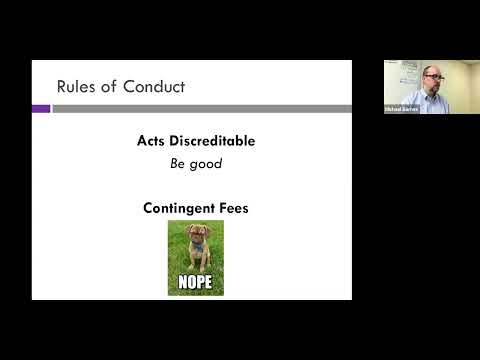
- Contingent fees and commissions are generally restricted; advertising is permitted if it is not misleading, including claims about CPA credentials.
- Contingent fees may be allowed for CPA representation in legal proceedings and compilations prepared for third parties, such as a bank evaluating a loan.
- Commissions and referral fees may be permissible for tax and non-attest services, unlike attest services.
- Acts discreditable include unprofessional conduct, including behavior on social media that can threaten a CPA license.
- A frequently tested example is failing to return client-provided records when the client requests them after an engagement.
- Covered members must be independent in fact and appearance for attestation engagements; they include engagement-team members and people able to influence the engagement.
- A partner providing more than 10 hours of non-attest services to an attest client in a fiscal year is also covered, as are partners in the lead engagement partner's office.
- The firm and relevant employee benefit plans must meet independence requirements; rules can also extend to entities influenced by covered members.
- Direct ownership, such as client stock, and material indirect interests, such as significant holdings through a subsidiary or mutual fund, can impair independence; Barnes notes that certain bank-loan exceptions exist.
- Immediate family members, including a spouse or partner and dependents, are subject to the covered member's independence restrictions.
- Parents, siblings, and non-dependent children can create an independence issue when they have a material financial interest in, or significant influence over, the client.
- Performing significant management work, such as designing a client's accounting information system, can impair independence because the CPA would later audit their own work.
- Engagement fees more than a year past due and actual or probable litigation between the client and CPA can also impair independence.
Transcript excerpt
0:00 Yeah, I'm also >> All right, so we got a lot to talk about today. I will hand back the exams after we get through the code of professional conduct, which I'm going to blitz through pretty quickly. Um, but I got plenty of announcements, things that I've been kind of been putting off announcing. So, with regard to the schedule, um, keep in mind 2 weeks from today we have our Excel assignment due. If you've not started looking at that now, the time is now to start looking at that. It won't take you a full 2 weeks to complete, but I recommend that you look at it over the next 2 weeks. I recommend you definitely don't wait till the last week to start working on it because you will find yourself up against something. Um, so please make sure you start looking at it now rather than later. If you've not already completed your professional interaction activity, please make sure that you think about doing so. There's a lot of activities coming up. I'm not going to talk about each of them today
0:46 simply because we don't really have the time. I probably will not remember to do them on Monday cuz Monday is traditionally a very long lecture. Um, but uh, please make sure you look at the newsletter Dr. Kaden sent out. Uh, I believe it was last night, wasn't it? It was last night or Wednesday night. Time goes together when you're my age. Uh, but uh, there's some opportunities coming up if you need professional interaction opportunities. Also, if you've not yet completed the extra credit activity, please keep in mind that we do have our True Biz Forum, which is going to be taking place on Wednesday at 4:00 p.m. Um, that is the last opportunity to earn
This is the start of the transcript. Save this video free for the whole transcript, searchable and time-coded.
In this course
Related notes
Summary, takeaways, and chapters were generated by AI from the video's transcript and may contain errors. The video belongs to its creator, Michael Barnes.