ACCT 417 (Fall 2026) - Chapter 10 Lecture
Overview
Michael Barnes applies the revenue-recognition framework in ASC 606 to auditing retail revenue, emphasizing its five steps, four revenue-fraud schemes, and the controls and substantive procedures used to audit accounts receivable. The lecture connects transaction assertions to segregation of duties, control testing, cutoff, and positive or negative customer confirmations, including how auditors evaluate exceptions and nonresponses.
Key takeaways
- ASC 606 revenue recognition follows five steps: identify the contract, identify performance obligations, determine and allocate the transaction price, and recognize revenue when obligations are satisfied.
- Four revenue-fraud patterns highlighted are side agreements, channel stuffing, related-party transactions, and bill-and-hold sales; each can make reported revenue differ from the substance or timing of the transaction.
- Segregation of duties is easier to assess by classifying process functions: credit authorization is authorization, billing is recording, and shipping and cash handling involve custody.
- Control testing should match the control to its risk and assertion: observe and reperform segregation-of-duties checks, and corroborate inquiry about a bank lockbox with further testing.
- Accounts-receivable confirmations usually target existence and occurrence, while liability confirmations commonly target completeness; positive confirmations provide more assurance than negative confirmations.
- A confirmation discrepancy caused by later payment may be a timing difference rather than an exception; for nonresponses, auditors can inspect subsequent cash receipts, shipping records, and other client documentation.
Chapters
- The True Business Forum is scheduled for Wednesday at 4:00 p.m., and the Excel assignment is due the following Friday.
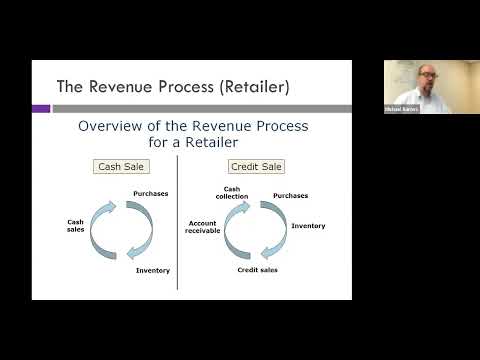
- Barnes introduces the revenue process as the first foundational business process, alongside purchasing, conversion, human resources, and financing and investing.
- The chapter applies auditing concepts learned earlier in the semester to specific business-process scenarios.
- ASC 606, introduced by ASU 2014-09, established a consistent GAAP revenue-recognition model across industries.
- The five steps are identify the customer contract, identify performance obligations, determine the transaction price, allocate the price to obligations, and recognize revenue when obligations are satisfied.
- A Taco Bell meal illustrates a single, straightforward performance obligation, while a Boeing aircraft may involve milestones over an extended construction period.
- Side agreements can make a sale conditional on arrangements outside the apparent transaction, such as reciprocal buying between a company and its vendors.
- Channel stuffing inflates period-end sales by shipping unwanted goods to customers and processing their returns in the next period.
- Related-party sales may use non-arm's-length terms and must be disclosed; auditors should assess whether favorable treatment signals fraud.
- Bill-and-hold schemes recognize revenue before goods ship, such as recording a customer's January order in December.
- Barnes focuses on business-to-business credit sales because they create accounts receivable and require assessment of customer payment.
- Sales discounts apply at the point of sale, while cash discounts such as 1/10, n/30 reward payment within 10 days and are recognized when cash is received.
- Returns reverse a sale when goods are sent back; allowances reduce the amount due while the customer keeps the goods.
- The allowance for uncollectible accounts centers on valuation, allocation, and accuracy, and the lecture treats bad-debt write-offs as a refresher rather than a major test topic.
- A customer's purchase order typically initiates the process and is converted into the seller's internally generated sales order.
- Key records include the sales invoice, customer statement, remittance advice, and cash-receipt documentation.
- A remittance advice identifies how much a customer is paying, whether attached to a paper check or associated with an electronic payment.
- The process includes order entry, credit authorization, shipping, billing, cash receipts, accounts receivable, and general-ledger recording.
- Order entry, billing, accounts receivable, and the general ledger are recording functions; credit approval is authorization, while shipping and cash handling involve custody.
- Segregate credit authorization from billing and shipping from billing to reduce unauthorized credit, bad debts, and misrecorded shipments.
- Separate cash receipts from accounts receivable, and use the subsidiary ledger and general ledger as redundant recording layers that can help detect errors.
- Four inherent-risk factors are industry conditions, complexity or contentiousness of revenue recognition, audit difficulty, and misstatements found in prior audits.
- For high-volume revenue, auditors generally use a reliance strategy and test controls rather than examining every transaction individually.
- Control assessment links a risk and management assertion to a client control and an appropriate test of that control.
- For fictitious sales, segregation of duties can support existence and occurrence; auditors can observe responsibilities and reperform relevant checks.
- For stolen or unrecorded cash receipts, a bank lockbox limits employee access; inquiry about the policy should be supplemented by testing such as reperformance.
- Revenue analytics are generally limited to trend and ratio analysis, which can direct further testing but often provide limited assurance by themselves.
- Existence and occurrence testing addresses fictitious customer balances; valuation, allocation, and accuracy testing assesses net realizable value and the allowance for uncollectible accounts.
- Rights and obligations testing considers factoring: receivables sold to a third party should not remain recognized by the entity.
- Presentation and classification work checks disclosures, material credit balances, and whether short-term and long-term receivables are properly classified.
- Cutoff procedures verify that accounts-receivable revenue transactions are recorded in the correct period.
- For asset confirmations such as accounts receivable, the primary assertion is usually existence and occurrence; liability confirmations more often focus on completeness.
- A positive confirmation requests a response whether the reported balance is correct or not, while a negative confirmation requests a response only when it is incorrect.
- Positive confirmations provide stronger evidence; negative confirmations are appropriate only when minimal assurance is sufficient, balances are small, and recipients are likely to consider the request.
- Auditors should send requests early, maintain control of their delivery and return, track responses, and investigate each exception.
- A timing difference, such as a customer paying after the balance date, can resolve with time and is not necessarily an exception.
- Differences such as a fictitious sale, goods shipped to the wrong customer, or an order the customer did not place require auditor investigation.
- For confirmation nonresponses, alternative procedures include examining subsequent cash receipts, shipping documentation, and other client records.
- Barnes closes by emphasizing that confirmation evidence must be evaluated in relation to the assertion being tested.
Transcript excerpt
0:02 All right, guys. I'm going to go ahead and start because I have been woefully unsuccessful at getting through this chapter in the past two semesters. I've always left content on the table. So, we're going to start, but I do want to give you a few announcements real quick. So, just a reminder, the True Business Forum is taking place on Wednesday at 4:00 p.m. Um if you have not completed the extra credit activity, this is the last opportunity you have for that. So, please keep that in mind. Also, next Friday, your Excel assignment is due. If you have started that, great. If you have not started that, start that. Um please remember that if you have any questions or concerns, you can reach out to my GTRA with with with any issues you have. His email is on the instructions. Um there is a quick note about this. Uh I have given him authorization. If you If you wait till the last minute, first of all, don't wait till the last minute. But, if you do wait till the last minute
0:48 and ask him like five emails on Thursday night before the thing is due, I have authorized him to basically cut you off of answers and questions. So, if you If you do run into issues, please feel free to reach out to him or to me if you think it's particularly complex issue. But, please do not overload at the last minute and basically start sending emails at 11:00 12:00 o'clock in the night before. Um that's why I'm asking you to start to work on this now. I've already advised you that waiting till the last minute is not likely to be successful. So, please do not do that. Please make sure you get it done. Not a
This is the start of the transcript. Save this video free for the whole transcript, searchable and time-coded.
In this course
Related notes
Summary, takeaways, and chapters were generated by AI from the video's transcript and may contain errors. The video belongs to its creator, Michael Barnes.