ACCT 417 (Fall 2026) - Chapter 6 Homework
Overview
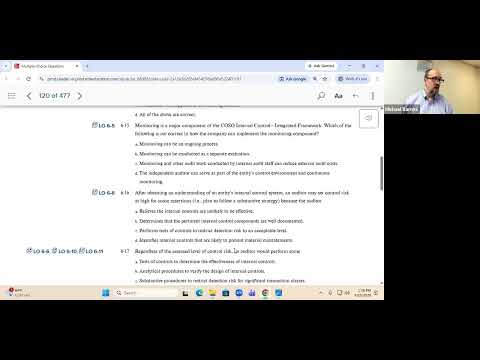
Michael Barnes reviews Chapter 6 audit homework on internal controls, control-risk assessment, interim substantive testing, and control testing. He applies the concepts to the $53 million Rita Crundwell fraud in Dixon, Illinois, the COS Corporation fraud, and purchasing voucher samples, emphasizing segregation of duties, audit evidence, and how control failures affect the audit plan.
Key takeaways
- Management is responsible for establishing and maintaining internal controls; auditors evaluate and test them rather than taking ownership of them.
- Strong controls can reduce substantive testing but cannot eliminate substantive procedures on account balances, and they cannot fully prevent collusion or management override.
- Rita Crundwell's Dixon fraud persisted because she controlled custody, authorization, and recording while operating with little supervisory review.
- Interim substantive testing must be supplemented for transactions and balance changes occurring between the interim date and year-end.
- A control deviation should be assessed alongside other controls addressing the same risk; redundant effective controls can support continued reliance and limit audit-plan changes.
- A SOC 1 Type 2 report evaluates service-organization control design and operating effectiveness over a period, whereas Type 1 reports on design at a point in time.
Chapters
- Michael Barnes explains that the Spire presentation ran beyond its planned 20 to 25 minutes, so the class watched a lecture afterward rather than shifting the schedule.
- Students seeking career-fair extra credit must email Barnes the names of people and companies they visited.
- Students who want to join a presentation group should contact Barnes, even if they only have a partial group.
- The audit control sequence links risks to management assertions, controls designed to address those risks, and auditors' tests of those controls.
- Management, not the internal auditor, is responsible for establishing and maintaining internal controls.
- Controls cannot eliminate collusion or management override, and effective controls cannot replace all substantive procedures on account balances.
- Cost-benefit analysis is a design constraint: a control costing far more than its expected benefit may not be worthwhile.
- Monitoring may be continuous or performed through separate evaluations; internal audit work can help reduce external audit effort.
- An external auditor cannot be part of the entity's control environment or monitor its controls, because that would require auditing the auditor's own work.
- Auditors can choose a substantive-only approach in an area, but they still perform substantive procedures; substantive analytical procedures are not mandatory.
- A SOC 1 Type 2 report covers whether service-organization controls are suitably designed and operating effectively over a period of time; Type 1 addresses design at a point in time.
- Cook CPA's example has a June 30 year-end and an August 1 report deadline, making interim fieldwork useful for completing the audit on time.
- Interim testing of account balances requires care because transactions between the interim date and year-end can change those balances.
- Control-test results inform control risk, which affects detection risk and the scope of substantive procedures.
- Auditors should test selected transactions from the remaining period and perform appropriate follow-up on controls tested at an interim date.
- Rita Crundwell, Dixon's finance official, stole about $53 million over roughly two decades through a secret bank account at Fifth Third Bank.
- She diverted city funds using false invoices and checks, then spent the money on horses, farms, a truck, jewelry, and a $2 million RV despite earning about $80,000 annually.
- The core control failure was lack of segregation of duties: Crundwell controlled custody, authorization, and recording, with little supervisory review.
- CliftonLarsonAllen agreed to pay $35 million in a settlement, while Fifth Third Bank paid $3.85 million; forged invoices contained visible problems such as missing letterhead and spelling errors.
- The COS Corporation case involved Michael Cost delegating CFO-type duties to Sue, who worked with Julie to disguise entries and maintain binders showing the company's underlying financial position.
- Controls requiring Michael Cost to approve invoices of $5,000 or more did not prevent unauthorized wire transfers and cashier's checks, some exceeding $100,000.
- Account reconciliations were often not prepared, maintained, or reviewed, and the computerized accounting system was nearly 30 years old.
- Sue's access across custody, authorization, and recording created major segregation-of-duties problems; board oversight and an internal audit function were also lacking.
- Collusion is an inherent limitation of internal controls, though the case's fraud also exploited weak controls that could have been improved through review and oversight.
- The purchasing exercise used four voucher packages to test five controls, including document completeness, supervisor approval, purchase-agent authorization, invoice accuracy, and paid stamps.
- The worksheet showed a sample of 75 items and allowed no more than one deviation before concluding a control was ineffective.
- Barnes notes that authorization is not a formal financial-statement assertion, and the purchasing controls may relate more directly to existence or occurrence.
- The voucher packages contained deviations in several controls, including supervisor approval, purchase-agent authorization, and matching invoice quantities to receiving reports.
- One package contained an invoice request rather than a vendor invoice, creating a judgment question because the client cannot directly control whether a vendor sends an invoice.
- An invoice request may be an acceptable substitute if the client's documented procedures allow it; otherwise, the missing invoice could count as a deviation.
- The class concludes that most purchasing controls operated effectively, while one control showed a failure that could increase control risk in that area.
- A single failed control does not automatically invalidate reliance on all controls when another control addresses the same authorization risk and is operating effectively.
- Barnes recommends improving the deficient control but expects only minor audit-plan changes because the related controls provide a redundant check.
Transcript excerpt
0:00 the best news. Well, no. >> All right, we got a lot to talk about today, so I'm going to go ahead and get started. Uh, first I wanted to talk about Wednesday. Um, so I want to say that I thought that the presentation was really good and I really appreciate Spire's contributions to Truman State. They are always here for meet the firms and for the career expo. And Andy is a big supporter. That being said, my personal experience the past few years with Andy is that if you let him talk, he will talk forever. And I told him in advance, I said, "I give you about 20 25 minutes for the class." And he he uh he and Megan basically ran with that and they just did not pay attention to the time. And I was hard. I was just really frustrated in the back because I was not angry at them, but I was just like, I'm either going to have to interrupt them and tell them to get out or I'm just going to have to do something after. And
0:46 I kind of was a little bit more diplomatic with that. But uh yeah, they apologized profusely to me afterwards saying they didn't realize the time was so much. I think they thought it was a full hour and so that's why they were going on. So I apologize for throwing the uh lecture with you afterwards. My thought with that was I promised you all that you would get the Monday off after fall break and uh I I could have moved everything back a day and then just filled it with that. So you were going to have to watch a lecture on one of those two days. It was either going to
This is the start of the transcript. Save this video free for the whole transcript, searchable and time-coded.
In this course
Related notes
Summary, takeaways, and chapters were generated by AI from the video's transcript and may contain errors. The video belongs to its creator, Michael Barnes.