ACCT 417 (Fall 2026) - Chapter 6 Part 2 Lecture
Overview
Michael Barnes explains how auditors assess control risk by identifying and testing specific controls, then using the achieved control-risk assessment to set detection risk and plan substantive procedures. He connects the Spire Energy presentation to interim control testing, service-organization SOC 1 reports, and the control-deficiency classifications that lead into Chapter 7.
Key takeaways
- Auditors who assess control risk below high must identify and test the specific controls they intend to rely on, then document results and determine the achieved control-risk level.
- A walkthrough follows a transaction from its initial entry into a client’s financial system through its appearance in the financial statements, helping auditors understand how the process operates end to end.
- Control-risk conclusions affect detection risk and therefore shape the nature, timing, and extent of substantive audit procedures.
- Interim control testing can improve scheduling and give management time to remediate deficiencies, but auditors still need selected procedures to establish whether controls continued operating through year-end.
- A SOC 1 Type 1 report evaluates control design at one point in time, while a SOC 1 Type 2 report evaluates both design and operating effectiveness over a period of at least six months.
- Control deficiencies are classified as control deficiency, significant deficiency, or material weakness, with a material weakness indicating a problem serious enough to create the possibility of material misstatement.
Chapters
- Auditors identify controls they plan to rely on, test those controls, document results, and conclude on the achieved level of control risk.
- If control risk is assessed below high, the auditor must adopt a reliance strategy and test the selected controls.
- Inspection, observation, inquiry, and reperformance are control-testing methods; a walkthrough traces a transaction from entry into the system through its inclusion in the financial statements.
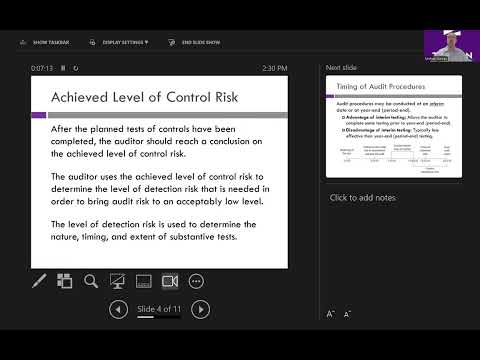
- Achieved control risk informs detection risk, which guides the nature, timing, and extent of substantive procedures.
- Interim testing lets auditors complete some work before year-end; the Spire Energy presentation described testing at interim and rolling work forward to period-end.
- A calendar-year audit may begin planning earlier, test controls around month seven, and start some substantive procedures around month eleven before year-end work is completed.
- Auditors may test controls at interim when an assertion is less significant, prior-year results support reliance, or scheduling makes interim work more efficient.
- Interim results do not establish that controls operated effectively through year-end: auditors perform selected follow-up procedures for the remaining period, and early testing can give management time to remediate deficiencies.
- Outsourced accounting services, such as payroll processing, become part of a client’s financial-reporting control system and require audit consideration.
- A SOC 1 Type 1 report addresses the design of controls over financial reporting at a point in time; a SOC 1 Type 2 report covers design and operating effectiveness over a period, at least six months.
- Under SOX 2002, managers of public companies assess internal control over financial reporting using the categories control deficiency, significant deficiency, and material weakness.
- A control deficiency is the lowest-level problem, a significant deficiency is more serious, and a material weakness is serious enough to create the possibility of a material misstatement.
Transcript excerpt
0:01 Hello everyone. I'm recording this just immediately after the Spire Energy presentation. I thought it was a great presentation. I hope you all got a lot out of it. It did not leave us any time to go over the chapter 6 materials. So, I'm left with a couple of options. The first option is to move back our schedule and just do this lecture on Friday and then do start chapter 7 next Wednesday. That would put us a little bit back and put us off. We do technically have an open class period during the Monday after fall break when I will be absent. But I had told you all that we would leave that open so that you wouldn't have anything to do. So it's a question of whether you want to watch this short video or have me record a much longer video and I assume that you wanted to do the latter. So that's why I'm going with the second op. Second option is having you all watch this video and staying on schedule. I promise
0:49 not to take up too much of your time but there are some important concepts we need to go over. So let's go ahead and continue our discussion about the uh controls uh internal control on a financial statement audit. Now, just as a reminder, and I'm going to go ahead and uh bring up a piece of information that uh I uh should have had open already, but uh just to recall, one of the things that we had with respect to internal controls that we had talked about was the control sequence, which was this incredible diagram that I put together that says that we characterize risk associ associated as they are with management associations or management
This is the start of the transcript. Save this video free for the whole transcript, searchable and time-coded.
In this course
Related notes
Summary, takeaways, and chapters were generated by AI from the video's transcript and may contain errors. The video belongs to its creator, Michael Barnes.