ACCT 417 (Fall 2026) - Exam 2 Review
 Watch on YouTube →
Overview
Michael Barnes outlines ACCT 417 Exam 2, a 12-question multiple-choice test plus two problems: one focused on Chapter 18 audit reports and another emphasizing Chapters 6 and 7. The review prioritizes internal-control frameworks and deficiencies, audit sampling, subsequent events, attestation, and a 12-point spot-the-errors exercise on a disclaimer report.
Key takeaways
- The exam contains 12 multiple-choice questions and two problems; the final Chapter 18 problem is worth 12 points, or 20% of the exam.
- A material weakness is the only ICFR deficiency that leads to an adverse opinion; reporting extends from management and the audit committee to external users.
- For control sampling, compare the upper deviation rate, calculated as sample deviation rate plus sampling-risk allowance, with the tolerable deviation rate.
- Type 1 subsequent events require adjustment because the underlying condition existed at the balance-sheet date; Type 2 events require financial-statement disclosure and sometimes pro forma statements.
- A disclaimer report cannot state that the auditor is responsible for expressing an opinion, and it omits the scope paragraph while explaining the basis for the disclaimer.
- A substantive strategy skips tests of controls, but auditors must still understand controls; lowering assessed control risk requires a reliance strategy and control testing.
Chapters
0:00
Exam 2 Format, Question Counts, and Problem Priorities
- The exam has 12 multiple-choice questions: 1 on the professional judgment framework, 3 on Chapter 6, 2 on Chapter 7, 1 on Chapters 8 and 9, 2 each on Chapters 17 and 18, and 1 on Chapter 21.
- The final problem is entirely Chapter 18 and resembles the practice exam's audit-report exercise.
- The preceding problem emphasizes Chapters 6 and 7, with possible overlap into Chapters 8 and 9, 17, and 21.
3:20
Professional Judgment and Chapter 6 Control Fundamentals
- Distinguish four professional judgment tendencies, especially confirmation bias from anchoring: anchoring relies on a quantitative reference point.
- The COSO 2013 framework has reporting, operations, and compliance objectives; reliability of financial reporting is most relevant to a financial-statement audit.
- Know all five internal-control components and their sequence: control environment, risk assessment, control activities, information and communication, and monitoring.
- A substantive strategy relies on substantive procedures without testing controls; a reliance strategy requires control testing and is necessary to assess control risk below high.
- Segregation of duties separates custody of assets, authorization, and recording, summarized as CAR; internal controls also face inherent limitations.
8:40
Chapter 7: Classifying Deficiencies and Auditing ICFR
- A remote likelihood of failure means no deficiency; a reasonably possible issue begins the classification process, and magnitude distinguishes a significant deficiency from a material weakness.
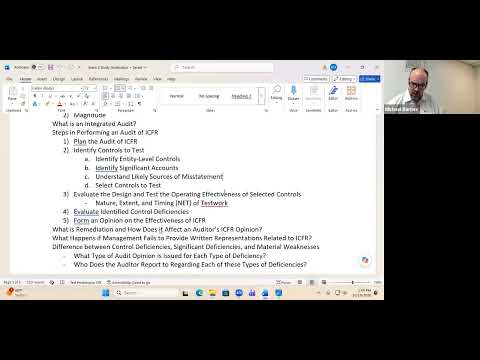
- The five-step ICFR audit process is examinable, with evaluating identified control deficiencies highlighted as the most important step.
- A control deficiency is reported to management; a significant deficiency goes to management and the audit committee; a material weakness is also externally reported.
- ICFR opinions are unqualified for control or significant deficiencies and adverse when a material weakness exists; a disclaimer applies when the auditor lacks enough information to assess ICFR.
- For control testing, know five evidence types and what each can demonstrate.
12:55
Chapters 8 and 9: Attribute Sampling and Control Effectiveness
- Sampling risk and confidence level are complements that total 100%; attribute sampling is used mainly for tests of controls.
- Calculate sample deviation rate as deviations divided by sample size, then add the allowance for sampling risk to obtain the upper deviation rate.
- Compare the upper deviation rate with the tolerable deviation rate: the control is effective when the upper rate is lower.
- A lower tolerable deviation rate generally requires a larger sample; a higher sampling risk means lower confidence and generally a smaller sample.
17:25
Chapter 17: Subsequent Events and Going Concern
- A Type 1 subsequent event concerns conditions existing at the balance-sheet date and requires adjustment of the financial statements.
- A Type 2 event concerns conditions arising after the balance-sheet date and requires financial-statement disclosure, with pro forma statements when appropriate.
- Dual dating limits auditor liability; changing the report date to the subsequent-event date extends the period covered by the auditor's responsibility.
- For going concern, assess whether substantial doubt exists, evaluate management's plans, and disclose remaining substantial doubt in the report; the issue alone does not change the opinion if properly disclosed.
- If new facts arise after the report and the client refuses further testing, notify the client not to rely on the report, alert the appropriate regulator such as the SEC, and notify report users.
22:20
Chapter 18: Audit Report Wording and Opinion Changes
- Learn the eight elements of the standard unqualified report and be prepared to identify errors in a PCAOB-style report.
- The sole modified-wording case discussed is reliance on another auditor's work without accepting responsibility; change the opinion and basis-for-opinion sections, and add an explanatory paragraph for a PCAOB report.
- Explanatory paragraphs address an ICFR audit, going concern, consistency or comparability issues, and other emphasis matters such as related-party transactions.
- A qualified opinion can result from a material GAAP departure or material scope limitation; an adverse opinion requires a pervasive GAAP departure.
- A disclaimer results from a pervasive scope limitation or lack of auditor independence; pervasive means the matter significantly affects the financial statements.
28:40
Chapter 21 Attestation and Practice Questions on Control Risk
- Review the three Chapter 21 tables: engagement assurance, attestation risk, report type and distribution; services matched to engagement types; and assurance-service requirements.
- For each assurance category, know whether independence and a report are required and what level of assurance is provided.
- An auditor must understand controls in every audit area, even when choosing a substantive strategy instead of testing controls.
- Assessing control risk below high requires a reliance strategy and evidence from control testing; an auditor can assess inherent risk but cannot change it.
- Interim control testing can spread audit work across the year, but it generally provides less assurance than testing near year-end.
28:45
Practice Questions: ICFR Steps, Deficiency Reporting, and Sampling
- The ICFR planning question distinguishes identifying controls to test from forming an opinion, which occurs after testing is complete.
- A significant deficiency must be reported to management and the audit committee; a material weakness is also reported externally.
- In attribute sampling, increasing the tolerable deviation rate narrows the acceptable control-failure threshold and can increase the required sample size.
- For an upper deviation rate, add the sample deviation rate to the allowance for sampling risk; a 7.5% upper rate is acceptable against an 8% tolerable rate, but an 8% upper rate fails against a 6% tolerable rate.
35:59
Attestation Examples, Subsequent Events, and Control-Testing Practice
- The phrase “not aware of any material modifications” signals a review, which provides negative or limited assurance; audits and examinations provide reasonable assurance, while agreed-upon procedures provide none.
- Inspection of guarantees, board minutes, and bank confirmations can help identify contingent liabilities; attorney letters mainly corroborate known matters rather than identify undiscovered liabilities.
- A lawsuit settlement that confirms a condition existing at the balance-sheet date is a Type 1 event and requires financial-statement adjustment.
- For another auditor's work, accepting no responsibility triggers modified wording, changes to the opinion and basis-for-opinion sections, and an explanatory paragraph in a PCAOB report.
- The annual report's other information must be read for consistency with the audited financial statements.
39:10
Control Sequence, Sampling Calculations, and the 12-Point Report Challenge
- The control sequence connects organizational risks to management assertions, controls designed and implemented in response, and the auditor's duty to understand and test those controls.
- The three internal-control limitations are management override, human errors and mistakes, and collusion that bypasses segregation of duties.
- Practice calculations show 3% deviations plus a 4.5% sampling allowance equals a 7.5% upper rate, effective against an 8% tolerance; 4% plus 4% fails against 6%; and 3% plus 4.2% passes against 9%.
- The 12-point, 20%-of-exam report exercise identifies five errors in a disclaimer report: replace “we have audited” with “we were engaged to audit,” add the reason for the modified opinion, remove the sentence claiming responsibility to express an opinion, omit the scope paragraph, and include the report date.
- Read the report exercise's notes carefully because deliberately excluded report elements should not be counted as errors.
Summary, takeaways, and chapters were generated by AI from the video's transcript and may contain errors. The video belongs to its creator, Michael Barnes.