ACCT 417 (Fall 2026) - Exam 1 Review
Overview
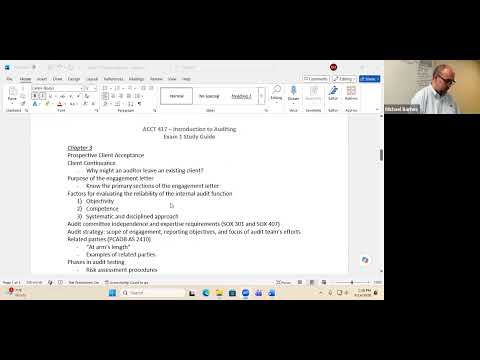
Michael Barnes reviews ACCT 417 Exam 1, outlining its 12 multiple-choice questions and one 24-point, multi-part problem, which draws mainly from Chapters 4 and 5. He emphasizes understanding management assertions, audit phases and evidence, materiality, fraud, and the audit risk model, then works through practice questions on engagement planning, evidence selection, analytical procedures, and risk relationships.
Key takeaways
- The exam has 12 multiple-choice questions and one multi-part problem worth 24 of 60 points, with the problem focused mainly on Chapters 4 and 5.
- Planning materiality separates the quantitative base, such as pretax income or total assets, from qualitative factors that change the percentage; the general tolerable-difference guideline is 5% of the recorded amount.
- Inherent risk and control risk form risk of material misstatement, which drives detection risk; lower acceptable detection risk means the auditor must perform more testing.
- Risk-assessment procedures use inspection of records and documents, observation, inquiry, and preliminary analytical procedures, while substantive analytical procedures rely on analytical evidence.
- Vouching tests existence or occurrence by moving from recorded entries to source documents, whereas tracing tests completeness by moving from source documents into the accounting records.
- Management prepares financial statements and creates controls; auditors are responsible for testing both, with assertions tested specifically during tests of controls and substantive procedures.
Chapters
- Bring a pencil, eraser, and calculator; the exam has 12 multiple-choice questions and one multi-part problem worth 24 of 60 points.
- Question distribution: Chapters 1 and 2 have one each, Chapter 3 has four, and Chapters 4 and 5 have three each; the problem focuses mainly on Chapters 4 and 5.
- Information asymmetry is the defining feature of the principal-agent relationship that creates the need for auditing.
- Know what management assertions mean and how auditors use them; transaction assertions exclude rights and obligations, while account-balance assertions exclude cutoff and authorization.
- The four audit phases introduced are planning, risk assessment, tests of controls, and substantive procedures; assertions are specifically tested in the latter two.
- Chapter 2 concepts to recognize include due professional care, professional skepticism, and reasonable assurance.
- An engagement letter covers audit objectives, management responsibilities, and auditor responsibilities; management creates controls and financial statements, while auditors test them.
- For prospective-client acceptance, predecessor-auditor inquiries are a planning task; Barnes recommends reviewing Chapter 3, slide 11, on audit strategy and plan.
- Auditors may leave an existing client because of contentious disagreements or disputes over audit fees; related-party transactions are not at arm's length.
- Distinguish the quantitative base for planning materiality, such as pretax income or total assets, from qualitative risk factors that adjust the percentage.
- Inherent risk and control risk combine as risk of material misstatement; the auditor sets detection risk and adjusts testing in response.
- Higher detection risk means greater tolerance for undetected misstatement and less work, while lower detection risk requires more audit work.
- Risk-assessment evidence includes inspection of records and documents, observation, inquiry, and preliminary analytical procedures; this work does not yet directly test assertions.
- Distinguish errors from intentional fraud, including fraudulent financial reporting and misappropriation of assets.
- Know factual, judgmental, and projected misstatements, and recognize the fraud triangle's pressure, opportunity, and rationalization factors; auditors can most directly affect opportunity.
- Communicate fraud to the audit committee and the next higher management level, escalating directly to the audit committee when senior management is involved.
- Substantive procedures follow risk assessment and tests of controls, and divide into substantive analytical procedures and tests of details; assurance gained earlier can reduce later work.
- Inspection of records and documents, observation, and inquiry can be used across phases; tests of controls also commonly use reperformance, and a walkthrough combines evidence-gathering techniques.
- Substantive analytical procedures use analytical evidence, while tests of details can use the other evidence types; evaluate evidence reliability and the assertions each procedure addresses.
- Vouching moves from recorded items to supporting documents to test existence or occurrence; tracing moves from source documents into records to test completeness.
- Audit documentation supports the report, helps plan and supervise audit work, and provides a basis for review; Barnes also highlights workpaper formats and tick marks.
- Practice preparing an analytical procedure like the in-class interest-expense example; a familiar calculation such as depreciation may also be used with criteria supplied.
- Use a tolerable difference, generally 5% of the recorded amount, to assess whether an analytical expectation is close enough to the reported balance.
- Practice questions review audit-opinion terminology, AICPA's Code of Professional Conduct, internal-audit reliability factors, audit committees, and planning materiality.
- A sales test for whether transactions were recorded in the proper period tests cutoff, a transaction assertion.
- For property, plant, and equipment existence, inspection of tangible assets is the strongest fit; recalculation is highly reliable but tests valuation, accuracy, and allocation rather than existence.
- Vendor confirmations for accounts payable are substantive procedures in the course framework, not risk-assessment procedures or tests of controls.
- Barnes distinguishes a financial-services firm or mutual fund, where total or net assets may be a better materiality base than pretax income, from risk factors that adjust the percentage.
- The analytical-procedure example builds an expected amount from activity and rate assumptions, then compares it with the recorded amount using the 5% tolerable-difference guideline.
- The four audit-risk-model components are audit risk, inherent risk, control risk, and detection risk; audit risk is the chance of issuing an inappropriate opinion when statements are materially misstated.
- Inherent risk arises from the entity's operations, control risk remains after controls are implemented, and detection risk concerns misstatements audit procedures fail to detect.
- Examples classify weak petty-cash supervision as control risk, omitted receivable confirmations as detection risk, inventory exposure and rapid industry change as inherent risk, and an unsupported unqualified opinion as audit risk.
Transcript excerpt
0:02 All right, guys. Wednesday's the day. So, let's go ahead and get started. So, we got a lot to talk about and I'm going to go through it quick. As always, if I go through something or if I fail to go through something you want more uh clarification on what I'm asking about, please raise your hand and ask about it. So, let's just go ahead and talk about the uh basics to start up. So, I strongly recommend that you bring a pencil and eraser. Is it possible to complete this exam via pen? Yes. Is it a good idea? Probably not. Most people will erase and change something. You have to change one of your multiple choice questions and then second guess and say no, my original question is correct. It's a little bit gets a little bit awkward after time. So pencil and eraser are what I recommend. Um I recommend that you also bring a calculator. There will be simple computational questions, but you may not want to waste time doing the hand or do it by long hand. Um I will not exclude
0:50 you from using graphing calculators. That being said, please keep in mind I will be watching for the amount of time that you're using on your calculators. There's only one or two questions that require computations. And if you're constantly referring to your calculator, I may get a little bit suspicious. Sounds like a joke, but uh that actually happened a few years ago is that somebody was referring to their calculator quite a bit during the exam. It was actually an exam where there were no computations. So, uh pretty obvious something weird is going on. Um that being said, if you really want to go through the effort of putting all this
This is the start of the transcript. Save this video free for the whole transcript, searchable and time-coded.
In this course
Related notes
Summary, takeaways, and chapters were generated by AI from the video's transcript and may contain errors. The video belongs to its creator, Michael Barnes.