ACCT 417 (Fall 2026) - Exam 3 Review
Overview
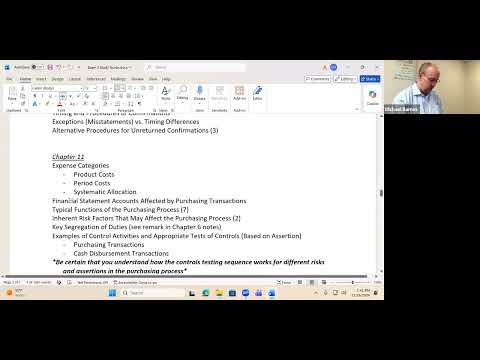
Michael Barnes reviews ACCT 417 Exam 3, outlining a 12-question multiple-choice section and two problems covering Chapters 10 through 16, professional conduct, audit controls, and substantive procedures. He emphasizes applying management assertions, separating incompatible duties, matching controls and tests to risks, and working through practice questions on revenue, payables, payroll, inventory, cash, dividends, and audit strategy.
Key takeaways
- For asset accounts such as cash, existence is a primary assertion; for liability accounts such as accounts payable, completeness is primary, guiding the direction of audit testing.
- To test completeness of purchases, begin with source documents such as receiving reports and trace them into the records; to test occurrence of recorded revenue, vouch sales to evidence such as shipping documents.
- Positive confirmations are substantive procedures, not tests of controls; unanswered requests can be followed up with subsequent cash receipts, shipping records, or client receivables documentation.
- A substantive strategy skips tests of controls and is often efficient for low-volume accounts such as PP&E, investments, long-term debt, and equity; a reliance strategy requires tests of controls.
- Auditors observe the client’s inventory count but also perform their own test counts, because reperformance provides stronger evidence than observation alone.
- Dividend audit procedures should be mapped to assertions: confirming or tracing payments addresses completeness, while agreeing amounts to board authorization or recomputing them addresses valuation, allocation, and accuracy.
Chapters
- Bring a pencil and eraser; a calculator is optional because Michael Barnes expects no computational questions.
- The exam has 12 multiple-choice questions, including one on the AICPA Code of Professional Conduct, with roughly two questions per covered chapter section.
- Two problems are planned: one on controls similar to the practice exam, and another with conceptual questions from Chapters 10 through 16.
- Match primary assertions to account types: cash, an asset, emphasizes existence, while accounts payable, a liability, emphasizes completeness.
- Review the audit evidence and procedure categories; Barnes says scanning in the old study guide is obsolete.
- Apply the three incompatible duties, custody, authorization, and recording, to scenarios rather than merely memorizing their names.
- The exam’s professional-conduct question will focus on the independence rule and material following it; know covered-member rules and related immediate or close family restrictions.
- Threatened litigation can impair independence, while unpaid audit fees become a problem when they remain outstanding for more than a year.
- Know all four Chapter 10 revenue-recognition fraud risks, including related-party transactions, and distinguish the specific examples Barnes discussed.
- Study the six control tables and the sequence linking risk, assertion, control activity, and test of controls; Barnes expects both a problem and multiple-choice questions from them.
- Relate substantive tests of details to assertions, and distinguish positive from negative confirmations, true exceptions from timing differences, and the three alternatives for unreturned confirmations.
- For unrecorded liabilities, compare period-end vendor balances with subsequent cash payments; an overpayment suggests a possible liability but does not prove one exists.
- For payroll, identify risks such as fictitious employees or paying valid employees for hours not worked, and match the control test to the separation of time-sheet authorization from payroll recording.
- The client performs the inventory count; auditors observe, evaluate the client’s procedures, and perform test counts as reperformance.
- Inventory tests should align with assertions: floor-to-sheet testing addresses completeness, while sheet-to-floor testing addresses existence or occurrence.
- Review the additional inventory considerations slide and the Chapter 13 control table, as Barnes has tested these topics on past exams.
- For a fixed-asset roll-forward, validate the ending balance by testing period additions and disposals, while also considering depreciation and leasing.
- Inherent risk for PP&E, long-term debt, and stockholders’ equity can depend on complexity: a simple bond may be low risk, while a hybrid instrument with difficult valuation may be higher risk.
- A substantive strategy skips control testing and obtains assurance through substantive procedures; it can suit low-activity accounts such as PP&E, investments, debt, and equity.
- A reliance strategy requires tests of controls and is often used for high-volume accounts such as cash, receivables, payables, and inventory.
- Dividend testing targets completeness and valuation, allocation, and accuracy: confirmation or tracing supports completeness, while agreement to board authorization or recomputation supports valuation.
- Cash testing uses the year-end bank reconciliation, a standard bank confirmation, and a cutoff bank statement to verify that reconciling items cleared after year-end.
- Review segregation of duties for investment transactions and the front end of the Chapter 16 EWC assignment.
- Barnes identifies three possible control-problem combinations: revenue and cash receipts, purchasing and cash disbursements, or human resources, payroll, and inventory.
- Study all six control tables even if one process appeared on the practice exam, since Barnes may reuse a process or test it in multiple-choice questions.
- A manager’s threatened client litigation can impair independence; a country-club membership with client executives does not automatically do so.
- To detect fictitious revenue, identify occurrence as the relevant assertion and vouch recorded sales to shipping documents, stronger evidence that goods were actually sent than an invoice alone.
- For unanswered positive receivables confirmations, alternatives include examining subsequent cash receipts, shipping documentation, and client accounts-receivable records.
- Confirmations are substantive procedures, not tests of controls; once substantive testing identifies an issue, the audit sequence does not simply return to control testing.
- An accounts-payable manager who issues purchase orders combines recording with authorization; completeness testing starts from receiving reports and traces them into the accounting records.
- For inventory observation, ensure movement and production stop during the count; observation is less reliable than auditor-performed test counts, which are reperformance.
- Match purchases and disbursement controls to assertions: numerical check sequencing supports completeness, receiving reports forwarded daily support cutoff, and a chart of accounts supports classification.
- Cash often lacks a predictable relationship with other accounts because many transactions affect it, making analytical procedures less suitable than for some income-statement accounts.
- A reliance strategy requires testing controls; a substantive strategy is often more efficient for accounts with few transactions, and dividend procedures should be evaluated by the assertions they address.
Transcript excerpt
0:05 Hello and welcome everyone. >> It's time for exam three review. >> Yeah. >> They're saying time for our exam three review. I I spent a few minutes before class plugging questions into chat GPT to see how the performance was. I got into an argument with chat GPT over some of the stuff in here. So, uh, keep in mind that even if ChatGpt may be right, that as far as this this classroom goes, I am always right. All right? So, even if you think what I'm saying is wrong, the answer that's going to be on the exam that's going to be correct is going to be my answer. It was actually really really minor details, but we got into some arguments about which assertions were relevant in very big situations and it led to some interesting conversations
0:54 that we're actually to the point now that chat GPT no longer is on the trial and error basis where it will come back and say, "Oh, you're absolutely right. Let me correct that." It's now saying, "No, you're wrong. I don't care if you're a tenure professor that's been teaching this stuff for 10 years. You're dead wrong." So, we'll take a little bit of offense to that. All right, let's go ahead and talk a little bit about the uh context that we're going to be coming up with. So, oh, I guess I probably should mention, so um today is our exam review. Wednesday is our exam. Friday, I want to be very clear about this. I will be in the classroom. You are not required to be here. We're not going to do the exam review on Friday. We're going to save that until you all get for Thanksgiving break. I will post the information up.
This is the start of the transcript. Save this video free for the whole transcript, searchable and time-coded.
In this course
Related notes
Summary, takeaways, and chapters were generated by AI from the video's transcript and may contain errors. The video belongs to its creator, Michael Barnes.