ACCT 417 (Fall 2026) - Professional Judgment Framework
Overview
Michael Barnes explains why accounting professionals need deliberate judgment rather than random choices or habitual shortcuts, connecting critical thinking with the KPMG Professional Judgment Framework. He covers judgment traps, perspective-taking, four tendencies that can distort audit decisions, and six characteristics of professional skepticism that help counter them.
Key takeaways
- A decision is not necessarily a judgment: a coin toss selects an outcome, while professional judgment requires assessing objectives, alternatives, and evidence.
- Auditors should investigate beyond readily available information and actively seek evidence that could contradict their initial view of a client's financial statements.
- Premature conclusions can cause lasting harm: Richard Jewell was wrongly treated as a leading suspect after the Atlanta Olympics bombing despite helping save people.
- Before solving a business problem, verify its cause: Axis Snack Company focused on packaging when smaller competitor portion sizes explained lost market share.
- Availability, confirmation, overconfidence, and anchoring tendencies can each distort professional conclusions, so skepticism must include questioning, withholding judgment, and searching for knowledge.
- Considering multiple perspectives improves judgment: the six blind men each described part of an elephant correctly, but none had enough information to describe the whole.
Chapters
- Barnes compares headlines from CNN, Huffington Post, and Blaze Media to show how the same political event can be framed from different perspectives.
- He distinguishes intelligence, meaning information a person possesses, from common sense, meaning the ability to apply it.
- Effective learning requires explaining accounting assertions and applying them, not simply memorizing their wording.
- A coin flip can produce a decision, but it does not apply judgment techniques, as the Maxwell's-versus-Taco Bell lunch example illustrates.
- The KPMG Professional Judgment Framework proceeds through clarifying issues and objectives, considering alternatives, evaluating information, and reaching a conclusion with a rationale.
- People rely on heuristics for routine choices, such as getting out of bed, but consequential decisions may require a more deliberate process.
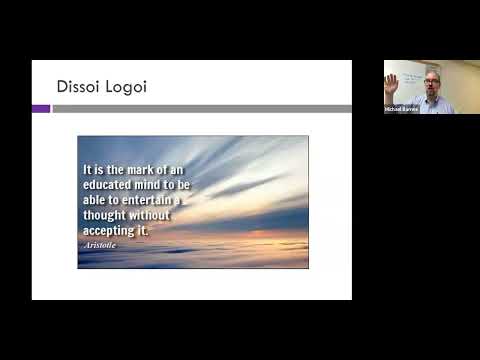
- Barnes uses dissoi logoi, the practice of arguing both sides of an issue, to illustrate how people can understand a viewpoint without accepting it.
- The rush to solve can lead to damaging conclusions before the evidence is complete; after the 1996 Atlanta Olympics bombing, Richard Jewell was wrongly treated as a leading suspect despite helping evacuate people.
- Eric Rudolph was ultimately identified as the bomber, illustrating the consequences of rushing to judgment about Jewell.
- Axis Snack Company lost market share and spent money on rebranding before research showed that Bob's Goodies competed with smaller portion sizes.
- Barnes warns against fixing an assumed cause without investigating other plausible explanations for the problem.
- In the parable of the six blind men and the elephant, each person describes one part accurately but misses the whole, showing why decisions need a broader view.
- Georges Seurat's A Sunday Afternoon on the Island of La Grande Jatte illustrates how individual dots make sense as part of the complete painting.
- A fresh lens means setting aside personal assumptions, similar to the advice to walk a mile in someone else's shoes.
- Barnes compares fresh perspective to cleansing a sushi palate between flavors, so one experience does not color the next judgment.
- Availability tendency uses only readily accessible information, which may leave auditors without evidence relevant to a sound conclusion.
- Confirmation tendency favors evidence supporting an existing belief, such as assuming financial statements are fairly stated and overlooking contradictory audit evidence.
- Overconfidence tendency exaggerates personal knowledge; the Dunning-Kruger discussion highlights how people mistake society's accumulated knowledge for their own understanding.
- Anchoring tendency keeps judgments too close to an initial number, such as a $400 price making a $4 price seem like a bargain or influencing salary negotiations.
- Barnes lists six skepticism characteristics: a questioning mind, suspension of judgment, active search for knowledge, interpersonal understanding, autonomy, and self-esteem.
Transcript excerpt
0:00 Good morning, everyone. So, I've heard there's a lot of test taking going on this week. I guess you all are ready for the weekend. All right. Well, I hope to not stand too much between you and the weekend. We will go over the exams at the end of class. I can't do it at the beginning of class cuz I found out historically that if I don't do my lecture first, then basically everything gets ignored once the exams are handed out. So, uh we're going to talk about some stuff um today, then we'll talk about the exams. Uh So, this topic is one that is near and dear to my heart. I used to spend two full class days talking about it. I really wish I could continue doing that. There's just so much coverage that we have to go over now that that's kind of why I limit it to like half a class session. That being said, it's it's it's relevant and it's been relevant for a very long
0:47 time. It's starting to become more relevant um over time. I've been really fascinated with the concept of learned helplessness as of late. Um something I've been looking at for research purposes. And um this kind of correlates to this idea of professional judgment and what we're going to be doing. Basically, in the realm of learned helplessness, and that idea is that the best way to avoid learned helplessness is to learn how to think critically and solve problems on your own. And that's going to be something we're going to talk about. Um this is not a critical thinking per se course. It This course definitely involves critical thinking, but it's not designed to be just about critical thinking, which is why we don't
This is the start of the transcript. Save this video free for the whole transcript, searchable and time-coded.
In this course
Related notes
Summary, takeaways, and chapters were generated by AI from the video's transcript and may contain errors. The video belongs to its creator, Michael Barnes.