ACCT 417 (Fall 2026) - Chapter 6 Part 1 Lecture
Overview
Michael Barnes introduces the COSO Internal Control Integrated Framework and explains how its five components help organizations respond to risk and auditors assess controls. The lecture connects control design and operating effectiveness to audit strategy, including when to use substantive procedures versus rely on tested controls, and explains why management override, human error, and collusion limit what controls can guarantee.
Key takeaways
- COSO’s five components are control environment, risk assessment, control activities, information and communication, and monitoring; management owns control design, implementation, and maintenance.
- Segregation of duties should separate custody, authorization, and recording, because combining CAR responsibilities can allow someone to execute and conceal unauthorized transactions.
- Auditors must understand internal controls in every financial statement audit, even when they decide not to test controls in a particular area.
- A substantive strategy treats control risk as high and requires more substantive audit work; a reliance strategy requires control testing to justify assessing control risk below high.
- Control testing evaluates both design and operating effectiveness, and failed tests can require auditors to expand substantive procedures.
- Management override, human mistakes, and collusion are inherent control limitations, so controls reduce risk but cannot guarantee that fraud or misstatements never occur.
Chapters
- Students who attend Thursday’s career fair should email Michael Barnes with the firms and key individuals they met to receive the alternative extra-credit opportunity.
- The executive-in-residence event and an alumni presentation on executive leadership can count toward the professional interaction assignment.
- Students should check Brightspace for grades and evaluation comments, and email Barnes about discrepancies or notify him in advance about absences or late work.
- Four end-of-semester presentation groups, planned as two groups of six and two of five, should be finalized before fall break.
- The Committee of Sponsoring Organizations, or COSO, formed in 1985 to support the Treadway Commission’s work on fraudulent financial reporting.
- COSO’s sponsoring organizations include the AICPA, Financial Executives International, the Institute of Management Accountants, and the American Accounting Association.
- Management is responsible for designing, implementing, and maintaining internal controls; auditors are responsible for understanding and assessing them.
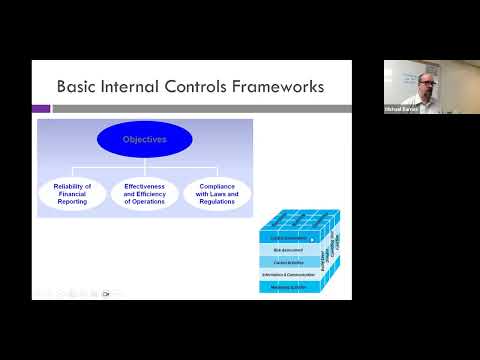
- The COSO Cube organizes control objectives around operations, reporting, and compliance, and controls can apply at entity, division, or functional levels.
- For financial statement audits, controls that support reliable, transparent, and timely external financial reporting are especially relevant.
- Relevant controls help prevent, or detect and correct, material misstatements in financial statements.
- Access controls are primarily preventive, while application controls commonly detect errors and support correction through system functions and audit trails.
- Chapter 6 focuses on auditors’ general control responsibilities, while Chapter 7 addresses internal control over financial reporting in greater depth.
- The five COSO components are control environment, risk assessment, control activities, information and communication, and monitoring.
- The control environment sets the organization’s tone and shapes how seriously employees treat controls.
- Management and the board of directors communicate control expectations through their attitudes and actions, which influence behavior across the organization.
- Barnes’s exam example illustrates the point: consistently enforcing restrictions signals that controls matter, while indifference encourages people to ignore them.
- Risk assessment identifies relevant business risks, estimates their significance and likelihood, and determines how the organization should respond.
- Control activities are policies and procedures that carry out management directives, including approvals, authorizations, verifications, reconciliations, and performance reviews.
- Segregation of duties separates custody of assets, authorization of transactions, and recording of transactions, summarized as CAR.
- Combining two or more CAR responsibilities can let a person bypass review or commit and conceal fraud, as illustrated by the Susak Dava case example.
- Information and communication provide relevant, high-quality information from internal and external sources so employees can perform assigned control responsibilities.
- External information can reveal changing risks, such as supply shortages, and help stakeholders evaluate an organization’s controls.
- Restaurant health inspection grades, such as the A displayed by Lenny’s Pizza in the example, communicate external assessments to customers.
- Monitoring evaluates control performance over time because changing risks, including evolving cybersecurity threats, may require controls to be updated.
- Auditors characterize financial statement risks through management assertions, such as whether inventory exists and is valued accurately.
- A control must address the relevant assertion, and the auditor’s test should evaluate whether that control is designed properly and operating effectively.
- Barnes’s control sequence builds on the basic risk-and-control model by aligning assertions, controls, and tests of controls.
- A preliminary assessment of control risk reflects expectations before testing; achieved control risk reflects conclusions after the test results are evaluated.
- A substantive strategy does not rely on controls for audit evidence and instead requires more extensive substantive procedures.
- Auditors may choose a substantive approach when controls do not address the assertions of concern, appear ineffective, or would be inefficient to test.
- A reliance strategy uses test results to support a lower control-risk assessment; if control risk is assessed below high, the auditor must test controls to support that assessment.
- If testing shows controls are weaker than planned, the auditor generally expands substantive procedures; if results support the plan, planned procedures can continue.
- Auditing standards require an understanding of all five COSO components, which helps auditors identify potential misstatements, assess risk, and design audit procedures.
- Management override is an inherent limitation: a Taco Bell manager may need to open a register to correct a transaction problem despite a control restricting access.
- Human error can defeat safeguards; in the McDonald’s Monopoly fraud, a security consultant exploited access to winning game pieces and replacement magnetic seals.
- Collusion occurs when two or more people work together to bypass controls, so even well-designed controls cannot provide perfect prevention.
Transcript excerpt
0:00 I'm pretty good. >> All right, I have got a lot to discuss at the beginning of class today. So, we're going to go and get started. Um, so first and foremost, um, there's some events that I want to talk to you about that I want to make sure that you're aware of coming up. So, for those of you who did not attend meet the firms, which there's a few of you in the class, um, we got the career the grad school career fair, the expo, it's going to be this coming Thursday from 12:00 to 4. If you attended uh the meet the firms uh then I gave you extra credit already and I'll talk a little bit about that in just a second. If you did not attend meet the firms then this is your other opportunity to meet that extra credit opportunity. Uh real quick request if you do attend the career fair please email me that you that you attended. Also with your email please tell me which firms you visited with and give me some names of individuals that you
0:47 talked with. All right does not need to be extensive list. you meet with like 20 20 uh firms, then you don't have to give me the names of all 20. I'd like kind of the highlights of the ones you think were the most or most uh had the best opportunities, the ones that you're going to look forward to further. So, uh tell me that you meet the you met with them at the career fair. Tell me the names of the firms and tell me the names of the individuals you met with. Um all right. Uh there's also this coming Friday a into entrepreneur speaker uh speaker Tim Grimes. It's taking place at
This is the start of the transcript. Save this video free for the whole transcript, searchable and time-coded.
In this course
Related notes
Summary, takeaways, and chapters were generated by AI from the video's transcript and may contain errors. The video belongs to its creator, Michael Barnes.