ACCT 417 (Fall 2026) - Chapters 12 and 13 Homework
Overview
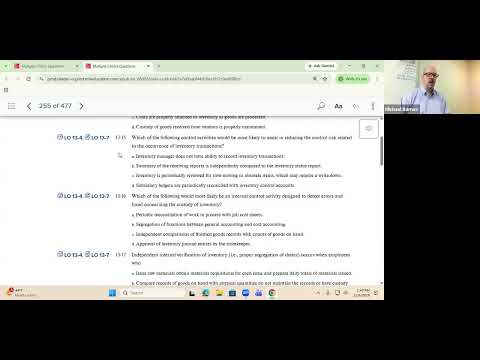
Michael Barnes reviews ACCT 417 homework from Chapters 12 and 13, using payroll and inventory questions to connect segregation of duties, audit assertions, control risk, and substantive procedures. He then analyzes an Endo Company case in which division manager JP Kumar inflated inventory to protect his bonus, showing how weak inventory controls and auditors’ failure to secure count sheets or investigate unusual additions allowed material fraud to go undetected.
Key takeaways
- Returning unclaimed payroll checks to payroll creates a custody-to-recording conflict; payroll check distribution should remain separate from the department responsible for recording payroll.
- Vouching recorded payroll transactions to approved time sheets supports occurrence, while tracing source documentation into the payroll register supports completeness.
- A high control-risk assessment calls for lower detection risk and more substantive assurance; a year-end inventory count is more relevant to the reported year-end balance than repeated interim counts.
- Inventory cutoff concerns whether goods owned at year-end are recorded in the correct period, whereas consignment and pledged inventory raise rights-and-obligations questions.
- In a periodic inventory system, overstated ending inventory decreases cost of goods sold and increases income, giving Kumar a direct way to inflate reported profitability.
- Auditors must safeguard inventory count sheets and investigate unusual additions; accepting Kumar’s $950,000 addition without proper verification or management communication exposed the audit to serious negligence concerns.
Chapters
- Barnes identifies a payroll weakness when employees distributing checks return unclaimed checks to payroll, a recording function, instead of keeping custody separate.
- Payroll checks prepared by the payroll department and signed by the treasurer separate recording from authorization.
- Human Resources sending termination notices to payroll helps prevent payments to former employees.
- Hiring is an authorization function, while distributing payroll checks is custody; separating these responsibilities reduces opportunities for improper transactions.
- Vouching payroll-register entries to approved time sheets and the employee master list supports occurrence; tracing source records into the register supports completeness.
- Low control risk implies lower risk of material misstatement and higher detection risk, generally reducing substantive testing.
- Unusual payroll fluctuations found by substantive analytical procedures warrant investigation and potentially more detailed testing.
- Preventing the inventory manager from recording inventory transactions separates authorization from recording and helps address occurrence.
- Barnes selects as the best segregation example employees who compare recorded inventory with physical quantities but do not maintain inventory records or hold inventory custody.
- When control risk is high, auditors need more substantive assurance; a physical inventory count scheduled at year-end provides stronger evidence about the year-end balance than counts earlier in the year.
- A purchase cutoff test checks whether goods owned at year-end are included in the correct inventory period, even when receipt occurs after year-end.
- Consigned goods and inventory pledged or sold relate to rights and obligations, not cutoff.
- Inquiries about obsolete or slow-moving inventory address valuation, while vendor price lists can help assess net realizable value or replacement cost.
- Selecting recorded count-sheet items and checking them on the warehouse floor tests existence; selecting physical items and checking whether they appear on count sheets tests completeness.
- Loan agreements and board minutes can provide evidence about inventory rights and obligations.
- Vendor price lists help test inventory write-downs, while vendor invoices and contracts can support recorded cost and accuracy.
- Reviewing draft financial statements addresses presentation and disclosure; Barnes notes that some textbook mappings are ambiguous.
- Endo Company lacked an internal audit department, allowed six divisions to operate autonomously, and intervened mainly when planned results were missed.
- Appliance division manager JP Kumar faced a bonus reduction risk after new competitors cut prices, and manipulated inventory to improve reported profitability.
- Under a periodic inventory system, overstating ending inventory reduces cost of goods sold and increases income; Kumar added fictitious count sheets, including a $950,000 addition equal to 8.6% of inventory and another $375,000 inflation.
- Auditors accepted added sheets without adequate existence verification, failed to notify management about the unusual $950,000 addition, and did not maintain secure control over count sheets.
- Count sheets should remain complete and secure under auditor control; Kumar introduced sheets before and after the count and altered unit descriptions on other sheets.
- Barnes identifies the auditors’ failure to communicate the material, unusual count-sheet additions to management as a major oversight with potential liability consequences.
- Auditors must communicate planned audit scope, risk assessment, and procedures to the audit committee; a significant inventory-fraud concern may also qualify as a critical audit matter.
- The case combines weak control environment, performance-based incentives, reduced inventory controls, and inadequate audit response as warning signs of fraud.
Transcript excerpt
0:00 Oh. >> Happy Friday, everyone. >> Which? >> We got some homework to go through and I don't know I don't know if I should count this as good news cuz I don't think the homework will take us the entire time, so I think we'll get out a little bit early. Problem is is that I've always worried about leaving like leaving class a little bit early is that that's just not giving you value for your tuition dollars right there. And I I had a unpleasant experience with this. This was like my first year teaching and I was teaching a Tuesday Thursday class, which I am not good at Tuesday Thursday classes. I talking for 50 minutes is already pretty rough because I go so fast and it's also also auditing. But Tuesday Thursday was just it was just a lot a little bit for me. So I let class out pretty significantly early and I got multiple comments in the
0:47 in my evaluation saying he was always letting class out early. And I don't think I've had those comments ever since then. I just came to the conclusion that if people are really looking for things to nitpick you on, then they're going to point out that one teacher. But if they really like the class, then then they probably won't pick it out. I guess I'm I'm going to find out at the end of this semester when the evaluations come out. If I see a lot of comments like he was letting class out early, then I'll know that my my postulate is untrue. But we'll see what happens. Anyway, I don't know what made me think of that. I'm just rambling. Let's get on to homework. Let's get on going. 12:15 Which of the following procedures would
This is the start of the transcript. Save this video free for the whole transcript, searchable and time-coded.
In this course
Related notes
Summary, takeaways, and chapters were generated by AI from the video's transcript and may contain errors. The video belongs to its creator, Michael Barnes.