ACCT 417 (Fall 2026) - Chapter 13 Lecture
 Watch on YouTube →
Overview
Michael Barnes explains how auditors assess inventory risks, test controls and balances, observe physical counts, and evaluate inventory costing and disclosure. He emphasizes existence and completeness, the risks of theft and obsolete stock, and the need to verify ownership, cutoff, LIFO liquidations, related-party transactions, and warranty accruals.
Key takeaways
- For inventory, existence is the primary asset assertion, but auditors must also test completeness by tracing receiving reports from source documents into inventory records.
- Inventory counts require both directions of testing: sheet-to-floor supports existence, while floor-to-sheet supports completeness.
- A client’s physical count observation has relatively low reliability on its own; auditor test counts add high-reliability reperformance evidence for selected items.
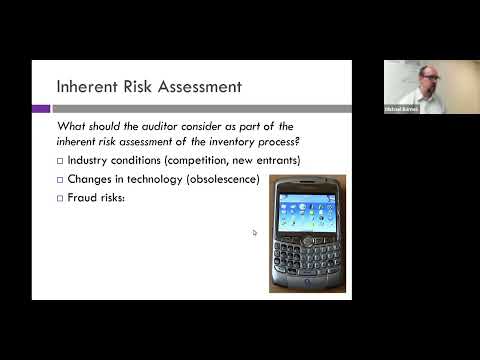
- Obsolete, slow-moving, or excessive inventory can be overstated, as illustrated by 100,000 BlackBerry phones recorded at $200 each despite limited prospects for sale.
- Under LIFO, selling more inventory than is replenished can release older, lower-cost layers and temporarily boost income, so the liquidation effect requires financial statement disclosure.
- Inventory possession does not prove ownership: goods held on consignment for another party should not be included in the holder’s inventory.
Chapters
- The Excel assignment is due Friday, and Barnes urges students to work on it steadily rather than wait until Thursday.
- The professional interaction assignment is due a week from Friday, and the third midterm is two weeks away.
- Chapter 13 focuses on auditing inventory, which connects the purchasing, production, and revenue processes.
- Inventory management authorizes purchases or production; raw materials, work in process, and finished goods involve custody.
- Cost accounting records production and purchase data, while general ledger accounting provides a financial reporting record.
- Barnes uses Walmart self-checkout to show how combining authorization and custody can enable theft, such as skipping a scan.
- Inventory is highly susceptible to misappropriation because it can be converted to cash, making it second only to cash as a common fraud target.
- Technology shifts create obsolescence risk: 100,000 BlackBerry phones carried at $200 each could be materially overstated if they cannot sell.
- Inflating ending inventory reduces cost of goods sold and increases net income; related-party inventory sales at unusual discounts can also mislead.
- Because inventory purchases and sales are frequent, auditors generally use a reliance strategy and test controls rather than test every transaction.
- A substantive-only strategy requires control risk to be set at high; the six examinable control tables include Chapter 13 Table 13-5.
- Existence is the primary assertion for inventory because it is an asset; completeness matters when received goods may not be recorded.
- Matching receiving reports to vendor invoices and the purchases journal tests completeness by tracing from source documents to records.
- Tracing vouchers to the purchase journal checks whether source documents made it into the accounting system.
- Barnes highlights existence, completeness, and valuation, accuracy, and allocation as assertions to distinguish when evaluating controls.
- Tracing receiving reports to inventory records tests completeness, while recalculating transaction amounts and testing standard costs addresses valuation, accuracy, and allocation.
- Reviewing inventory checks for proper expense categorization tests classification, and examining records around period-end tests cutoff.
- Vouching recorded inventory additions back to receiving reports and purchase requisitions tests occurrence.
- Goods held on consignment for another party should not be recorded as the holder’s inventory because physical possession does not establish ownership.
- A standard cost represents an expected price, cost, or quantity under normal operating conditions; variances signal deviations to investigate.
- For materials, auditors examine expected quantities and prices; for labor, they examine production time or amount and labor rates.
- For overhead, auditors review the allocation method for reasonableness and consistency.
- Although managerial accounting is not itself governed by GAAP, cost accounting amounts flow into financial statements and must support GAAP-compliant reporting.
- Auditors generally observe the client’s physical count rather than conduct it; observation alone has relatively low reliability.
- Auditor test counts reperform the client’s work on selected items, providing high-reliability evidence for that sample.
- Before counting, auditors should prevent or minimize inventory movement, assign count documentation by area, and ensure instructions are understood by both client staff and auditors.
- Barnes stresses clear communication and firsthand completion of assigned test counts, including difficult-to-reach stock.
- Sheet-to-floor testing starts with inventory records and checks items physically present, supporting existence; floor-to-sheet testing starts on the floor and checks the records, supporting completeness.
- Auditors inspect stock for obsolescence, slow movement, and excess quantities, such as the example of 100,000 unsellable BlackBerry phones.
- Rights and obligations require confirming that recorded inventory belongs to the organization and excluding goods owned by others.
- Cutoff work checks the last shipping and receiving document numbers to determine whether inventory was recorded in the correct period.
- Auditors consider unreported scrap, spoilage, theft, and shrinkage because each can make recorded inventory exceed what is actually on hand.
- Purchase contracts, consignments, pledges, and assigned inventory require examining ownership and related obligations, not just physical possession.
- A LIFO liquidation occurs when sales exceed replenishment and older, lower-cost layers are sold, temporarily increasing income; auditors should ensure the unusual effect is disclosed.
- Related-party inventory transactions must be disclosed and assessed for arm’s-length terms, while warranty costs and related allowances must be properly accrued.
Transcript excerpt
0:02 Hello everyone. We have yet another exciting topic to discuss today. But I do have one a few announcements to make. So D-Day is upon us. Friday, the Excel assignment is due. I notice some people have already completed and submitted their Excel assignment. So those of you that have, great. If you have not, please start to work on it. Uh in rare exceptions, I may accept a uh may accept a extension such as your computer exploded. That's basically the level of uh level of exception that I will be operating. It's like if your exception is Dr. Barnes, I let time get away from me. I didn't realize that I wouldn't have as much time to complete it. I will say what have I been doing for the past three weeks. Been announcing this assignment. So that assignment is due on Friday. If you have not started it yet, don't tell me. Don't
0:50 just don't don't don't react to anything I'm saying right now. I'm assuming everybody has started it yet, started working on it because it is due. Again, do not wait. Do not wait. Get it done. It will take some time. There will be some things very very thorough to or very important to emphasize that if you are going to uh be working on it over the next few days. I would make sure that you work on it consistently through the next few days and do not wait until Thursday. Thursday night, I get an email from Isaac, my GTR, saying, "Yeah, this one student has been emailing me and send me like five emails." I will say, well, let me reach out to that student and let them know that they will we will no longer be responding to emails about
This is the start of the transcript. Save this video free for the whole transcript, searchable and time-coded.
In this course
Related notes
Summary, takeaways, and chapters were generated by AI from the video's transcript and may contain errors. The video belongs to its creator, Michael Barnes.