University of New Haven CHEM 3331
Dr Seifert · University of New Haven · 10 lectures with notes
Students in this class: ask your lecturer for the class code, and these lectures will already be in your library when you sign up.
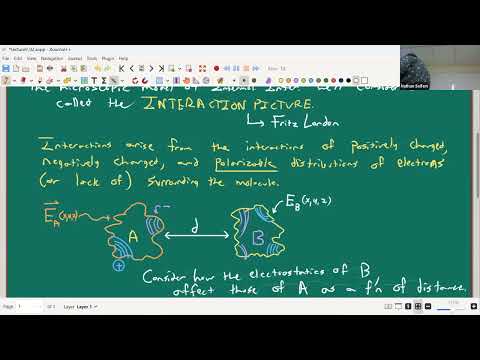
Lecture 10 - Intermolecular Interactions
Fritz London's four-force model explains intermolecular binding as a balance of electrostatics, induction, dispersion, and Pauli exchange repulsion.
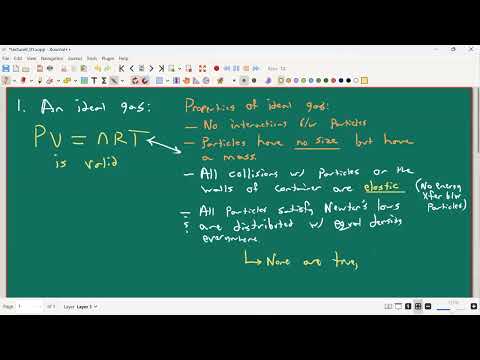
Lecture 9 - Real Gases, Pt. 1
Real-gas behavior reflects a balance between particle-size repulsions and intermolecular attractions, with conditions determining which dominates.
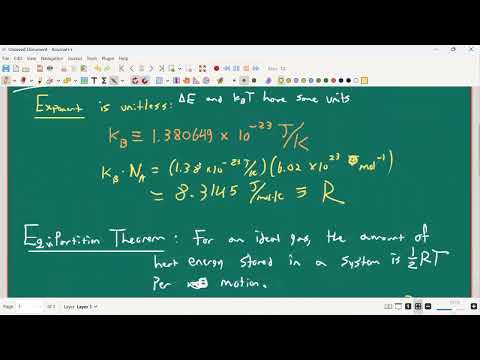
Lecture 8 - Applying Boltzmann's Distribution
Boltzmann populations explain how temperature shifts molecular conformations and changes whether NMR detects distinct states or a fast-exchange average.
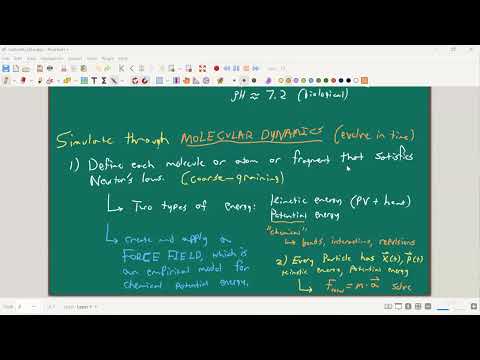
Lecture 7 - Isothermal Simulation & Boltzmann Distribution
Thermal equilibrium weights molecular energy states exponentially, as expressed by the Boltzmann distribution.
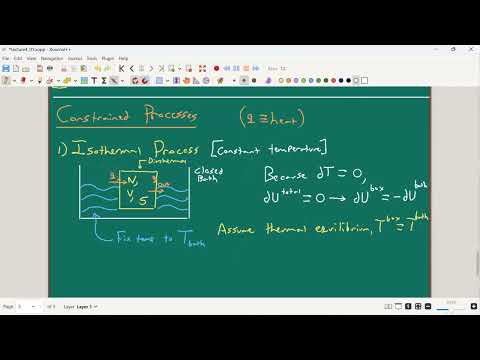
Lecture 6 - Isothermal Processes
For an isothermal ideal gas, volume changes produce ΔS = nR ln(Vf/Vi), linking heat exchange and pressure–volume work.
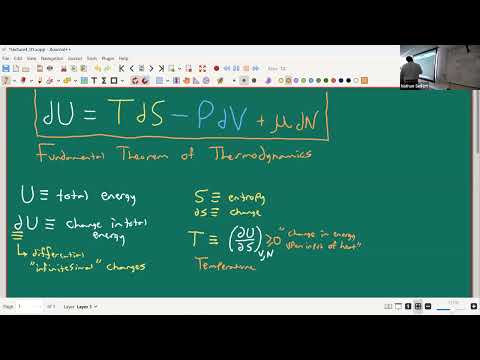
Lecture 5 - The Fundamental Equation of Thermodynamics (TRASH AUDIO)
The fundamental equation connects energy changes to entropy, volume, and particle transfer—and explains why equilibrium requires equal temperature.
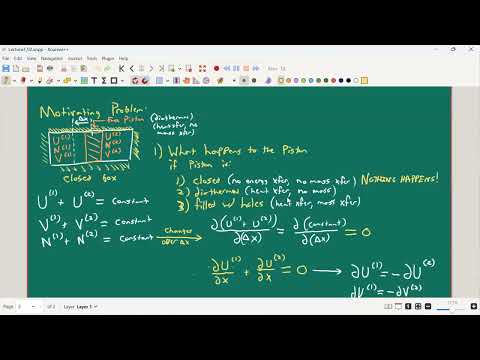
Lecture 4 - The Entropy Postulates
Entropy’s postulates make equilibrium a maximum-entropy, minimum-energy state and provide a framework for analyzing chemical systems.
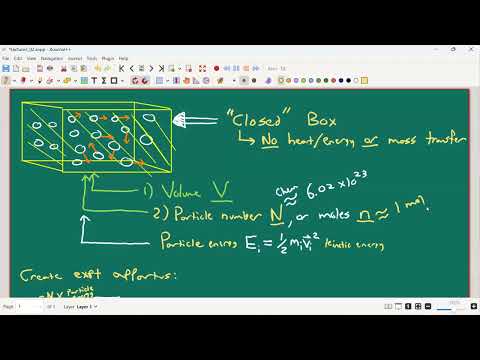
Lecture 3 - Equations of State & Introducing Entropy
Entropy provides a macroscopic route to describing equilibrium when tracking individual particles is impractical.
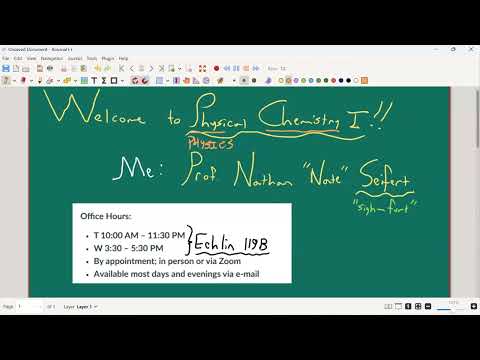
Lecture 1 - Intro to Class / Introductory Rambling
Physical chemistry uses measurement, mathematics, and first-principles reasoning to explain why chemical systems behave as they do.
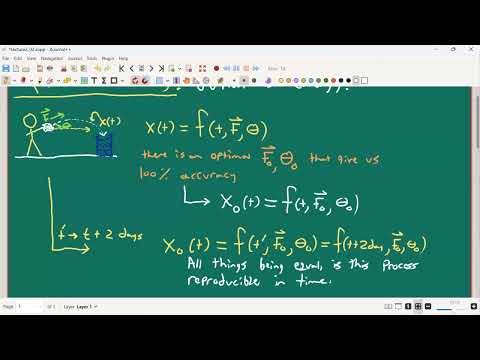
Lecture 2 - Energy & Conservation
Time-translation symmetry explains why energy is conserved; a gas-in-a-box model previews the variables needed to describe chemical systems.