Lecture 8 - Applying Boltzmann's Distribution
 Watch on YouTube →
Overview
Nathan Seifert applies the Boltzmann distribution, \(N_i/N_{\mathrm{ref}}=e^{-\Delta E/RT}\), to relate molecular energy differences and temperature to state populations, using cyclohexane conformations as the central example. He connects those populations to temperature-dependent NMR exchange, potential-energy barriers, and reaction rates, distinguishing the energetic preference between states from the kinetics of moving between them.
Key takeaways
- For two states with equal degeneracy, their population ratio is \(N_i/N_{\mathrm{ref}}=e^{-\Delta E/RT}\); a 2.5 kJ/mol gap at 298.15 K gives a lower-to-higher-energy ratio of about 2.7 to 1.
- A Boltzmann population ratio is not itself a normalized percentage: an axial-to-equatorial ratio of 0.37 corresponds to approximately 27% axial and 73% equatorial.
- NMR line shape reports exchange speed relative to the measurement timescale: cyclohexane shows one averaged signal during fast chair inversion, broadening during intermediate exchange, and distinct axial/equatorial signals when cooled enough to slow exchange.
- The energy gap between conformer minima governs their equilibrium populations, while the height of the potential-energy barrier governs how quickly they interconvert.
- In an exothermic reaction, products in a lower-energy well require more thermal excitation to reach the reverse barrier; a smaller population of reverse-ready products can make the forward reaction rate dominate.
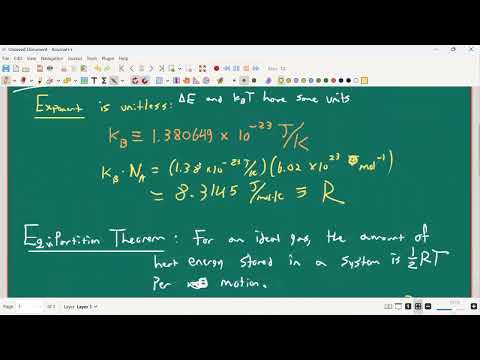
- Boltzmann's constant \(k_B=1.380649 imes10^{-23}\) J/K and the molar gas constant \(R\approx8.314\) J mol⁻¹ K⁻¹ express the same thermal-energy scale per particle and per mole, respectively.
Chapters
0:00
Boltzmann Distribution: From Energy Differences to Molecular Populations
- Seifert introduces the Boltzmann equation as a recurring chemistry tool for predicting how molecules distribute among states of different energies.
- The example begins with molecules in a thermal bath and asks how many occupy each energy state at equilibrium.
- The population ratio depends exponentially on the energy difference divided by thermal energy, using either \(k_BT\) per molecule or \(RT\) per mole.
3:00
Why the Boltzmann Exponent Uses \(k_B\), \(R\), and Temperature
- The exponent \(-\Delta E/k_BT\) must be dimensionless, so \(k_B\) has units of energy per kelvin.
- Boltzmann's constant is exactly \(1.380649 imes10^{-23}\) J/K; multiplying it by Avogadro's number gives \(R\approx8.314\) J mol⁻¹ K⁻¹.
- The equipartition theorem assigns an average \( frac12RT\) of energy per mole to each quadratic degree of freedom; a monatomic ideal gas has three translational degrees of freedom and average energy \( frac32RT\).
- Seifert describes \(RT\) as a useful scale for comparing molecular energy differences with thermal energy.
11:00
Planck, Boltzmann, and the Conversion Between Heat and Energy
- Seifert credits Max Planck with a later estimate of Boltzmann's constant and notes Planck's separate constant relates energy to light frequency.
- He frames thermodynamics as connecting heat with mechanical, light, and other forms of energy.
- The central practical idea is that \(k_B\) or \(R\) converts temperature into an energy scale for molecular processes.
12:00
Fluorocyclohexane: Axial and Equatorial Conformations Have Different Energies
- Seifert compares the axial and equatorial conformations of fluorocyclohexane, assigning the axial form the lower energy in this example.
- He contrasts fluorine with a methyl substituent: methyl generally favors the equatorial position because an axial methyl group experiences unfavorable 1,3-diaxial interactions.
- The lecture attributes fluorine's axial preference to stabilization associated with its strong electronegativity and orbital interactions.
- The stated energy gap is about 2.5 kJ/mol, with the axial conformation used as the zero-energy reference.
20:00
Using \(e^{-\Delta E/RT}\) to Estimate Conformer Populations
- At 298.15 K, the axial-to-equatorial population ratio for a 2.5 kJ/mol energy gap is approximately \(e^{-2500/(8.314 imes298.15)}\approx0.37\).
- A ratio of 0.37 axial molecules per equatorial molecule corresponds to roughly 27% axial and 73% equatorial after normalizing the two populations.
- As temperature approaches zero, the higher-energy state becomes less populated; at very high temperature, equal-energy weighting drives the ratio toward one.
- For these two states, temperature changes the population ratio but does not make the higher-energy state more abundant than the lower-energy state.
24:00
Equal-Energy Cyclohexane Conformers and the Labeled-Hydrogen Test
- Seifert removes fluorine and considers cyclohexane with one hydrogen hypothetically marked so its axial and equatorial environments can be distinguished.
- Because the two conformers have equal energies in this simplified comparison, the Boltzmann ratio is one at any temperature.
- A static picture would predict two equally populated hydrogen environments and therefore two equally intense NMR signals if exchange were slow.
29:00
Fast Conformational Exchange Produces One Averaged NMR Signal
- At high temperature, the marked cyclohexane hydrogen gives one narrow NMR peak rather than separate axial and equatorial peaks.
- Seifert explains the single signal by rapid chair interconversion: the NMR measurement detects an average when exchange is fast relative to its observation timescale.
- The single peak does not mean the conformers have disappeared; it means the molecule samples them rapidly enough that their signals are averaged.
33:00
Cooling Cyclohexane Reveals the NMR Exchange Regime
- At about −43°C, the spectrum still has one signal, but it is much broader, consistent with exchange slowing into an intermediate regime.
- Near −60°C, the signal broadens further; around −78°C it resolves into two peaks, and by approximately −90°C the separate peaks become narrower.
- At low temperature, the axial and equatorial hydrogen environments can be assigned separately because chair interconversion is slow on the NMR timescale.
- The temperature series illustrates the progression from fast exchange, through broadening, to resolved slow-exchange signals.
36:00
Cyclohexane Chair Inversion on a Potential Energy Surface
- Seifert plots molecular energy against structure and marks the axial and equatorial conformations as two minima.
- Moving between chair conformations requires structural distortion, including chair-to-boat-like geometries, and the path must pass through a higher-energy region.
- The barrier height controls how difficult it is to interconvert; the energy difference between the minima instead determines their relative stability.
- The lecture flags this barrier as a kinetic concept to revisit when studying reaction rates.
43:00
Thermal Energy Determines Which Molecules Can Cross a Conformational Barrier
- At low temperature, relatively few molecules have enough thermal energy to reach the barrier between cyclohexane conformations.
- Seifert applies the Boltzmann factor to estimate the fraction of molecules energetic enough to cross, distinguishing the barrier requirement from the energy difference between conformer minima.
- Molecules above the barrier can cross in either direction; those below it tend to remain in their current conformational basin.
47:00
Microscopic Reversibility and Why Equal-Energy Paths Balance
- Seifert introduces microscopic reversibility: in the lecture's equal-energy-path comparison, a barrier-crossing route is as likely forward as backward.
- For equal-energy axial and equatorial states, equivalent thermal access in both directions produces no net population flow between them.
- An energy difference between states changes the number of thermally excited molecules available for each direction, which can create a net rate imbalance.
50:00
Combustion: Product Stability Makes the Reverse Process Much Slower
- Seifert contrasts equal-energy cyclohexane conformers with exothermic combustion, where CO₂ and H₂O lie at lower energy than the hydrocarbon and oxygen reactants.
- Because products start in a deeper energy well, a larger energy input is needed for them to reach the reverse-reaction barrier.
- The Boltzmann distribution therefore predicts fewer product molecules with sufficient energy to react backward than reactant molecules able to proceed forward.
- The lecture emphasizes that net reaction direction reflects unequal forward and reverse rates, not a prohibition on microscopic reversibility.
55:00
Temperature-Dependent Exchange Changes the Structure NMR Observes
- As temperature rises, more cyclohexane molecules can cross the chair-inversion barrier, increasing the exchange rate.
- At low temperature, NMR captures distinct axial and equatorial environments; at high temperature, rapid exchange makes the instrument report their average.
- Seifert explains that the molecule itself is not transformed into a new chemical species: temperature changes its dynamics relative to the spectrometer's observation timescale.
- Cooling can therefore make conformational structure appear more distinct, while heating can make it look averaged.
1:01:00
Fluorocyclohexane Follow-Up and the Next Thermodynamics Topics
- Seifert corrects a board-labeling slip: the equal-energy, 50/50 conformer discussion refers to hydrogen-substituted cyclohexane, not fluorocyclohexane.
- For fluorocyclohexane, the two conformers have unequal energies, but the same exchange-versus-temperature logic applies; Seifert notes that the fluorine NMR example needs verification.
- He closes by previewing a return to ideal gases, followed by enthalpy and phase transitions in upcoming lectures.
Summary, takeaways, and chapters were generated by AI from the video's transcript and may contain errors. The video belongs to its creator, Nathan Seifert.