Lecture 1 - Intro to Class / Introductory Rambling
 Watch on YouTube →
Overview
Nathan Seifert frames physical chemistry as a universal toolkit for explaining how chemical systems behave, not as a collection of rigid rules or a prerequisite for becoming a specialist. He connects that approach to spectroscopy, molecular-beam experiments, and his own research journey, then lays out the course’s grading, collaboration, AI-use, and student-support policies.
Key takeaways
- Physical chemistry provides a transferable way to analyze problems across organic, atmospheric, materials, and biological chemistry by connecting measurements to physical principles.
- Crossed molecular-beam experiments use pulsed gas jets, laser ablation, and angle-resolved product detection to isolate and reconstruct individual molecular collision dynamics.
- Spectrometry applies instruments to characterize samples, whereas spectroscopy investigates the fundamental interaction between light and matter that makes those measurements possible.
- Hydrogen bonds and London dispersion are not always separate categories: Seifert’s water, phenol, and naphthalene examples show how molecular geometry can shift the balance between directional and broad attractions.
- Course grading rewards scientific communication as well as correct answers: accuracy is 60% of the rubric, and students are expected to use proper units, significant figures, derivations, and graph labels.
- Students may collaborate on problem sets and use AI for quantitative help if they disclose prompts and outputs, but the take-home final is individual and qualitative answers should reflect their own thinking.
Chapters
0:00
Physical Chemistry as a Universal Toolkit
- Nathan Seifert presents physical chemistry as a broad foundation for understanding chemistry rather than a narrow specialty.
- The course uses physical reality, mathematics, and scientific fundamentals to analyze problems across chemistry.
- A central goal is to question simplified models from general chemistry: their rules are useful approximations, but often break down.
6:00
Why Seifert Chose Physical Chemistry
- Seifert says he initially disliked physical chemistry, earned a B-minus as an undergraduate, and did not consider himself a physics specialist.
- He describes the course as an engagement course rather than a mastery course designed only for future physical chemists.
- His aim is to help students understand how chemists reason from the ground up and apply that reasoning in varied careers.
8:00
Laser Ablation and Crossed Molecular-Beam Reactions
- In the experiment Seifert describes, a nanosecond laser pulse ablates silicon atoms from a rotating solid target without simply heating the rod.
- Helium carries the silicon into a high-vacuum region, where a second pulsed gas source sends diatomic molecules across its path.
- Most particles pass without reacting; occasional collisions form products whose scattering angles reveal how the molecules interacted.
17:00
What Molecular-Beam Scattering Reveals
- A detector records product ions at different angles, allowing researchers to work backward from the products’ distribution to collision dynamics.
- Crossed molecular-beam methods can isolate reactions at very low density and study them molecule by molecule, rather than averaging behavior in a flask.
- Seifert cites Ralph Kaiser’s work at the University of Hawaiʻi at Mānoa, where laboratory experiments investigate reactions relevant to astrochemistry.
23:00
From First-Generation Student to Argonne National Laboratory
- Seifert describes growing up in a rural, low-income family and becoming the first in his family to earn an advanced degree.
- He studied chemistry at Amherst College, completed a PhD at the University of Virginia, and spent four years in Edmonton, Alberta, as a postdoctoral researcher.
- In 2019 he moved to Argonne National Laboratory near Chicago, a Department of Energy research center with major battery and solar programs.
- He joined the University of New Hampshire in 2021, choosing teaching over another research-faculty opportunity.
30:00
Leaving Organic Synthesis for Spectroscopy
- Although Seifert entered graduate school passionate about organic chemistry and inspired by Robert Burns Woodward, he found six-day lab weeks and repetitive synthesis work unsatisfying.
- He enjoyed analyzing samples with NMR because spectra gave direct evidence about whether a reaction worked and what molecule had formed.
- After switching labs during his first graduate-school semester, he encountered microwave spectroscopy and found a research direction he continued pursuing for about 15 years.
36:00
Spectrometry, Spectroscopy, and Measuring Chemical Properties
- Seifert distinguishes spectrometry—the practical use of an instrument to measure a sample—from spectroscopy, which studies how light interacts with matter at a fundamental level.
- He identifies as an experimental spectroscopist who builds spectrometers and uses microwave radiation, lasers, and other light sources.
- His distinction highlights the link between fundamental measurement science and applied work that uses instruments to identify or characterize materials.
39:00
Spectroscopy as a Probe of Interactions and Molecular Dynamics
- Beyond identifying molecular structure, spectroscopy can reveal attractions and repulsions between molecules and how those forces influence collisions and reactions.
- Time-resolved measurements can track molecular systems as they evolve, while spectroscopy also provides experimental access to quantum-mechanical behavior.
- Seifert connects physical chemistry’s interest in exceptions to the study of when ideal models fail and what changes when a system is perturbed.
45:00
Water Clusters and the Continuum of Intermolecular Forces
- Seifert describes microwave studies of tiny gas-phase water droplets containing clusters of 10 water molecules, using spectra to determine structures and bond lengths.
- He compares water dimers with phenol and naphthalene systems to show how molecular geometry changes the balance of interactions.
- The examples show hydrogen bonding as a narrow, directional interaction and London dispersion as a broader attraction; real molecules can combine both rather than fitting a simple either-or classification.
49:00
Student Support, Course Materials, and Recordings
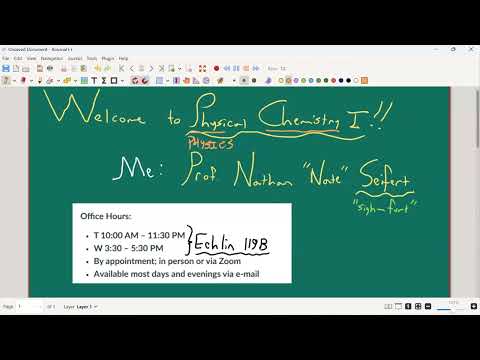
- Seifert offers office hours and says students can email him with questions; he expects to memorize class members’ names during the first month.
- Bridget Golden is the lecture teaching assistant, while Charlie Matheny supports the Wednesday-night lab; additional tutoring is planned with Angela Chew.
- The course has no required textbook, though Seifert recommends an optional roughly $76 reference covering both semesters and offering math support.
- Lectures will be posted on YouTube, with whiteboard PDFs, notes, readings, and guides available through Canvas; students should have a laptop, and recommended computer-math tools will be free.
51:00
Eight Assessments and the Scientific-Work Rubric
- The course has eight assessments: six problem sets and two assessment units equivalent to a take-home final; each is worth 10 points, with a small participation adjustment.
- The 10-point grading rubric emphasizes accuracy at 60%, alongside scientific precision and the quality of students’ effort and interpretation.
- Scientific presentation matters: work should include appropriate units, significant figures, derivations, and clearly labeled graph axes.
- Seifert says students who submit consistent, decent work typically earn around the B to B-plus range; missing assignments, rather than imperfect answers, are the main cause of very low grades.
57:00
Late Work, Collaboration, and Transparent AI Use
- A skipped homework caps the best possible course grade at B-minus; two skipped assignments cap it at C-plus, while one late submission can be used without losing the chance at an A.
- Homework is designed for collaboration: students may solve problems together but must submit their own work; the take-home final must be completed individually.
- Students may use AI as a quantitative tool, but should provide screenshots or copies of prompts and outputs so the process is transparent and errors can be reviewed.
- Seifert discourages using AI to write qualitative responses because the course is meant to assess students’ own reasoning; he supports using it to summarize concepts or assist with calculations when disclosed.
1:03:00
Open-Book Final, Equitable Support, and Homework Zero
- The take-home final is open-book and open-resource, and students do not need to attend on the scheduled final-exam day.
- Seifert describes the class as respect-based and says he will adjust support and accommodations to give students equitable opportunities to succeed.
- Homework Zero is a 25-question survey, mostly optional, that also asks for each student’s favorite movie.
- Completing the survey by the stated deadline earns an extra late-work allowance; Seifert plans to compile the movie responses for a later class discussion.
Summary, takeaways, and chapters were generated by AI from the video's transcript and may contain errors. The video belongs to its creator, Nathan Seifert.