Lecture 3 - Equations of State & Introducing Entropy
 Watch on YouTube →
Overview
Nathan Seifert builds an entropy-first framework for thermodynamics, starting with a sealed sample and the challenge of describing roughly Avogadro-scale particle systems without tracking every particle. He distinguishes volume-changing work from other microscopic motion, introduces entropy as a macroscopic state variable, and sets up a two-compartment piston problem whose equilibrium conditions will be derived using conservation laws and derivatives.
Key takeaways
- A macroscopic chemical sample can contain about 6.02 × 10²³ particles per mole, so a useful thermodynamic description must rely on measurable averages rather than particle-by-particle velocity measurements.
- The lecture’s microscopic model distinguishes volume-changing expansion from motions such as translation and rotation that can carry energy without a net volume change.
- Entropy is introduced as a general state variable in U(N,V,S), while enthalpy is deferred because its familiar definition depends on a constant-pressure constraint.
- The equilibrium piston problem is constrained by conservation: total energy, total matter, and total box volume remain fixed, so changes in one compartment must be offset by changes in the other.
- PV has units of energy, but PV = nRT does not imply that an ideal gas’s energy is split equally between heat and work; boundary work is generally given by an integral such as ∫P_ext dV.
- For the two-compartment problem, temperature is ultimately defined through how energy changes with entropy under specified constraints, rather than simply being an informal measurement of entropy.
Chapters
0:00
A Sealed Particle Box as the Simplest Thermodynamic System
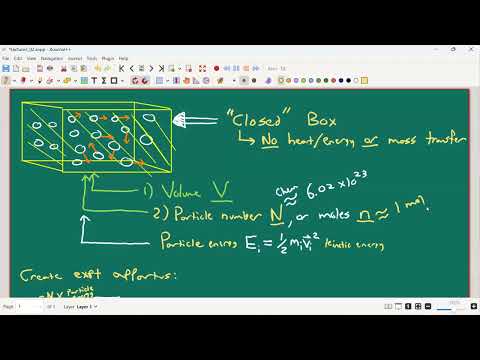
- The starting model is a fixed-volume box containing particles, isolated from its surroundings so neither matter nor energy can escape.
- Nathan Seifert postpones adding constraints such as a constant-temperature bath until the general system framework is established.
- The aim is to identify a minimal set of measurable properties that can describe how a sample changes.
4:10
Why Measuring Every Particle’s Kinetic Energy Does Not Scale
- The proposed measurement device would take particle count, volume, and particle energy as inputs and return the system’s total energy.
- For a particle of mass m and velocity v, the kinetic-energy example is ½mv².
- A laboratory-scale sample may contain about 6.02 × 10²³ particles per mole, making individual velocity measurements impractical.
10:00
Statistical Averages Lead Toward an Equation of State
- Instead of measuring each particle, the framework uses statistical averages over the random distribution of particle energies.
- A nanomole still contains vastly more particles than a one-particle system, illustrating why chemistry usually concerns macroscopic samples.
- The target is an equation of state: a function that maps a small set of system variables to total energy.
14:00
The Ideal Gas Law as a Familiar Equation of State
- For a sealed gas cylinder that exchanges heat with a temperature bath but not matter, the lecture recalls PV = nRT.
- The example connects pressure, volume, amount of gas, and bath temperature as macroscopic descriptors.
- The ideal-gas example serves as a bridge from familiar chemistry to a more general description that does not initially rely on temperature.
16:00
Gas Expansion, PV, and the Mechanical Meaning of Work
- A rapidly vaporized liquid droplet is used to picture gas molecules spreading out until they fill the container.
- The expansion is described as mechanical motion that pushes against the container walls; pressure is linked to the force on those walls.
- The lecture uses PV to motivate the energy scale of expansion, although actual boundary work is generally calculated as an integral of pressure over volume change.
20:00
Heat and Work as Different Ways Energy Is Transferred
- Mechanical work is illustrated as organized expansion, while heat is introduced as energy transfer that changes particle motion without necessarily changing the container’s volume.
- The lecture connects the distinction to the historical motivation for thermodynamics and heat engines, which convert heat transfer into useful work.
- Both heat and work are treated as energy transfer in different contexts, rather than as separate conserved substances.
24:00
A Microscopic Observer Classifies Particle Motion
- A hypothetical observer records repeated snapshots of nearby gas particles and sorts their motions into categories.
- Weak springs between particles stand in for interactions such as van der Waals attractions or hydrogen bonds.
- A flexible membrane around the local region gives the observer a way to detect whether a motion changes volume.
28:00
Translation and Rotation Can Add Energy Without Changing Volume
- Collective translation in different directions is expected to cancel on average across repeated random snapshots.
- Particles orbiting around a center illustrate rotational motion that can carry energy without producing a sustained volume change.
- The lecture classifies these volume-preserving motions as non-work contributions in its microscopic model.
34:00
Separating Volume-Changing Motion from Other Energy Modes
- Motion in which particles move outward from a center stretches the membrane and changes volume, providing the lecture’s example of work.
- The model divides microscopic motion into volume-changing PV work and other modes, including translation and rotation.
- The ideal-gas discussion uses PV = nRT to motivate a 50/50 work–heat interpretation; this is a heuristic rather than a general thermodynamic identity.
38:00
Entropy as the Non-Work Contribution and Temperature’s Role
- The lecture introduces entropy, denoted S, as a name for the energy associated with motion not classified as PV work.
- Entropy is presented as useful across different containers, while enthalpy is deferred because it depends on constraints such as constant pressure.
- Temperature is proposed as an experimentally accessible guide to entropy, setting up a later mathematical definition.
43:00
Randomness and the Statistical Assumption Behind Thermodynamics
- A student asks whether different motion types can occur simultaneously; the model instead considers many snapshots over time and sorts the observed configurations.
- The key assumption is that the sample has already been randomized enough to represent its possible microscopic configurations.
- The lecture acknowledges that some systems may not satisfy this assumption and sets those cases aside.
47:00
Thermodynamics as a Macroscopic Description of Microscopic States
- Thermodynamics is framed as using statistical measurements to describe systems with enormous particle counts without tracking microscopic details individually.
- Nathan Seifert distinguishes postulates from the familiar textbook laws of energy conservation, increasing entropy, and zero entropy for a perfect crystal at 0 K.
- The postulate-based approach is intended to make the assumptions behind the framework explicit.
53:00
Equilibrium States and the Fundamental Equation U(N,V,S)
- A thermodynamic equilibrium state is described as one whose total energy is uniquely determined by particle number N, volume V, and entropy S.
- The proposed equation of state is U = U(N,V,S), with the macroscopic variables stable over time at equilibrium.
- Chemical equilibrium is offered as an analogy: concentrations settle to stable values, whereas this framework emphasizes energy and thermodynamic state variables.
58:00
A Two-Compartment Piston Problem for Defining Temperature
- The motivating setup places two particle samples, with states (U₁, N₁, V₁) and (U₂, N₂, V₂), on opposite sides of a movable piston in a closed box.
- Three piston conditions are compared: sealed to energy and matter transfer, diathermal to heat transfer only, and perforated to both heat and matter transfer.
- The system’s final piston position is presented as an equilibrium problem that entropy and conservation can help solve.
1:04:00
Conservation Constraints and the Shift to Derivatives
- For the sealed case, no energy or matter crosses the piston, so the lecture concludes that the piston does not move.
- For the whole closed box, total energy U₁ + U₂ and total particle number N₁ + N₂ remain constant; the combined volume is also fixed.
- Differentiating the conserved totals with respect to piston displacement shows that a change on one side must be balanced by an opposite change on the other.
- The next step is to use partial derivatives of the equation of state to derive equilibrium conditions and define temperature.
Summary, takeaways, and chapters were generated by AI from the video's transcript and may contain errors. The video belongs to its creator, Nathan Seifert.