Lecture 9 - Real Gases, Pt. 1
 Watch on YouTube →
Overview
Nathan Seifert explains why the ideal-gas law is an approximation: real particles have finite size and intermolecular attractions, so deviations depend on pressure, temperature, and molecular identity. He uses molar volume and the compressibility factor Z to compare gases, then connects universal weak attractions to the Casimir effect and previews how stronger interactions such as hydrogen bonding help explain phase differences.
Key takeaways
- The ideal-gas law assumes negligible particle volume and no intermolecular forces; real molecules violate both assumptions, so ideality is a condition-dependent approximation.
- The compressibility factor Z = PV/(nRT) equals 1 for an ideal gas, falls below 1 when attractions dominate, and rises above 1 when repulsive or excluded-volume effects dominate.
- High pressure makes finite molecular size consequential: helium, methane, and nitrogen all show increasingly positive deviations in the lecture’s high-pressure comparisons.
- Lowering methane’s temperature strengthens the relative impact of attractions; the plotted value near 200 K reaches Z ≈ 0.3.
- Neutral metal plates attract at submicron separation through the Casimir effect, illustrating a universal weak attraction related to van der Waals dispersion forces.
- Water’s liquid phase at 298.15 K, compared with gaseous H₂S under similar conditions, shows that hydrogen bonding can outweigh the size-based dispersion trend.
Chapters
0:00
Phase Transitions as a Route into Real-Gas Chemistry
- Nathan Seifert frames the coming lectures around phase conditions and why liquids, gases, and solids differ.
- He argues that phase changes are chemical processes worth explaining from molecular behavior, not merely labeling as physical transformations.
- The ideal-gas law serves as a useful starting point, but its assumptions must be tested against real materials.
3:00
Four Ideal-Gas Assumptions—and Why They Fail
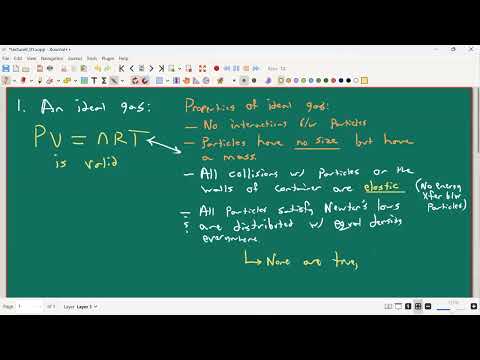
- The ideal model assumes particles have mass but negligible volume and exert no intermolecular forces.
- Particle-particle and particle-wall collisions are assumed elastic, with no energy lost in collisions.
- Particles obey Newtonian mechanics and are uniformly distributed; Seifert emphasizes that these are approximations rather than literally true properties of gases.
8:00
Why Real Gases Need More Than PV = nRT
- Seifert treats nRT as the energy available to the system and PV as the work associated with filling the container.
- A real gas also experiences interaction-related contributions, so the energy bookkeeping can include additional work beyond PV.
- Which corrections matter depends on context: intermolecular forces are broadly relevant, while strain, tension, and mass flow matter in particular systems.
13:00
Intermolecular Forces, Flow, and Context-Dependent Corrections
- Examples of additional contributions include hydrogen bonding, repulsions, material strain, and chemical-potential-driven mass flow.
- Pressure differences in a vacuum line can drive gas flow, making flow an important process beyond a static ideal-gas description.
- The lecture focuses next on interactions that persist across conditions, especially intermolecular attractions and finite particle size.
18:00
Molar Volume as a Density Measure for Gas Comparisons
- Molar volume, V̄ = V/n, is the volume occupied by one mole at specified temperature and pressure; its units can be liters per mole.
- Because density is mass per volume, smaller V̄ corresponds to a denser gas.
- For an ideal gas, P V̄ = RT, so at fixed temperature the ideal-gas baseline varies inversely with pressure.
24:00
Hydrogen, Nitrogen, and CO₂ Deviate from the Ideal Baseline
- At 0°C, the lecture compares real-gas pressure–volume behavior with the ideal prediction P V̄ = RT.
- Hydrogen occupies slightly more volume than the ideal prediction, while nitrogen and especially carbon dioxide are more compact in the plotted range.
- The deviations near atmospheric pressure are small—Seifert estimates roughly 0.5% for one example—but measurable.
29:00
Compressibility Factor Z Tracks Non-Ideal Behavior
- Seifert introduces Z = PV/(nRT), equivalently Z = P V̄/(RT); an ideal gas has Z = 1.
- Z greater than 1 indicates a positive deviation associated here with repulsive or excluded-volume effects; Z below 1 indicates net attraction relative to the ideal baseline.
- At high pressure, helium, methane, and nitrogen all show increasingly positive deviations, consistent with particles resisting further compression.
38:00
Methane’s Attractions Strengthen as Temperature Falls
- Temperature-dependent methane curves show that the attractive region becomes more pronounced as temperature decreases.
- At 600 K, the plotted behavior is predominantly repulsive; near 300 K a dip below Z = 1 appears.
- At 200 K, methane reaches Z around 0.3 in the presented range, indicating a much denser state than the ideal-gas estimate.
45:00
Real-Gas Corrections Matter in High-Pressure Applications
- The balance between attraction and finite-size repulsion changes with conditions, so no gas is universally well described as ideal.
- Seifert contrasts common low-pressure work with industrial reactors operating around 200–300 bar, including ammonia production.
- At such pressures, large deviations can materially alter predicted volumes and energy balances.
48:00
Casimir-Effect Experiment: Neutral Plates and a Spring
- The experiment places two electrically neutral metal plates parallel to each other, with one plate moved by a motor and the other attached to a spring.
- Spring displacement measures whether the plates attract or repel as their separation changes.
- At ordinary macroscopic separations, the measured interaction is effectively zero; the key test is bringing the plates to submicron distances.
55:00
Submicron Separation Reveals Casimir Attraction
- At separations of roughly hundreds of nanometers, the plates attract even though they are neutral and not touching.
- The measured force grows sharply as distance decreases; for ideal parallel plates, the Casimir force scales with separation as 1/d⁴.
- The result is associated with the Casimir effect, predicted by Hendrik Casimir and experimentally measured in the 1990s.
1:00:00
Casimir Attraction Connects to Van der Waals Forces
- The Casimir effect demonstrates that neutral objects containing bound electrons can experience a weak attraction at close range.
- Seifert connects this universal attraction to the van der Waals interactions used to describe attractions between atoms and molecules.
- Larger, more polarizable atoms generally have stronger dispersion attractions; the lecture contrasts small helium with stickier, larger argon.
1:06:00
Recap: Attractive Forces Versus Finite-Size Repulsion
- At low pressure, gases are diffuse and often approximate ideal behavior; at high pressure, finite particle size and crowding produce positive deviations.
- At lower temperatures, attractions can outweigh repulsions, as shown by methane’s Z below 1.
- Seifert identifies the next question: whether attraction and repulsion are separate mechanisms or different expressions of a unified interaction model.
1:10:00
Why Water Is Liquid but Hydrogen Sulfide Is a Gas
- At 298.15 K and 1 bar, water is liquid while hydrogen sulfide (H₂S) is a gas, despite their related molecular structures.
- Sulfur is larger than oxygen, which could strengthen dispersion attractions in H₂S, but that size difference does not explain water’s much higher cohesion.
- The comparison points to an additional strong attraction in water: hydrogen bonding.
1:14:00
Hydrogen Bonding Completes the Real-Gas Preview
- Seifert distinguishes water’s hydrogen bonding from the universal van der Waals attraction that also acts in H₂S.
- Water’s hydrogen bonds help account for its liquid phase under ordinary conditions, unlike H₂S.
- The next lecture will organize hydrogen bonding, van der Waals attractions, and repulsions into a shared model of intermolecular behavior.
Summary, takeaways, and chapters were generated by AI from the video's transcript and may contain errors. The video belongs to its creator, Nathan Seifert.