Lecture 5 - The Fundamental Equation of Thermodynamics (TRASH AUDIO)
 Watch on YouTube →
Overview
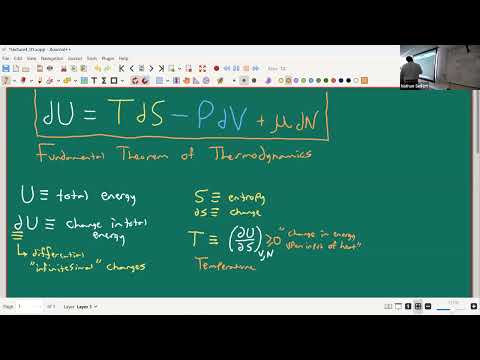
Nathan Seifert develops the fundamental thermodynamic relation dU = T dS − P dV + μ dN, interpreting temperature, pressure, and chemical potential as energy responses to changes in entropy, volume, and particle number. He applies entropy maximization to an isolated two-box piston system to show that thermal equilibrium requires equal temperatures, then connects temperature measurement to water’s triple point and uses James Prescott Joule’s paddle-wheel experiment to distinguish state functions from path-dependent heat and work.
Key takeaways
- The fundamental equation dU = T dS − P dV + μ dN expresses internal-energy changes through entropy, volume, and particle-number changes.
- Temperature is the energy derivative with respect to entropy at fixed volume and particle number; pressure is the negative energy derivative with respect to volume at fixed entropy and particle number.
- For two compartments that can exchange energy but not particles, maximizing total entropy at fixed total energy yields the equilibrium condition T₁ = T₂.
- Water’s triple point provides a reproducible temperature reference: about 273.16 K and 611.657 Pa, where ice, liquid water, and vapor coexist.
- Joule’s paddle-wheel experiments showed that mechanical work can heat water, helping establish the equivalence of work and heat as energy-transfer modes.
- Internal energy is a state function, whereas heat and work are path-dependent transfers; their values depend on how the system moves between its initial and final states.
Chapters
0:00
The Fundamental Equation: Three Ways Internal Energy Changes
- Nathan Seifert revisits the relation dU = T dS − P dV + μ dN as a framework for analyzing energy changes in a thermodynamic system.
- The differential dU represents an infinitesimal change in total internal energy, with contributions from entropy, volume, and particle number.
- The lecture uses the equation to return to a two-compartment piston problem and identify its final equilibrium conditions.
4:30
Temperature as the Energy Response to Entropy
- Temperature is defined as T = (∂U/∂S) at fixed volume and particle number: the energy change associated with an entropy change.
- The units of T convert entropy change into energy change, so T dS has energy units like dU.
- Seifert interprets temperature as the system’s response when heat is supplied while volume and molecule count remain fixed.
10:00
Heat Capacity and the System’s Capacity to Absorb Energy
- Seifert uses a storage-capacity analogy to explain how a system can absorb energy as its entropy and temperature change.
- He connects the energy-versus-entropy slope to heat capacity, emphasizing that a system’s response depends on its temperature and available ways to store energy.
- The analogy is presented as a conceptual aid; heat capacity is a response property, not a literal container of heat objects.
12:00
Pressure and the Energy Cost of Changing Volume
- Pressure is defined by P = −(∂U/∂V) at fixed entropy and particle number, so the minus sign makes expansion work consistent with the energy change.
- For an ideal gas at fixed temperature, P = nRT/V; increasing volume lowers pressure.
- The pressure term −P dV describes mechanical energy transfer associated with expansion or compression.
17:00
Chemical Potential Tracks Energy per Transferred Mole
- Chemical potential is μ = (∂U/∂N) at fixed entropy and volume, expressing how internal energy changes as particles are added.
- Seifert relates μ to mass transfer across a gradient and to converting reactants into products.
- Chemical potential differences help determine the direction of transfer and the conditions for chemical equilibrium.
22:00
Controlling Energy Flow by Constraining a Process
- The three terms in the fundamental relation correspond to energy changes associated with entropy, volume, and particle number.
- Fixing volume, preventing particle exchange, or holding another variable constant removes or limits a pathway in the energy balance.
- Pressure, temperature, and chemical potential act as proportionality factors that quantify responses to changes in their paired variables.
25:00
Set Up the Closed Two-Box Piston Problem
- The piston separates two compartments in a sealed system; heat can pass through the piston, but molecules cannot cross it.
- Because the combined system is isolated, total energy is conserved, and the compartments’ energy changes satisfy dU₁ = −dU₂.
- The goal is to determine the final equilibrium condition without predicting the piston’s exact position or motion over time.
29:00
Entropy Maximization Gives Equal Temperatures
- The total entropy is S₁ + S₂, while the total energy remains fixed as energy moves between the compartments.
- At equilibrium, the total entropy is stationary under an allowed energy transfer; using (∂S/∂U) = 1/T gives 1/T₁ = 1/T₂.
- The resulting condition T₁ = T₂ explains why the piston system reaches thermal equilibrium when both sides have the same temperature.
35:00
Water’s Triple Point as a Temperature Reference
- Seifert explains that a reproducible reference is needed to calibrate a thermometer and establish an absolute temperature scale.
- At water’s triple point, solid ice, liquid water, and water vapor coexist in equilibrium; the pressure is about 611.657 Pa.
- The modern triple-point temperature is 273.16 K, approximately 0.01 °C; this differs from the 273.15 K freezing point at standard atmospheric pressure.
45:00
Thermometers Require Thermal Equilibration
- A thermometer measures a sample by exchanging energy with it until the thermometer and sample reach thermal equilibrium.
- Once equilibration occurs, the thermometer’s calibrated reading represents the sample’s temperature.
- The argument makes temperature operational: measurement requires a physical pathway for the thermometer and system to exchange energy.
53:00
Joule’s Paddle-Wheel Experiment Links Work and Heating
- James Prescott Joule used mechanical work from a paddle wheel, driven by falling weights, to warm water and quantify the mechanical equivalent of heat.
- The lecture contrasts mechanical stirring with heating by a source, emphasizing that both can raise the water’s temperature.
- Joule’s experiments helped establish that work and heat are different modes of energy transfer, not distinct substances.
58:00
Joule’s Result and Gibbs’s State-Variable Framework
- The lecture frames Joule’s experiments as evidence that mechanical work and heating can produce the same change in a system’s thermal state.
- Joule’s paddle-wheel work was historically important to the conservation-of-energy framework and the mechanical equivalent of heat.
- Seifert contrasts apparatus-focused descriptions of heat and work with Gibbs’s use of thermodynamic state variables such as entropy, volume, and particle number.
1:03:00
Why Heat and Work Depend on the Path
- Different sequences of heating and mechanical work can take a system between the same initial and final states while requiring different transfer amounts.
- Internal energy U is a state function, but heat and work depend on the process path; modern notation commonly writes their infinitesimal transfers as δQ and δW.
- A physical apparatus and operating sequence therefore matter when calculating heat and work, even when the system’s endpoints are fixed.
1:09:00
Use State Variables to Describe Material Changes
- The fundamental equation focuses on material properties rather than the particular apparatus used to change a system.
- Entropy, volume, and particle number specify state changes independently of the route taken between states.
- Seifert closes by assigning derivative practice as homework and previews further work with the thermodynamic equations.
Summary, takeaways, and chapters were generated by AI from the video's transcript and may contain errors. The video belongs to its creator, Nathan Seifert.