Lecture 10 - Intermolecular Interactions
 Watch on YouTube →
Overview
Nathan Seifert presents Fritz London's microscopic model of intermolecular interactions, arguing that experimentally measurable binding energy is the observable outcome while the underlying mechanism is modeled through interacting electrostatic charge distributions. The model decomposes molecular behavior into four simultaneous effects—electrostatic attraction, induction, London dispersion/Casimir interactions, and Pauli exchange repulsion—then combines attractive inverse-distance terms with short-range repulsion to produce an equilibrium interaction distance and energy minimum.
Key takeaways
- Binding energy is the primary experimental observable for a noncovalent complex; labels such as hydrogen bond, induction, or dispersion are theoretical interpretations of that measured energy.
- Fritz London's model treats molecules as interacting electrostatic potentials and organizes intermolecular behavior into electrostatic attraction, induction, dispersion, and exchange repulsion.
- A nonpolar molecule can still interact strongly through induction when a nearby polar molecule distorts its electron distribution; polarizability α quantifies that response.
- London dispersion exists even for helium, whose permanent dipole and polarizability are both very small, because instantaneous electron fluctuations have nonzero variance despite zero average polarization.
- Pauli exchange repulsion increases sharply as electron clouds overlap because indistinguishable electrons must be represented through exchanged quantum configurations and cannot occupy the same quantum state.
- The stable separation of neutral molecules comes from adding weak, longer-range attractions to a powerful short-range repulsion, producing a potential-energy minimum rather than unlimited molecular collapse.
Chapters
0:00
Why Intermolecular Interactions Require a Microscopic Model
- Nathan Seifert introduces intermolecular interactions as useful but often oversimplified chemistry concepts, especially hydrogen bonding.
- Only the binding energy, or energy required to separate molecules A and B, is directly measurable for a noncovalent interaction.
- The microscopic cause of a measured binding energy must therefore be inferred through theoretical models and checked against experimental energy values.
5:00
Fritz London's Electrostatic-Potential Framework
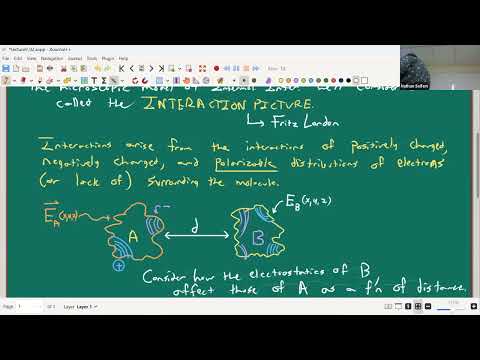
- Fritz London models molecules as three-dimensional electrostatic potentials containing positive, negative, and polarizable regions.
- Molecule B perturbs molecule A as the intermolecular distance changes, allowing the total interaction energy to be decomposed into distinct mechanisms.
- The framework reduces intermolecular behavior to four broad effects: three attractive contributions and one repulsive contribution.
10:00
The Four Fundamental Interaction Contributions
- The three attractive effects are permanent electrostatic interactions, induction, and London dispersion, also called van der Waals or Casimir interactions.
- The major repulsive effect is exchange repulsion, associated with the Pauli exclusion principle.
- Real molecular interactions generally contain all four contributions simultaneously, although their relative magnitudes depend on molecular structure.
15:00
Permanent Electrostatic and Dipole-Dipole Attraction
- Positive regions of one molecule attract negative regions of another, causing polar molecules to align complementary charge regions.
- A polar molecule has separated positive and negative charge centers and therefore possesses a permanent dipole moment.
- The interaction is described as a rapidly distance-dependent attraction; Seifert emphasizes that neutral dipolar interactions weaken much faster with distance than ionic interactions.
20:00
HCl Chains and Water Hydrogen Bonds
- Gas-phase HCl remains a covalent molecule, unlike aqueous HCl, which is substantially ionized into H+ and Cl−.
- HCl molecules align chlorine toward hydrogen and can form linear chains and small clusters through dipole-dipole attraction.
- Water hydrogen bonding follows the same electrostatic principle: oxygen lone pairs provide negative regions that attract electropositive hydrogen atoms.
25:00
Ionic Interactions, Long Range, and Plasma Behavior
- Ion-ion attraction is presented as the strongest charge-based interaction and as much longer-ranged than interactions between neutral dipoles.
- A plasma is a gas of positive and negative charges whose long-range electrostatic interactions prevent it from behaving like an ideal gas.
- Activity coefficients are necessary for ionic solutions because ion-ion interactions make equilibrium constants concentration-dependent.
30:00
Induction: Polar Molecules Creating Dipoles
- A polar molecule can distort the electron distribution of a nonpolar neighbor, shifting electrons away from or toward the approaching charge region.
- The distortion creates an induced dipole in the initially nonpolar molecule and produces a secondary dipole-dipole attraction.
- Induction depends on polarizability, represented by α, which measures how strongly a molecule's dipole changes in response to an external electrostatic field.
35:00
Polarizability in CO2, Nitrogen, and Argon
- CO2 has no permanent dipole because its two C=O bond dipoles cancel, but its extended electron distribution makes it highly polarizable.
- CO2's stronger induced interactions help explain why it evacuates more slowly than nitrogen or helium in a collision-diameter experiment.
- Argon is described as a highly polarizable 'sticky gas,' while nitrogen has a quadrupole arrangement that can produce T-shaped nitrogen dimers.
40:00
Molecular Complexes: Monomers, Dimers, and Larger Aggregates
- A single molecule is a monomer, while an aggregate of two identical molecules is a dimer, such as a water dimer or nitrogen dimer.
- Nitrogen's quadrupole distribution places negative regions near the molecular ends and a relatively positive region near the bond center.
- The resulting electrostatic geometry differs from HCl, whose permanent dipoles preferentially form end-to-end chains.
45:00
London Dispersion and the Casimir Effect
- London dispersion is also called the van der Waals interaction or, in physics contexts, the Casimir effect.
- Even weakly polarizable helium atoms attract one another and form extremely fragile helium dimers, showing that permanent dipoles and strong induction are not required.
- Dispersion arises from correlated, instantaneous electron fluctuations rather than a permanent charge separation.
50:00
Transient Polarizations and Variance-Driven Attraction
- Benzene-like plates provide an example: random electron motion in one plate temporarily polarizes the neighboring plate in the complementary direction.
- The time-averaged polarization is zero, but the instantaneous polarization has nonzero variance.
- London and Casimir theory attributes the net attractive energy to the variance of these fluctuations, not to their zero mean.
55:00
Dispersion as the Universal Long-Range Interaction
- Every material has electron fluctuations, so every atom and molecule experiences some nonzero dispersion attraction.
- Seifert characterizes dispersion as weak but longer-ranged than the short-range exchange repulsion and therefore as the first attraction to appear as particles approach.
- The lecture emphasizes a broader physical principle: fluctuations that average to zero can still generate measurable interactions.
1:00:00
Why Attraction Alone Cannot Describe Matter
- If all intermolecular contributions were attractive, atoms and molecules would collapse into one undifferentiated mass.
- A repulsive contribution is therefore required to stabilize molecular separations and preserve distinct chemical structures.
- The dominant repulsive mechanism in the model is exchange, also called Pauli exclusion or Pauli exchange repulsion.
1:05:50
Electron Indistinguishability and Pauli Exchange
- Electrons are identical and indistinguishable, so individual electrons cannot be assigned persistent identities as they move through a molecular system.
- The Pauli exclusion principle prevents two electrons with the same quantum properties from occupying the same state.
- As two molecular electron clouds overlap, quantum-mechanical exchange between indistinguishable electrons becomes increasingly probable and produces repulsion.
1:11:40
The Net Potential: Attraction, Repulsion, and Equilibrium Distance
- The lecture represents attraction with a negative inverse-distance contribution and exchange repulsion with a rapidly increasing positive term proportional to approximately 1/r^12.
- At long range, interactions approach zero; at intermediate range, attractions dominate; at very short range, exchange repulsion rises sharply.
- The sum produces a potential-energy minimum where dV/dr = 0, defining a preferred 'Goldilocks' separation and an interaction energy that will be used to explain deviations from the ideal-gas law.
Summary, takeaways, and chapters were generated by AI from the video's transcript and may contain errors. The video belongs to its creator, Nathan Seifert.