Lecture 2 - Energy & Conservation
 Watch on YouTube →
Overview
Nathan Seifert frames energy as a measurable accounting quantity whose conservation follows from time-translation symmetry: shifting a reproducible process in time leaves its outcome unchanged, and Emmy Noether’s theorem links that symmetry to a conserved quantity. He then applies the idea to a gas in a box, identifying particle number, volume, and a measure of particle motion as variables needed to describe its state, and uses the ideal-gas relation and energy units to preview heat, pressure-volume work, and the coming definition of temperature.
Key takeaways
- Noether’s theorem connects continuous symmetries to conserved quantities; for time-translation symmetry, the conserved quantity is total energy.
- Energy conservation means the total for a system stays constant while energy can be transferred among its parts.
- A particle model with fixed particle number and volume is not enough to predict gas pressure; a variable describing particle motion or thermal state is also needed.
- The ideal-gas equation PV = nRT is dimensionally consistent because both PV and nRT have energy units, but it is an equation of state, not by itself an energy-conservation law.
- The lecture distinguishes temperature measured through equilibrium with a reference bath from the more general microscopic motion variable that it plans to define next.
Chapters
0:00
Energy as Chemistry’s Accounting System
- The course will focus on thermodynamics—including enthalpy and entropy—and kinetics, which Nathan Seifert says are connected despite being taught separately.
- Energy is introduced as a way to track transfers between parts of a chemical process, rather than as a tangible substance like money.
- Lord Kelvin’s historical fluid analogy is presented as suggestive but incorrect: energy can be tracked as it moves between objects, but it is not literally a fluid.
7:16
A Paper-Ball Throw Tests Reproducibility in Time
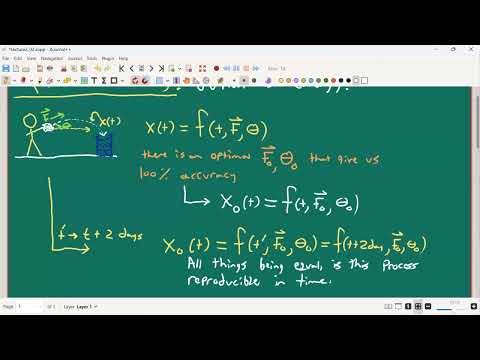
- A student’s throw toward a trash can is modeled by a trajectory that depends on time, the initial force, and the launch angle.
- After finding an optimal force and angle, the student can repeat the experiment later and expect the same trajectory if the conditions remain unchanged.
- Seifert uses this ordinary reproducibility to introduce the more formal idea that physical processes behave consistently when shifted in time.
14:14
Time Reproducibility as the Basis for Energy
- The throwing experiment is treated as reproducible whether repeated two days later or after a much shorter time shift.
- Seifert identifies this invariance under time shifts as the reason energy can serve as a useful measurable quantity.
- He notes that the connection was formalized in the 1920s, rather than being obvious from everyday experience.
17:02
Emmy Noether and the Origin of Noether’s Theorem
- Emmy Noether, a German mathematician born in 1882, developed the theorem that connects continuous symmetries with conserved quantities.
- After earning a mathematics PhD, Noether faced years of rejection from academic posts because she was a woman.
- David Hilbert helped bring her to the University of Göttingen, where she lectured and conducted research despite lacking a paid faculty position.
21:03
Continuous Symmetry: Changing an Input Without Changing the Result
- Noether’s theorem is stated as a link between a system’s continuous symmetry and a conserved quantity.
- A symmetry means that changing a specified variable leaves the system’s output unchanged; a mirror reflection is offered as an intuitive analogy.
- The trash-can experiment is symmetric with respect to time shifts, but changing the force or angle changes the result, so those are not symmetries of that experiment.
25:39
Time-Translation Symmetry Leads to Energy Conservation
- Time-translation symmetry means a process produces the same result when performed at another time, provided the relevant conditions are unchanged.
- A conserved quantity may move between parts of a system while its total remains constant, as with mass redistributed among molecules.
- Applying Noether’s theorem to time-invariant mechanics identifies energy as the conserved quantity: the total energy’s time derivative is zero.
32:20
Noether’s Legacy and Other Conservation Laws
- Seifert surveys other symmetry-conservation connections, including spatial symmetry and conservation laws such as electric charge.
- Noether’s academic career included unpaid work in Germany and later a position at Bryn Mawr College after she left Germany in the 1930s.
- Albert Einstein wrote Noether’s New York Times obituary and praised her mathematical stature; her theorem became central to advanced physics.
38:31
Why Energy Matters for Chemical Processes
- Time and energy are described as closely linked, alongside the analogy between momentum and space.
- Chemical processes such as reactions, melting, and freezing unfold in time, making energy a useful way to track them.
- Seifert shifts from the origin of conservation to the practical question of which measurable variables define a chemical system.
41:18
Building a Minimal Model of a Chemical System
- The class begins a minimal model: identical particles contained in a box, initially treated like billiard balls rather than specific molecules.
- The model seeks a function that takes measurable system variables and returns the total energy.
- Pressure, particle mass, box volume, and particle number are proposed; density is derived from particle number and volume.
48:30
Why Particle Motion Is Missing from the State Description
- Particle number and volume establish how much material occupies how much space, while number density is defined as N/V.
- A stationary collection of particles and a rapidly moving gas could share the same N and V but have very different pressures.
- The missing variable must describe particle motion or thermal energy; Seifert marks it as an unknown to be developed in the next class.
54:40
A Gas in a Thermal Bath and the Ideal-Gas Relation
- A gas-filled container is placed in a water bath so heat can transfer while material remains inside the container.
- For an ideal gas at equilibrium, Seifert writes the equation of state PV = nRT, with pressure P, volume V, amount n, gas constant R, and temperature T.
- The example uses the bath’s fixed temperature to connect a measurable external reference with the gas’s thermal state.
57:16
Checking Energy Units: Joules, Work, and PV
- Mechanical work is introduced as force multiplied by displacement, with SI units of joules: 1 J = 1 N·m = 1 kg·m²/s².
- Using R = 8.314 J·mol⁻¹·K⁻¹ shows that nRT has units of energy.
- Pressure multiplied by volume also has energy units; dimensional agreement alone does not make PV = nRT an energy-conservation equation.
1:02:37
Interpreting Heat, Pressure, and the Gas State
- Seifert interprets pressure as arising from particle collisions with container walls and introduces pressure-volume work as a concept for later study.
- The water bath supplies or absorbs heat as the gas approaches thermal equilibrium with the bath.
- The lecture uses the ideal-gas relation to motivate how thermal and mechanical descriptions connect, while the relation itself is an equation of state rather than a general formula for a gas’s total energy.
1:07:16
Temperature Requires a Reference; The Next Variable Is Still Unknown
- The bath provides a practical temperature reference: once the gas reaches equilibrium with it, the bath’s temperature can be used to describe the gas.
- Seifert asks how to characterize a sealed system without that reference and argues that the underlying motion-related quantity must be more general than temperature.
- The lecture ends by previewing the next class, which will identify that quantity and develop its properties.
Summary, takeaways, and chapters were generated by AI from the video's transcript and may contain errors. The video belongs to its creator, Nathan Seifert.