Lecture 6 - Isothermal Processes
 Watch on YouTube →
Overview
Nathan Seifert uses the triple point of water and statistical averaging to motivate temperature as a tool for simplifying thermodynamic processes. For an isothermal ideal gas, he derives the entropy change ΔS = nR ln(Vf/Vi) and relates heat exchange to pressure–volume work, then connects constant-temperature constraints to combustion engines and to molecular-dynamics simulations of proteins, water, and drug molecules.
Key takeaways
- For an ideal gas undergoing an isothermal volume change, integrating dS = nR dV/V gives ΔS = nR ln(Vf/Vi).
- For a reversible isothermal ideal-gas path, the heat and work magnitudes scale as nRT ln(Vf/Vi); at a fixed volume ratio, entropy change does not depend on temperature.
- A thermal bath can maintain a sample’s temperature while allowing heat to flow in or out, so a piston’s volume change couples thermal exchange to pressure–volume work.
- Molecular-dynamics models depend on both representation resolution and a force field: Newtonian motion supplies particle trajectories, while empirical interactions represent bonds and intermolecular forces.
- Periodic boundaries let a finite simulation box represent a repeating bulk material, but researchers still need statistical diagnostics to determine whether the simulated system has equilibrated.
Chapters
0:00
The Triple Point of Water and Temperature as an Average
- The triple point gives water a unique temperature–pressure reference that can be reproduced experimentally.
- Seifert frames temperature as an average over the many microscopic states a system samples.
- Introducing temperature simplifies thermodynamic calculations, including deriving the ideal-gas internal energy U = 3/2 nRT.
4:00
Using Constraints to Simplify Thermodynamic Processes
- The fundamental energy relation allows changes associated with entropy, volume, and mole number.
- Constraining variables—such as holding temperature or volume fixed—reduces the number of ways a system can change.
- An isothermal process means temperature stays constant; examples include reflux, water baths, and liquid-nitrogen conditions.
8:00
A Heat Bath Enforces Constant Temperature
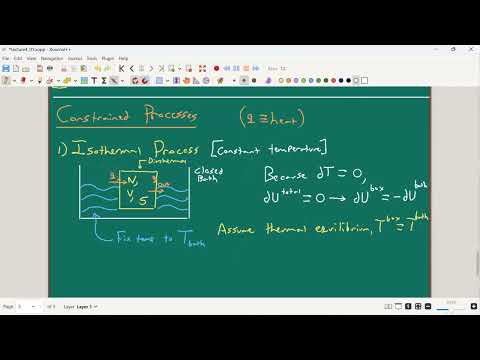
- A sample sits inside a closed bath that can exchange heat with it while maintaining a fixed bath temperature.
- At thermal equilibrium, the sample and bath have the same temperature, and heat leaving one enters the other.
- The sample’s volume is not constrained, so heat transfer can accompany expansion or compression work.
12:00
Isothermal Energy Balance: Heat Exchange and PV Work
- For a constant-temperature system, Seifert relates the entropy term T dS to pressure–volume work, with signs depending on the work convention.
- Heat entering a deformable sample can drive expansion work; heat leaving it can accompany compression.
- A piston or balloon provides a physical model because its volume can change as it exchanges heat with the bath.
16:00
Ideal-Gas Equation of State Gives the Entropy Differential
- Starting from dS = (P/T)dV for the isothermal path, Seifert substitutes the ideal-gas relation P = nRT/V.
- The temperature cancels, giving dS = nR dV/V for an ideal gas.
- The differential shows that equal volume increments produce smaller entropy increments at larger volumes.
20:00
Integrating to Obtain ΔS = nR ln(Vf/Vi)
- Integrating nR dV/V from initial volume Vi to final volume Vf yields ΔS = nR ln(Vf/Vi).
- The logarithm follows from integrating 1/V; Seifert reviews log quotient rules to express the result as a volume ratio.
- For an ideal gas following this isothermal path, entropy increases when the gas expands and decreases when it is compressed.
24:00
Temperature Sets the Work for a Fixed Volume Ratio
- Combining the entropy result with the isothermal energy relation gives a reversible-work magnitude of nRT ln(Vf/Vi).
- For the same volume ratio, ΔS is independent of temperature, while the work and heat magnitudes scale with T.
- A hotter gas therefore requires more work for a comparable expansion or compression than a colder gas.
28:00
Piston Motion Tracks Heat Flow Between Sample and Bath
- Seifert models a gas-filled piston in contact with a large water bath and treats the bath volume change as negligible.
- Heat transfer between bath and gas is coupled to piston motion against an external pressure.
- The example links a change in thermal energy to expansion or contraction rather than treating heat and mechanical work as unrelated.
35:00
Combustion Engines Use Cooling to Manage Temperature
- Seifert applies isothermal reasoning to engine strokes, emphasizing that compression and expansion involve heat transfer and work.
- He cites engine compression ratios around 9:1 to 13:1, with some engines reaching roughly 14:1–15:1.
- Coolant channels, radiators, oil, and—in older Volkswagen Beetles and Porsche 911s—air cooling help manage engine heat and stabilize operating conditions.
42:30
A Biochemistry Simulation Box Models Proteins and Drug Binding
- A typical computational biochemistry system contains water, a protein, and dilute drug or inhibitor molecules.
- Seifert describes Vertex Pharmaceuticals as using simulations to optimize candidate molecules for binding to target proteins.
- Simulation setups specify conditions such as temperature, pressure near 1 bar, pH around 7.2, and a fixed-volume box.
49:00
Periodic Boundaries and Molecular-Dynamics Coarse-Graining
- Periodic boundary conditions make a molecule leaving one side of the simulation box re-enter on the opposite side, approximating a much larger material.
- Molecular dynamics evolves the modeled system over time, with each atom, molecule, or fragment represented as an object obeying Newton’s laws.
- Coarse-graining lets researchers choose the model’s resolution, from individual atoms to simplified molecular or protein representations.
56:45
Force Fields Add Chemical Interactions to Particle Motion
- Each simulated object has kinetic energy and potential energy; the latter captures bonds and intermolecular effects.
- A force field is an empirical model that supplies forces for covalent bonds, hydrogen bonds, van der Waals interactions, and repulsions.
- Once positions, momenta, masses, and force-field interactions are specified, software can numerically advance the particles through time.
1:01:00
Equilibrium Requires Statistical Checks, Not Just a Long Run
- A gas initialized with atoms crowded into one corner should spread through the box toward a more uniform density.
- Running molecular dynamics longer does not by itself prove that the system has reached equilibrium or that a sampled state is representative.
- The next analytical task is to identify statistical properties of an equilibrated gas that can validate microscopic simulations against macroscopic expectations.
Summary, takeaways, and chapters were generated by AI from the video's transcript and may contain errors. The video belongs to its creator, Nathan Seifert.