Lecture 4 - The Entropy Postulates
 Watch on YouTube →
Overview
Nathan Seifert builds the entropy postulates from a gas-and-piston model, arguing that equilibrium can be characterized by entropy reaching a maximum and energy reaching a minimum under the system’s constraints. He then connects those criteria to calculus-based stability tests, protein-folding energy landscapes, path-independent state functions, and entropy’s additivity, monotonic increase with energy, unique value, and extensivity; temperature is introduced as a response to be derived in the next lecture.
Key takeaways
- For an isolated system with fixed total U, V, and N, equilibrium is identified by the accessible state with maximum entropy; the lecture also describes the corresponding stable state as a minimum of energy under its constraints.
- The first-derivative condition locates a candidate equilibrium, while curvature distinguishes stability: U has positive second derivative at a minimum and S has negative second derivative at a maximum.
- For a composite system split into K components, entropy adds as S_total = Σ S_i, allowing a complicated mixture to be analyzed through its component entropies.
- Entropy’s extensivity means scaling U, V, and N by λ scales S by λ, a property useful for defining reference states and standard thermodynamic quantities.
- Reaction pathways can have different activation barriers and rates while sharing the same endpoint thermodynamic change; state functions U and S depend only on initial and final states.
- Protein folding illustrates why energy landscapes matter: a funnel toward a stable minimum can guide molecules through many conformations, whereas a blind search across the simplified 2^583 BSA possibilities would be infeasible.
Chapters
0:00
Temperature as a Response to Changing Entropy
- Seifert frames temperature as something to derive rather than assume as an input in this construction.
- Changing a system’s entropy will produce a temperature response; a reference-temperature bath can then help identify the material’s temperature.
- The lecture’s goal is to establish the entropy properties needed to define temperature in a later session.
2:20
Gas Motion Divides into Work and Non-Work Energy
- In a gas, collective expansion or compression motions push against the container walls and contribute to pressure-volume work.
- Translations, rotations, and other microscopic motions can carry energy without producing net work on the walls.
- For an ideal gas, the lecture uses the relation between PV and nRT to illustrate an equal split between these energy categories.
6:40
Hidden Molecular Modes Motivate Thermodynamic Equilibrium
- Many microscopic motions cannot be tracked through macroscopic inputs such as volume and particle number; Seifert calls these hidden modes.
- Thermodynamic equilibrium lets the system’s energy be represented collectively rather than by monitoring every molecular motion.
- The lecture previews a link between equilibrium and temperature: temperature will provide a measurable description of the hidden modes.
9:40
A Piston Tests How Systems Reach Equilibrium
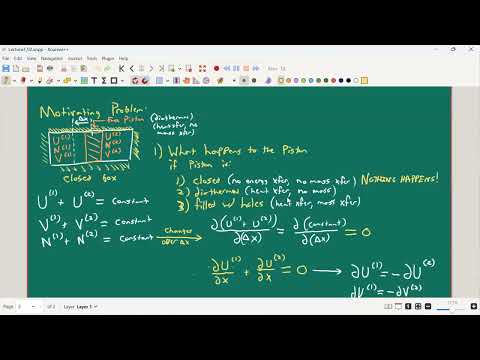
- A partition can be locked, diathermal—allowing heat but not molecules through—or perforated to allow molecules to pass.
- The central question is where a released piston settles when the two sides begin with different volumes, energies, or particle counts.
- The model connects heat transfer and chemical changes to mechanical work, including the operation of a combustion engine.
12:15
Conservation Laws Constrain Piston Motion
- For a closed two-part system, total energy, volume, and particle number remain constant as the piston moves.
- A change on one side must be balanced by an equal-and-opposite change on the other side for each conserved total.
- These constraints describe exchanges but do not by themselves specify when the piston stops; an equilibrium condition is still needed.
16:20
The Entropy Postulate: Equilibrium Maximizes S
- Seifert defines entropy S as a well-defined, single-valued function of internal energy U, volume V, and particle number N.
- At thermodynamic equilibrium, entropy must take its maximum value among the states accessible under the imposed constraints.
- This maximum principle is presented as the basis of the second law for spontaneous processes.
20:15
Using an Entropy-versus-Piston Plot to Find Equilibrium
- Plotting S against piston position makes candidate equilibrium points visible as entropy maxima.
- Intermediate positions on the curve are not equilibrium states under the postulate, even if the system passes through them.
- A system may move past a candidate position and return; the stable endpoint is identified by the accessible maximum.
23:44
Stable Equilibrium Combines Maximum Entropy and Minimum Energy
- Seifert states the complementary criterion that equilibrium corresponds to a minimum of U under the relevant constraints.
- The mnemonic “lazy and chaotic” summarizes the paired tendencies toward low energy and high entropy.
- A local entropy maximum is not sufficient if the system is not also at an energy minimum; both views identify the stable equilibrium.
28:25
Protein Folding Illustrates an Astronomical Conformational Search
- Flexible molecules have multiple conformations; the lecture models each of 583 BSA amino-acid residues as having two arrangements.
- That simplified model gives 2^583, approximately 3.1 × 10^175 possible arrangements, illustrating why blind searching is implausible.
- Seifert contrasts denatured, disordered proteins with the reproducible folded structure observed under suitable biological conditions.
39:24
Energy-Landscape Funnels Help Explain Rapid Protein Folding
- A flat landscape with isolated low-energy pockets would make finding a folded structure like blindly locating a tiny target among immense possibilities.
- A funnel-shaped landscape guides many intermediate conformations toward a stable minimum rather than requiring a random search.
- Folding reflects both the drive toward lower energy and the entropy constraints that shape which paths and configurations are accessible.
43:24
First- and Second-Derivative Tests Identify Extrema
- A candidate extremum occurs where the first derivative with respect to a coordinate is zero.
- At that stationary point, a positive second derivative indicates a local minimum, while a negative second derivative indicates a local maximum.
- A zero second derivative is inconclusive and can mark an inflection point, such as the flat-curvature point in a cubic curve.
50:28
Thermodynamic Stability and Observable Chemical Structures
- The stability test combines a stationary point, positive curvature for U, and negative curvature for S along the permitted change.
- Computational chemistry searches for molecular structures by adjusting atomic positions and bonds until the calculated energy reaches a minimum.
- The course treats experimentally observable starting materials and products as stable equilibrium states, while reaction pathways between them are not assumed to be equilibria.
56:00
Reaction Pathways Affect Kinetics, Not Endpoint Thermodynamics
- Two routes from reactant A to product B can have the same initial and final states but different activation barriers.
- The higher-barrier route is slower, illustrating a kinetic difference even when the endpoint energy change is the same.
- Thermodynamics compares stable endpoints; kinetics is needed to explain how quickly molecules traverse alternative paths.
1:01:11
Internal Energy and Entropy Are State Functions
- Changes in U and S depend on the initial and final states, not on the route taken between them.
- This is the same endpoint logic used in thermochemistry when calculating products-minus-reactants energy differences.
- Seifert contrasts state functions with path-dependent heat transfer, which can vary with the experimental route.
1:03:56
Entropy Postulate Three: Additivity and Growth with Energy
- For a composite system divided into K boxes, total entropy is additive: S_total = Σ S_i.
- Entropy is monotonic in internal energy: at fixed other inputs, ∂S/∂U > 0.
- The lecture uses this positive slope to motivate the later connection between added energy, entropy, and positive temperature.
1:11:23
Single-Valued Entropy and Its Extensive Scaling Rule
- For specified U, V, and N, the postulate assigns one unique entropy; the relationship can also be represented by an energy function of entropy and other variables.
- Entropy is extensive: scaling U, V, and N by λ scales S by the same factor, S(λU, λV, λN) = λS(U, V, N).
- This scaling property supports reference states and standard values, though Seifert reserves the full temperature construction for the next lecture.
1:17:11
Q&A: Entropy, Randomness, and the Stability of Crystals
- In the closing discussion, Seifert describes entropy as a quantity related to the number of accessible arrangements and distinguishes endpoint entropy changes from the route used to transfer heat.
- A crystal can have lower entropy than a disordered phase yet still form when its energetic stabilization compensates for that entropy loss.
- The competition between enthalpic stabilization and entropy helps explain why equilibrium does not always mean maximum disorder in isolation.
Summary, takeaways, and chapters were generated by AI from the video's transcript and may contain errors. The video belongs to its creator, Nathan Seifert.