ZOO*3700 - Lecture 14 - Feeding III: parasites
Overview
Parasitism is a feeding strategy in which a smaller organism derives nutrition from a host while typically benefiting from keeping it alive, and its effects can extend from host behavior to whole ecosystems. Examples include Nematomorpha that manipulate crickets into streams, a Japanese study where infected crickets were 20 times more likely to enter streams and became 60% of an endangered trout’s diet, and fossil evidence consistent with escalating defenses in mollusks. The lecture also connects parasite life cycles and host manipulation to Toxoplasma, Schistosoma, ticks, leeches, trematodes, orthonectids, and unionid mussel larvae.
Key takeaways
- Nematomorph-infected crickets were 20 times more likely to enter streams in a Japanese study, and their arrival shifted an endangered trout’s diet to 60% crickets, triggering changes in stream grazers and algae.
- Parasites generally benefit from keeping hosts alive, unlike parasitoids that kill their hosts; host death can indicate that a stable evolutionary balance has not been reached.
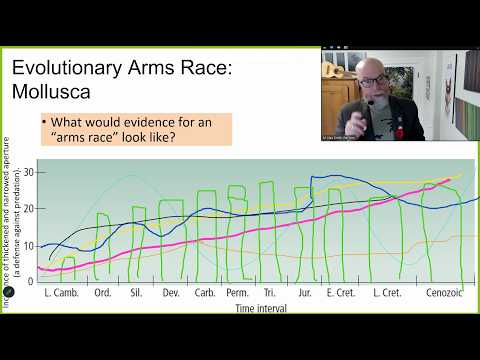
- Fossil records show increasing frequency of thickened, narrowed apertures in mollusks and declining proportions of poorly defended sedentary gastropods, patterns consistent with escalating predation defenses.
- Toxoplasma gondii uses cats as definitive hosts and birds or rodents as intermediate hosts, while humans can become inadvertent hosts through environmental and food or water exposure.
- Schistosoma can persist in people for up to 25 years and produce roughly 300 eggs daily, making clean-water access central to preventing continued transmission.
- Parasite effects can be subtle at the level of one host but substantial across ecological systems, as shown by cricket-driven changes in trout diets, benthic invertebrates, and algal breakdown.
Chapters
- The lecture builds on earlier discussions of deposit feeding, suspension feeding, symbiosis, grazing, and mollusk feeding modes.
- Parasites provide a way to study how interactions affect both individual hosts and the communities those hosts belong to.
- The examples span arthropods, nematodes, flatworms, mollusks, annelids, and the parasitic phylum Orthonectida.
- Mutualism benefits both partners, commensalism benefits one without harming the other, and parasitism benefits one organism at the host’s expense.
- Parasites live in or on a host and derive nutrition directly from it, often despite being many orders of magnitude smaller.
- Unlike a parasitoid, which kills its host, a parasite generally benefits from harvesting a host over time rather than killing it outright.
- Nematomorph eggs and larvae develop in freshwater, and larvae enter aquatic insect larvae such as flies before reaching terrestrial hosts.
- A beetle, mantis, or cricket can serve as a definitive host, allowing the worm to grow from a tiny cyst to as much as 2 meters long.
- At maturity, the worm manipulates its terrestrial host to enter water, where it emerges, mates, and lays sticky eggs.
- In a Japanese study, camel crickets and grasshoppers infected with Gordionus nematomorphs were 20 times more likely to enter a stream.
- During cricket pulses, parasitized camel crickets made up 60% of an endangered trout species’ annual diet.
- With trout eating crickets instead of stream invertebrates, benthic grazers increased, algal biomass fell, and algae broke down faster.
- Nematomorph species are difficult to identify, so it remains unclear whether these parasite-host relationships are specialists or generalists.
- Antagonistic coevolution describes populations evolving adaptations and counter-adaptations in response to one another through natural selection.
- Across mollusks from the Cambrian to the Cenozoic, the frequency of thickened, narrowed shell apertures, a defense against predation, increased over time.
- Within gastropods, poorly defended, loosely attached sedentary forms declined, consistent with increasing predation pressure.
- Fossil patterns support an arms-race interpretation, though broad taxonomic trends can obscure smaller-scale fluctuations.
- Endoparasites live inside hosts, while ectoparasites such as fleas, ticks, lice, leeches, and monogenean flatworms live on the exterior.
- Researchers distinguish pathogenic infections, which cause disease, from non-pathogenic infections, with examples including hookworms and Entamoeba.
- Facultative parasites can complete their life cycle without parasitism; obligatory parasites require a host, and temporary parasites such as leeches feed on hosts briefly.
- Parasitic feeding resembles hunting, but killing the host is generally not the parasite’s evolutionary objective.
- Small parasite body size can support rapid reproduction and complex life cycles involving multiple hosts.
- Some parasites alternate asexual reproduction, which can increase numbers quickly, with sexual reproduction, which generates variation relevant to host-parasite coevolution.
- Parasite species can hybridize, illustrating that reproductive isolation develops gradually rather than appearing at a single sharp boundary.
- Trematode larvae that cause swimmer’s itch can burrow into human skin, making people unintended hosts.
- Cats are the definitive host for Toxoplasma gondii, where sexual reproduction occurs; oocysts in cat feces can persist in soil and water for years.
- Birds and mice can become intermediate hosts, with parasite cysts forming in muscle or nervous tissue and increasing the chance of transmission back to cats.
- Humans can become inadvertent hosts through multiple routes, including contaminated water and food, and the lecture notes estimates that infection is widespread.
- Cross-national data associate greater health-care investment with lower Toxoplasma exposure, but water access, cat populations, and national wealth are possible confounders.
- Schistosoma infects about 200 million people, with at least 600 million more at risk, especially in warm regions where people have frequent water contact.
- An infection can last up to 25 years, and a parasite may lay about 300 eggs per day, making transmission difficult to interrupt where clean water is inaccessible.
- Tick distributions and Lyme disease cases have increased in parts of Ontario, and regional data associated lower affluence with more tick and Lyme cases.
- A 2019 border case involving nearly 5,000 medicinal leeches showed how DNA identification and blood-meal analysis can help establish species and geographic feeding history.
- Orthonectida is a little-known, entirely parasitic phylum with about 20 known species; its tiny forms swim within hosts, and much of its life cycle remains poorly understood.
- Some trematodes alter snail behavior and appearance, making infected snails more vulnerable to birds required to complete the parasite’s life cycle.
- Unionid mussel glochidia larvae attach to the blood-rich gills of fish, making a usually filter-feeding mussel a parasite during its larval stage.
- Ctenophores may both parasitize other organisms and be parasitized, including by tiny annelids; the next course topic shifts to sensory adaptations.
Transcript excerpt
0:01 Good morning. Good morning. Good morning. Good morning. It's Monday. Here we are. Um let's start with some congratulations. Well done. You've got the entire sheet here. So, start out putting your right hand up, patting yourself on the back, and patting whoever is sitting near you on the back, congratulating you on getting all of those words, kind of keywords as we continue our voyage through the incredible array of feeding modes and methods that the invertebrates have. So, we're going to jump right into it. And say, "Where were we last time?" Well, last week both of our shared lecture times together, we were talking about invertebrate feeding modes. And we started out with deposit and suspension feeding. We extended uh on Wednesday
0:49 into thinking about the myriad of ways of important ways that symbiosis molds our world and affects not just invertebrate taxa, but vertebrate taxa. We talked about grazing and browsing in um terrestrial and aquatic and marine environments. We kind of renewed your familiarity with the optimal foraging theory from back in ecology. And we talked about some different some a wide array of ways that mollusks have for feeding. Cuz if given enough time, what can mollusks do? Practically anything. And where are we going today? We're going to talk about a very specific kind of predator um and parasites. Parasites have been a thread, this is my thread, through the sweater of 2700 and
1:36 3700 um because when we're thinking about successful ways of living, parasites, I mean, for every species on the planet, however many hundreds of millions that there are, there are uh each one of them has uh a parasite, potentially many parasites. And thinking about how those parasites affect that host species and then further affect the um the community that
This is the start of the transcript. Save this video free for the whole transcript, searchable and time-coded.
In this course
Related notes
Summary, takeaways, and chapters were generated by AI from the video's transcript and may contain errors. The video belongs to its creator, Alex Smith.