ZOO*3700 Lecture 19- Mobility II - swimming crawling running
Overview
Alex Smith compares how invertebrates swim, crawl, walk, and run, showing that locomotion depends on body size, the physical forces organisms encounter, and their anatomy. Examples range from cilia-driven plankton and jet-propelled cephalopods to tube-footed sea stars, soft-legged caterpillars, tripod-gaited insects, and bipedally walking octopuses, with applications to biomimetic robots.
Key takeaways
- At roughly a millimeter in size, organisms cross from a viscous-dominated regime to one where inertia matters more, changing whether a swimming pulse produces sustained movement or stops quickly.
- Cephalopod paralarvae use jet pulses mainly to resist sinking, while larger adults can use mantle-powered jets for horizontal travel, escape, and predation.
- Sea-star tube feet use water-filled bulbs and coordinated muscles for locomotion, while mutable connective tissue helps support faster galloping strides.
- Caterpillar locomotion is not simply legs pulling the body forward: X-ray tracking showed that the gut pistons forward before the legs follow.
- Insect tripod gait maintains three points of contact and a stable platform; Cataglyphis ants also use step-based path integration to estimate distance home.
- Octopuses can walk bipedally using flexible hydrostatic arms controlled by transverse and oblique muscles, an approach that has inspired soft-legged robots.
Chapters
- The lecture extends the previous discussion of mobility and flight to swimming, crawling, walking, and running.
- Water movement involves gravity, buoyancy, thrust, and drag, as illustrated by a cuttlefish expelling water from its mantle cavity.
- Around a Reynolds number of 1, roughly the scale of a millimeter, viscous forces dominate for small organisms while inertial forces matter more for larger ones.
- Cilia and flagella, often beating in metachronal waves, propel tiny organisms such as paramecia and many marine larvae.
- Larval stages across groups including annelids, echinoderms, snails, and bryozoans commonly encounter low-Reynolds-number conditions.
- Ctenophores are unusually large animals that still swim exclusively with cilia, bundled into visible comb rows.
- A medusa contracts its coronal muscles around the bell, expelling water and moving forward through jet propulsion.
- Adult cuttlefish and other cephalopods refill the mantle cavity and expel water through an adjustable siphon, using the resulting thrust to escape or pursue prey.
- Tiny cephalopod paralarvae face strong viscous drag and use short jet pulses mainly to stay in the water column; larger adults can glide through an inertial regime.
- Colonial pyrosomes move slowly as zooids draw water through oral siphons and expel it through the colony opening.
- Sea cucumbers can undulate their bodies to generate thrust and lift themselves off the seafloor.
- Shell-less predatory gastropods use their foot and mantle as wing-like paddles, trading large surface area for agile swimming.
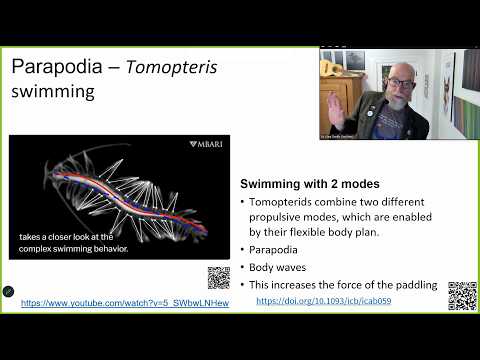
- The polychaete Tomopteris coordinates flexible parapods in a metachronal wave, with body flexion adding force to each stroke.
- Feather stars can creep, crawl, or swim by coordinating movements of their arms.
- Seawater enters the sea star's water vascular system through the madreporite, then travels through canals to the tube feet.
- Muscles and water-filled bulbs extend, attach, and retract hundreds of tube feet in coordinated walking cycles.
- Mutable connective tissue can stiffen to support movement; sea stars can also switch to a faster gait called galloping.
- Galloping speed rises in oscillating strides, with the movement data showing both increasing amplitude and tighter stride frequency.
- Velvet worms, or onychophorans, move with soft, unjointed lobopods that function like muscular hydrostats, with each leg acting like a hooked water balloon.
- Caterpillars such as Manduca sexta also use soft-bodied legs, but X-ray tracking revealed that their internal gut and outer body wall move independently.
- During a caterpillar step, the gut region pistons forward before the legs follow in a wave-like sequence.
- Arthropods evolved articulated legs independently across major lineages, including crustaceans, insects, and chelicerates; leg specialization carries energetic costs but enables diverse functions.
- A six-legged insect has 18 leg joints in the simplified example, requiring coordinated control across all six limbs.
- Insect tripod gait keeps three legs in contact with the ground at a time, creating a stable support platform and limiting movement of the body's center of mass.
- Internal flexor and extensor muscles move the hard cuticular joints, as illustrated by an ant knee.
- Cataglyphis desert ants combine celestial compass cues with path integration; experiments with shortened legs and glued-on stilts showed that step length affects their estimate of distance home.
- Ant-inspired autonomous robots use similar navigation strategies to return to a starting point, including potential search tasks in disaster rubble.
- Millipedes coordinate many legs in metachronal waves, while centipedes use related coordination for faster predatory movement.
- Cockroaches run with a low, stable gait and can compress through a gap only 3 millimeters high while withstanding forces up to 300 times their body weight.
- Two octopus species observed off Papua New Guinea lift the rest of their arms and walk using two pairs of arms.
- Transverse and oblique muscle bands supplement the usual longitudinal and circular muscle arrangement, enabling precise control of the hydrostatic arms.
- Engineers have built an octopus-inspired soft-legged robot that can walk forward and backward, though it remains an early design.
- The mobility unit closes by connecting sessile versus mobile lifestyles, flight, swimming, crawling, walking, and running.
- The next course topic is biodiversity: how many species exist and what happens when they are lost.
- The second Invert R assignment video is due Friday, the lab report Sunday, and the case study the following Tuesday.
- The December 16 final covers all lectures with about 50 questions; students have a 24-hour access window and up to four hours to complete it.
Transcript excerpt
0:00 Arranging my mic. Good morning. Good morning. Good morning. Good morning. And welcome back to the shared time in your week for thinking about one of the shared times for thinking about your invertebrate enthusiasms. Um I see now that congratulations are in order. Put your hands up. Self five. The hidden word is indeed walking. And there it is. Uh don't lose your annotation tools. We'll be using them again today. But today, what are we doing? What are we doing today? Today we're continuing. This is our week, our chapter of moving um of
0:49 thinking about moving. We started out uh last time by considering kind of from a big picture perspective pros and cons associated with being sessile or being mobile or motile. Uh we talked about and then we talked spent the majority of our time talking about flight. Talking about powered flight, the most abundant and successful kinds of powered flight. Not the birds. Millions of years before the birds we're talking about insects. We talked about powered flight. We talked about gliding. We talked about ballooning. We talked about all sorts of things. Some biomimetic strategies to copy that. And today what we're going to do is continue our voyage inside of the invertebrate world and thinking about movement. And today we're going to think about swimming and crawling and walking
1:38 and running. And so there is a Simpson's example of each kind of mobile strategy. So we're going to draw on zoom into some spotlights in each case. We'll talk about movement by cilia. We'll talk about movement by jet propulsion. We'll talk about movement by flapping uh by low soft lopopod uh legs and by hard articulated legs movement all over their planet that they share with us. Where does this sit? We're drawing on
This is the start of the transcript. Save this video free for the whole transcript, searchable and time-coded.
In this course
Related notes
Summary, takeaways, and chapters were generated by AI from the video's transcript and may contain errors. The video belongs to its creator, Alex Smith.