ZOO*3700 - Lecture 18: Mobility I: Flight
Overview
Alex Smith contrasts the energy-saving and reproductive advantages of sessile life with the food-finding, escape, and dispersal benefits of mobility, then explains how insect flight works through wing structure, muscle mechanics, and aerodynamic adaptations. Examples range from direct and indirect flight muscles to featherwing beetles, canopy-gliding ants, spider ballooning, fly halteres, and dragonflies, including estimates of 3 × 10^9 insects in a kilometer-high air column and dragonfly flight muscles reaching about 60% of body mass.
Key takeaways
- Sessile organisms conserve locomotion energy for reproduction but must rely on food delivery by the environment; mobile larval stages can still provide dispersal.
- Insect wings are cuticular extensions, and most flying insects power them indirectly by deforming the thorax rather than attaching muscles directly to the wings.
- Wing flexibility and recovery strokes are essential parts of insect flight mechanics, helping explain why simplified rigid-wing calculations incorrectly predicted that bumblebees could not fly.
- Featherwing beetles reduce wing membrane to bristle-like structures, an adaptation that lowers the cost of flying in viscous, low-Reynolds-number air.
- Cephalotes atratus workers can steer toward tree trunks while falling from 30 to 40 meters in the canopy, using flattened tarsi as aerodynamic surfaces.
- Dragonflies devote about 60% of body mass to flight muscle and can generate agile maneuvers that offer design ideas for biomimetic drones.
Chapters
- Sessile adults such as sponges can invest energy saved from locomotion in reproduction, while depending on environmental flow to bring food.
- Sponges and sabellid worms use mobile larval stages for dispersal; adult sabellid worms can retract into protective tubes when threatened.
- Sessile bilaterians such as bryozoans and stalked crinoids may show reduced cephalization and more radial feeding arrangements.
- Time-lapse observations show that some apparently sessile sponges and corals move over seasonal timescales.
- Movement helps animals reach patchily distributed prey and mates, leave toxin-accumulating environments, and escape hostile interactions.
- Mobility requires energy that could otherwise support reproduction, creating a life-history tradeoff.
- Flight is one of several movement strategies; swimming, crawling, walking, and running are addressed as other forms of locomotion.
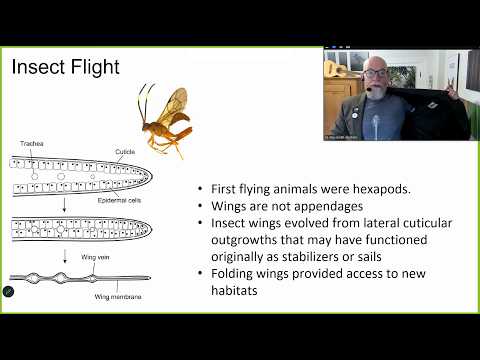
- Insects were the first animals to fly, and hexapods, especially insects, dominate flying-animal diversity and abundance.
- Insect wings are lateral extensions of the cuticle, not limbs; legs and antennae are the true appendages.
- Thin membranous wings retain cuticular veins that contain structures including tracheae, and their flexibility allows controlled deformation.
- Rove beetles, or staphylinids, fold their wings under the elytra using abdominal movements, then rapidly unfold them for flight.
- Flight involves lift, weight, thrust, and drag; insect muscles supply thrust while wing orientation and movement generate lift.
- In odonates, including dragonflies and damselflies, muscles attach directly to the wing bases and power wing strokes.
- Mayflies and odonates use direct flight muscles and cannot fold their wings over the abdomen.
- Most flying insects use indirect flight: longitudinal and dorsal-ventral muscles deform the thorax rather than attaching directly to the wings.
- Thoracic cuticle rebounds between strokes, helping drive wing movement through antagonistic, stretch-activated muscle pairs.
- Indirect flight is associated with high efficiency and with the ability to fold wings over the abdomen in some insect groups.
- Blowfly imaging distinguishes large flight-powering muscles from smaller muscles that adjust wing angle.
- High-speed imaging shows that insect wings flex and twist in flight, unlike rigid airplane wings.
- Grasshoppers, hawk moths, and bumblebees use power and recovery strokes; wing deformation helps explain why the claim that bumblebees cannot fly was based on oversimplified calculations.
- Wingbeat frequency generally declines with body mass, while accounting for wing area changes the relationship and reveals differences among insect groups.
- Butterflies and moths show a clearer scaling pattern in the presented data than odonates, emphasizing that wing area and shape matter alongside body mass.
- An upward-pointing radar study estimated roughly 3 × 10^9 insects moving through a kilometer-high air column.
- Insects around or below a millimeter encounter low-Reynolds-number conditions, where viscous drag matters more than inertia.
- Featherwing beetles, with a scale-bar example of about 200 micrometers, use bristle-like wings with greatly reduced membrane area.
- Their wings paddle through viscous air with power and recovery strokes, reducing the wing mass and muscle demands of flight.
- Wingless workers of the rainforest ant Cephalotes atratus can steer back toward a tree trunk after falling 30 to 40 meters from the canopy.
- Researchers in Panama used forceps and video to document directed gliding, rather than simple passive falling.
- Dorsoventrally flattened tarsi and body shape act as aerodynamic surfaces that help the ants control their glide.
- Ballooning spiders release nanoscale silk fibers that interact with air through viscous forces, allowing dispersal even when wind is absent.
- Spider legs and mechanosensory hairs, including trichobothria, help detect airflow and atmospheric electrical conditions associated with ballooning.
- Hawk moths hover by adjusting body position and abdomen movement; opening spiracles supplies oxygen to powerful flight muscles.
- Dipteran halteres act as gyroscopic sensory organs, and some calyptrate flies keep them moving while walking to support faster takeoff without sacrificing stability.
- Dragonflies use direct flight muscles, with flight muscle reaching about 60% of body mass and recorded speeds around 55 km/h.
- The lecture describes dragonflies as highly successful predators, with a cited capture efficiency of about 97%.
- They can fly upside down, hover, and fly backward by rotating the body and redirecting wing forces; backward flight can generate forces greater than body weight.
- Dragonfly flight mechanics inspire biomimetic aerial robots and drones designed for agile forward, backward, and inverted movement.
Transcript excerpt
0:03 All right. Good morning. Good morning. Good morning. Good morning. It's Monday. Thank you, Sloane. I needed a bit of a pick-me-up. I hope your week uh I hope your weekend was exactly whatever you needed it to be. I hope it was as um efficient and effective or as relaxing as uh as you required it to be. Today, we're starting our second last more or less chapter in our invertebrate time together. We're going to be talking both days this week about mobility. Um so we're going to be talking today about ways of being mobile or sessile decisions, evolutionary decisions associated with each of those strategies.
0:50 And then we're going to jump right in off the deep end and as Tom Petty said, we're going to be learning to fly. Where did we come from? In 3,700 [clears throat] we were talking last week about um their our last time in our chapter on sensory systems and we talked about mechanoreception and we talked about statocysts and statoliths and halteres. Halteres will make an an appearance today actually. Spider legs and slit sensilla and actually the sensitivity of spider legs makes an appearance today as well. Uh these all share the same invertebrate universe, so there's crossover. Uh ants, winds, and herbivores, ants making an appearance today. Oh my god, there's themes in this, Dr. Smith. And acoustic communication. What are we talking about today? Um we're going to be talking about the pros
1:38 and cons of being sessile or mobile from an evolutionary perspective. When we start talking about flight, we're going to talk about physical forces. We're going to talk about uh the preponderance of flying animals across the world. This is not a bird thing. This is an insect and arthropod thing. We're going to talk
This is the start of the transcript. Save this video free for the whole transcript, searchable and time-coded.
In this course
Related notes
Summary, takeaways, and chapters were generated by AI from the video's transcript and may contain errors. The video belongs to its creator, Alex Smith.