04 - InvertR - Assignment II - Video reflections and suggestions
 Watch on YouTube →
Overview
Alex Smith advises students preparing their second invertebrate research-and-reporting assignment to shape their findings into an accurate, engaging three-minute briefing that a federal research scientist could deliver to a minister at short notice. He emphasizes early analysis and repeated practice, then gives concrete guidance on following R-code instructions, using statistical results, cutting material rather than speaking faster, and incorporating scientific literature through spoken citations.
Key takeaways
- Prepare the assignment as a three-minute briefing a federal research scientist might have to deliver to a minister without warning.
- A short science pitch should connect accurate findings to their value, because data alone does not communicate why conclusions matter.
- Complete the R analysis, figures, and literature review early, then use the remaining two weeks for script iterations and presentation practice.
- The first assignment's deadline pattern, with about three-quarters of submissions in the final 24 hours and nearly 20% in the final hour, left limited opportunity for practice and feedback.
- When a presentation runs over three minutes, remove or restructure content rather than increasing speaking speed.
- Give credit to relevant research through concise spoken citations that explain how prior work informed the findings.
Chapters
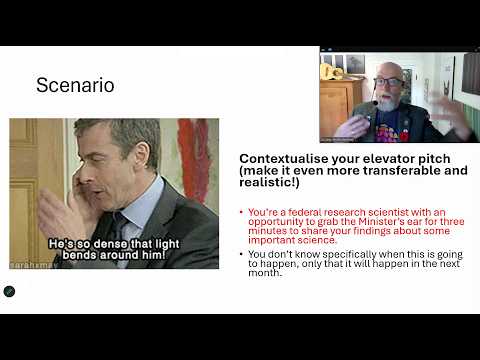
- Smith suggests treating the assignment as preparation for a federal research scientist asked to brief a minister at a moment's notice.
- The three-minute pitch should be concise, enthusiastic, accurate, and give context and significance to the data and species.
- The minister scenario is guidance for making the task career-relevant; the assignment rubric remains unchanged.
- Smith invokes Peter Capaldi's Malcolm Tucker from The Thick of It and argues that facts need personal communication to convey the value of scientific conclusions.
- A three-minute presentation takes practice, just like sports or musical performance; leaving preparation to the final moment reduces readiness for an unexpected briefing.
- About three-quarters of students submitted the first assignment in its final 24 hours, and nearly 20% submitted in its final hour, leaving little time for revision or feedback.
- Smith recommends completing the GitHub R work, figures, and relevant literature early, then reserving the following two weeks to revise the script and presentation.
- Record and review the presentation, test it with friends or colleagues, and refine the narrative and visual setup, whether using a wall, whiteboard, or another prop.
- Follow the assignment's R-code instructions, include requested elements such as your name, and write down statistical results to support the argument.
- If the talk exceeds three minutes, cut or reorganize material instead of speaking faster, which can make communication harder to follow.
- Integrate literature in a natural spoken form by naming an author or study and explaining the idea it contributed, rather than relying only on a PDF.
- Smith describes citing prior research during talks and meetings as a skill developed by maturing scientists.
Transcript excerpt
0:01 Good afternoon. Good evening. Good morning. Good day and hello, wherever and whenever you are consuming this. I wanted to take 10 minutes uh here in this window between when you've received back your evaluations on your first invertebrate RR experiment. And as you have kind of 2 to 3 weeks still to complete your second invertebrate RR experiment. And I want to just touch base with uh some of my impressions and reflections on your first video assignment. And I think they're going to uh come in, barring any tangents that my mind heads into, they're going to come in four. I'm going to talk about adjusting your scenario, uh which we talked about as an elevator pitch. I'm going to add a particular tweak or a um a direction to that that I hope will help. And I'm going to talk about the importance of practicing. And I'm going
0:49 to practice uh I'm going to practice talking about the importance of of time management and a timeline in preparing for this. And then there were some common questions that happened, so I'll uh I'll just jump into some of those, so you all have the benefit of those answers. The first one is um tweaking the scenario, adding to the scenario. So, I want you uh I have asked you in the first invertebrate RR to consider all of the thought and the enthusiasm and the passion and the conciseness and the density that goes into an elevator pitch in the first invertebrate RR. I'm going to ask you to focus a little bit now on making it even more transferable and realistic to your career as a biologist. And I want you to consider the scenario being that you're a federal research scientist with an
1:38 opportunity to grab a minister's ear uh
This is the start of the transcript. Save this video free for the whole transcript, searchable and time-coded.
In this course
Related notes
Summary, takeaways, and chapters were generated by AI from the video's transcript and may contain errors. The video belongs to its creator, Alex Smith.