ZOO*3700 - Lecture 16 - Sensory I: chemoreception
Overview
Alex Smith presents chemoreception as a broad system for sensing chemicals, arguing that the human distinction between taste and smell does not capture how many invertebrates use chemical cues to feed, find mates, navigate, and coordinate social behavior. Examples range from annelid nuchal organs and molluscan osphradia to moth antennae with pheromone-sensitive neurons, spider leg sensilla, and ant colonies with far more extensive olfactory systems than solitary flies.
Key takeaways
- Invertebrate chemoreception uses overlapping systems rather than a universal taste-versus-smell division; sensilla and ionotropic receptors can contribute to detecting multiple kinds of chemical cues.
- Pores in cuticular sensilla provide a route for environmental chemicals to reach sensory neurons, while the number and placement of sensilla vary with an animal's habitat and behavior.
- Male moths can detect pheromone signals from up to 11 kilometres away, with one hawk moth estimate reaching about 360,000 sensory neurons across its antenna.
- Male spiders detect female sex pheromones with wall-pore sensilla on their legs, concentrated in areas with little contact to reduce damage.
- Ants have much greater olfactory investment than solitary flies: about 400 versus 60 receptor genes and more than 7,000 versus about 400 antennal sensilla.
- Chemical trails allow ants to recruit nestmates to food, and trails fade when workers stop reinforcing them after a resource is depleted.
Chapters
- Chemoreception is the sensing of chemicals in or around an organism, and it informs feeding, homing, mating, social behavior, and escape from predators.
- Alex Smith argues that separating gustation from olfaction reflects human experience more than a universal division across invertebrates.
- Olfactory and gustatory receptor neurons often sit in sensilla, while ionotropic receptors can contribute to both taste and smell.
- A typical sensillum is a hair-like projection from the cuticle, innervated by sensory neurons whose processes extend toward its tip.
- Pores in the sensillum allow environmental chemicals to alter the sensillar lymph and contact the sensory system.
- Sensilla can occur on antennae, body walls, and mouthparts, and chemical cues can trigger larval settlement, gamete release, or predator-prey interactions.
- Polychaete annelids have a substantial share of brain tissue devoted to chemical sensing used in feeding, shelter seeking, and social or aggressive interactions.
- Nuchal organs are paired ciliated pits or slits found in annelids but not in every annelid; some can evert to expose more sensory surface.
- Removal experiments linked nuchal organs to feeding, while microscopy revealed cilia with pores and sensory innervation.
- Predatory polychaetes such as fireworms can have expanded, eversible arrays; leeches also have numerous sensory pits along the body.
- Gastropod tentacles contain chemical as well as light-sensing structures, supporting orientation, homing, and feeding in terrestrial and aquatic environments.
- Some predatory surfing snails detect decaying fish downstream from as far as 20 metres away.
- The molluscan osphradium samples water entering the mantle cavity and may inform feeding, gamete release, or shell closure when water contains harmful particles.
- Osphradia are understood as a molluscan shared feature that has been lost in some lineages, including terrestrial slugs and cephalopods.
- Ant antennae detect cuticular hydrocarbons that help distinguish nestmates from other species or rival colonies.
- Male moths have feathered antennae with many pheromone-sensitive sensilla, matching their role in detecting female signals.
- Moth pheromone cues can be detected from up to 11 kilometres away, and one estimate for a hawk moth antenna is about 360,000 sensory neurons.
- A specialized receptor neuron responds to the species-specific pheromone component bombykal.
- Crustacean antennae and antennules bear chemosensory structures called aesthetascs, often arranged as dense tufts along feather-like branches.
- Guard sensilla provide mechanoreception alongside aesthetasc chemical sensing, making some antennules bimodal sensory organs.
- Marine isopods have extensive antennular sensory surfaces, while terrestrial isopods tend to have fewer segments and reduced sensory areas concentrated near the tip.
- Beetle species living in permanently dark caves can have longer antennae than close surface-dwelling relatives, consistent with greater investment in nonvisual sensing.
- Male spiders detect female sex pheromones using wall-pore sensilla on their legs, despite lacking antennae.
- Female spiders and young males lack these specialized pheromone-sensing sensilla, which appear in sexually active males.
- Wall-pore sensilla are concentrated on leg regions with little contact, reducing the chance of damage; tip sensilla associated with taste are more common near contact areas.
- Staphylinid beetles in tropical montane forests combine compound eyes with mouthparts covered in taste-sensitive structures.
- Differences in mandible shape and the density of tip-pore sensilla may reflect differences in prey capture and evaluation of food already in the mouth.
- Beetle antennae contain chemosensory and mechanosensory pits and hairs, with sensory structures visible in scanning electron micrographs.
- Ant workers use chemical cues to locate food, recognize nestmates, care for larvae, remove waste, and defend colony resources.
- Compared with solitary flies, ants have roughly 400 versus 60 olfactory receptor genes and more than 7,000 versus about 400 antennal sensilla.
- Ant trail pheromones guide workers from the nest to food; as a food source is exhausted, the trail fades when workers stop reinforcing it.
- In tandem running, a scout recruits a worker through antennal contact, and both ants can lay trails that help recruit additional nestmates.
- The lecture closes by distinguishing chemical sensing from mechanoreception, which detects mechanical conditions and includes responses to sound.
- Antennae and moth legs can carry mechanoreceptors such as proprioceptive bristles alongside chemosensory sensilla.
- The following lecture and lab work move from chemoreception to mechanoreception and sensory responses across invertebrate groups.
Transcript excerpt
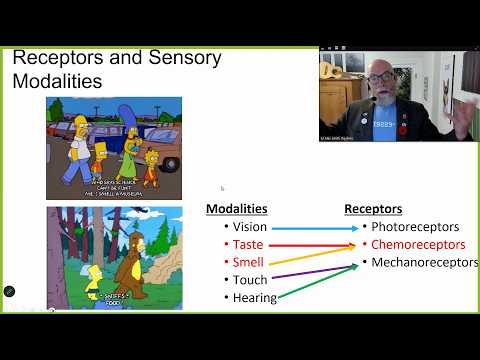
0:01 All right. Good morning. Good morning, good morning, good morning. And welcome back to this couple of preserved times, several preserved times in a week that you have the privilege and responsibility for thinking about the little things, whose world this is that they share with us. Today, we're going to be continuing our our journey, our sensory journey through the myriad of ways that invertebrates experience the world via We talked last time about let me clear these to have a visual to go along with my words. Where were we last time? We were talking about photoreception. We kind of talked
0:48 about modalities and sensing. And we talked principally about photoreception, about light and about the ways that invertebrates have for dealing and receiving light and how that's broadly experienced across the animal phylogeny speaking to its age. And we talked a little bit about the emergence of photoreception likely from chemosensory tools in the Cambrian. And where we're going today is to talk about some of those chemosensory tools. We're going to talk a little bit about the history of how we talk about taste and smell. We're going to talk about methods of chemoreception across some invertebrate groups including annelids and mollusks. We're going to spend a lot of time with arthropods though today because arthropods with their antennas
1:37 kind of waving around are really just wonderful opportunities to think about the number of different ways that organisms have invertebrates have for smelling and tasting the world. And it also then at the end makes a nice bridge to jumping off on Wednesday when we're going to be talking about mechanoreception. Okay. So, first of all, um as we're So, and then I'll put up here's the kind of where this sits in terms of the uh
This is the start of the transcript. Save this video free for the whole transcript, searchable and time-coded.
In this course
Related notes
Summary, takeaways, and chapters were generated by AI from the video's transcript and may contain errors. The video belongs to its creator, Alex Smith.