ZOO*3700 - Lecture 13 - Feeding II: Symbiosis, grazing, browsing & hunting
 Watch on YouTube →
Overview
Alex Smith compares how invertebrates obtain food through symbiosis, grazing, browsing, and hunting, emphasizing that these strategies have evolved repeatedly and often overlap. Examples include Riftia tubeworms relying on chemoautotrophic bacteria at hydrothermal vents, Elysia sea slugs retaining algal plastids for photosynthesis, sea urchins grazing kelp forests, and predators whose feeding choices can be analyzed with Charnov’s marginal value theorem.
Key takeaways
- Riftia tubeworms have no gut; their trophosomes house chemoautotrophic bacteria that convert reduced chemicals at hydrothermal vents into nutrients for the host.
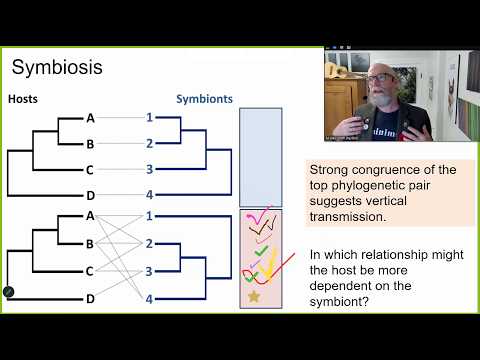
- Symbiont transmission leaves evolutionary signatures: matching host and bacterial phylogenies support vertical transmission, while environmental acquisition is horizontal and can produce less congruent trees.
- ROV SuBastian observations published in Nature in 2024 revealed tunnels beneath hydrothermal vents that may connect surface communities and provide routes for larval dispersal.
- Elysia sea slugs retain algal plastids for photosynthesis but must keep feeding to replace plastids as they die; Elysia marginata can also detach its head and regenerate a body.
- Sea urchin grazing can sharply reduce kelp cover once densities rise above roughly one urchin per square metre, illustrating how predator release can reshape an entire ecosystem.
- Charnov’s marginal value theorem predicts that foragers should leave a food patch when its declining rate of return is lower than the expected gain from moving elsewhere.
Chapters
- The lecture builds on suspension and deposit feeding, introducing symbiosis, grazing, browsing, and hunting as additional invertebrate feeding strategies.
- Symbiosis and mutualism have received increasing recognition in evolutionary biology, alongside traditional emphasis on competition.
- These feeding strategies are not monophyletic groups: similar solutions have evolved independently in multiple lineages.
- Deep-sea hydrothermal vents lack sunlight and expose animals to chemical conditions that many large eukaryotes cannot tolerate directly.
- Chemoautotrophic bacteria use reduced compounds such as sulfur, hydrogen, and methane to produce organic nutrients for animal hosts.
- Vent symbioses include siboglinid worms with bacterial-housing trophosomes, shrimp with external symbionts, and gastropods with bacteria in gill structures.
- Symbiosis-based vent communities support wider ecological networks, and similar associations occur across at least seven animal phyla.
- Riftia and other siboglinid tubeworms lack a gut and rely on a highly vascularized trophosome containing chemosynthetic bacterial symbionts.
- The worm provides the bacteria with a habitat, while bacterial metabolism supplies nutrients that sustain the host.
- In Riftia, larvae acquire symbionts horizontally from free-living bacteria in the environment, likely after settling near a vent.
- When a host dies and its trophosome degrades, bacteria return to the environment and can become available to later generations.
- Horizontal transmission occurs when hosts acquire symbionts from the environment; vertical transmission passes symbionts directly from parent to offspring.
- Host and bacterial phylogenies that closely match, as in the discussed Calyptogena and Vesicomyidae examples, support a history of vertical transmission.
- A mismatch between host and symbiont phylogenies is more consistent with horizontal acquisition across host lineages.
- Removing symbionts experimentally could test host dependence: the prediction is that hosts with intimate, vertically transmitted associations may suffer greater health effects.
- ROV SuBastian, operated by the Schmidt Ocean Institute, used a manipulator to turn over vent habitat and expose previously overlooked cavities and tunnels.
- Observations reported in Nature in 2024 revealed subseafloor passages containing adults and larval dispersal routes between surface communities.
- These tunnels may connect otherwise separated vent sites and change assumptions about how vent animals disperse through the water column.
- Population connectivity matters because it affects whether hosts and their symbionts can reach suitable habitat and establish new populations.
- Elysia sea slugs feed on algae but can retain some plastids rather than digesting them, allowing photosynthesis to continue inside the animal.
- The slug’s nuclear genes help maintain plastid function, making it a photosynthesizing animal that still needs to feed and replenish plastids.
- In Elysia marginata, the head can detach from a parasite-laden body, continue photosynthesizing, and regenerate a new body.
- Research has revised the taxonomy of some familiar Elysia examples, which were once treated as one species but may represent many species across multiple genera.
- Plant food is often low in nutritional quality and difficult to digest, encouraging herbivores to evolve longer guts, digestive enzymes, and microbial symbionts.
- Plants and herbivores participate in an evolutionary arms race: plant alkaloids, glycosides, and tannins can counter adaptations that improve digestion.
- Mollusks use the radula, a tooth-bearing organ, to scrape food; salivary and digestive glands can begin digestion near the mouth.
- Elysia radular teeth can vary with diet, including flatter spatulate and more knife-like forms, showing developmental plasticity within a species.
- Sea urchins use Aristotle’s lantern, a five-part chewing apparatus, to scrape algae and other sessile food into a long, looping gut.
- Urchin guts contain bacterial, protozoan, and metazoan symbionts that contribute to digestion.
- West Coast kelp data show a dramatic, nonlinear decline in kelp cover as urchin density rises, with a marked effect as abundance increases from fewer than one to roughly one to five urchins per square metre.
- When predators no longer control herbivore numbers, abundant grazers can transform kelp forests and harm the broader community that depends on them.
- Predators use pursuit, searching, or ambush; examples include grasping chaetognaths, raptorial mantids, and spiders that wait in flowers.
- Predatory adaptations include sensory and visual specializations, concealment, mimicry, and toxins; some jumping spiders resemble ants closely enough to fool observers at a distance.
- Feeding categories have fuzzy boundaries: shrimp can hunt fish, boring sponges such as Cliona can prey on other animals, and vampire moths use hooked proboscises to feed on blood.
- Charnov’s marginal value theorem predicts that a forager should leave a patch when its diminishing rate of food gain falls below the expected return from moving to another patch.
- Optimal foraging compares energy gained with search and handling time; crabs may favour intermediate-sized mussels rather than the largest or smallest prey.
- Ladybird beetles use aposematic warning colors, and more orange coloration can signal greater toxicity and higher costs to predators.
- Some nudibranchs capture prey with a mantle-like hood, while surface-dwelling rafting nudibranchs feed on barnacles and may comprise multiple species previously grouped as one.
- Cone snails have radulae modified to inject venom, enabling them to immobilize and consume mobile fish.
- The weekly case study is scheduled to appear on CourseLink the following morning, and students are advised to begin the invertebrate research assignment early.
- Students should finish the crayfish model before Lab 5, which covers anatomy and physiology.
- The next lectures will cover parasites, including nematomorphs, followed by photoreception, chemoreception, and mechanoreception.
Transcript excerpt
0:00 All right, I hope you can hear me. Good morning, good morning, good morning. And uh welcome to our continuing journey through the myriad of ways that invertebrates feed. That's the theme for this week, right? Um and for part of next week even. So, let me clear the words you have found. Awesome. And we'll get going. Um previously on Zoology 3700, uh we were talking we began our journey into the ways than the myriad of ways in which invertebrates feed. We talked about the first ways, uh suspension and deposit feeding, and the most broadly distributed ways across the world, suspension and deposit feeding.
0:51 And I am wondering we had a visitor in class. Um I was going to write a poll, but show me in the chat. Did any of you notice uh about seven times, I think, right here. We had a visitor in the back of the class. Did anybody notice him? He was a small uh child who was very excited about Halloween and took his PD day as an opportunity uh to share that with you. >> [laughter] >> All right. Well, there's the Easter egg. So, when you if you can go back and if you want to scan in and watch last week's lecture, uh you can count the number of times you
1:38 see Daniel appear in the background. Where are we going today? We're going to be talking about uh oh gosh. Here's the Here's a surprise. We're going to be talking about a lot. We're going to talk about symbiosis because I think one of the major trends in evolutionary biology, one of the major um aspects of the 21st century uh study of evolutionary biology versus the 20th and 19th century study of biology is the emphasis, the increasing recognition
This is the start of the transcript. Save this video free for the whole transcript, searchable and time-coded.
Related notes
Summary, takeaways, and chapters were generated by AI from the video's transcript and may contain errors. The video belongs to its creator, Alex Smith.