ZOO*3700 - Lecture 17 - Sensory III: mechanoreception
Overview
Mechanoreception converts physical deformation into neural signals, allowing invertebrates to sense orientation, touch, vibration, sound, and movement. Examples range from statocysts in cnidarians and ctenophores to fly halteres, spider slit organs, acoustic signaling in ants and caterpillars, and specialized hearing in katydids and parasitoid flies; ship noise also illustrates how altered sensory environments can stress marine animals.
Key takeaways
- Statocysts use moving mineralized statoliths and sensory hairs to detect orientation, appearing across groups from cnidarians and ctenophores to decapod crustaceans.
- Crabs exposed to ship noise consumed more oxygen than crabs in a normal acoustic environment, indicating that human-generated underwater sound can impose physiological stress.
- Dipteran halteres act as gyroscopic strain sensors, giving flies rapid feedback for stabilizing flight and coordinating wing control.
- Ants and caterpillars can read vibrations through plants: acacia ants distinguish herbivore browsing from wind, while birch caterpillars silence their signals when predators approach.
- Katydids separate communication from predator detection using different tympanal pathways: body drums hear conspecific calls, while knee drums respond to bat frequencies.
- Ormia ochracea's mechanically coupled eardrums amplify minute timing differences, enabling a tiny fly to locate cricket calls and inspiring acoustic microsensors.
Chapters
- Mechanoreceptors convert deformation of body structures into neural impulses, supporting touch, vibration, sound, and orientation.
- Examples include statocysts, cuticular hairs, bristles, deformable plates, and arthropod chordotonal organs.
- Mechanoreception contributes to movement, mating, predator avoidance, and communication, but signals such as mating sounds can also reveal an animal's location to predators.
- A statocyst contains mineralized statoliths suspended in fluid; when the mass shifts, it contacts sensory hairs and signals body orientation.
- Statocysts occur in cnidarians, ctenophores, Xenoturbella, and many pelagic larvae, where detecting orientation in the water is useful.
- Cnidarian rhopalia combine statocyst function with photoreception and chemoreception.
- Decapod crustaceans retain statocysts in the basal segment of the antennules, where they aid balance.
- Crabs raised in ship-noise conditions consumed more oxygen than crabs in a normal acoustic environment at comparable body mass.
- The higher oxygen consumption is presented as evidence that loud underwater sound can be physiologically stressful.
- The example connects human-caused ocean noise with sensory conditions to which marine organisms may not be adapted.
- In true flies, or Diptera, the hind wings have become small, beating structures called halteres.
- Sensory receptors on the halteres detect strain and movement, providing rapid feedback that helps stabilize flight and steer the wings.
- Halteres function like gyroscopes, supporting precise maneuvers such as the hovering and directional control seen in flies.
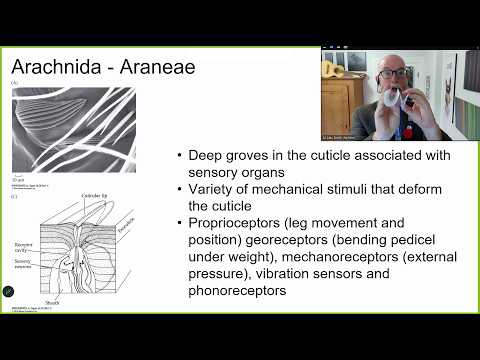
- Spider legs carry mechanosensory structures including hairs, pit organs, and slit sensilla, which detect touch, vibration, and changes in cuticle strain.
- Lyriform organs consist of groups of slit sensilla that register small deformations and provide proprioceptive information about leg position.
- These receptors help spiders maintain balance on moving webs and support movement in active predatory spiders.
- The slit-sensilla design has inspired biomimetic approaches to monitoring stress and deformation in structures such as concrete.
- Mutualistic acacia ants use vibrations traveling through the plant to detect browsing herbivores and respond by increasing patrol behavior.
- Ants distinguish herbivore activity from wind by differences in vibration amplitude and frequency, avoiding an unnecessary response to wind.
- The example shows how vibration sensing can convey information about a threat even when visual cues are also available.
- Male crickets produce calls by scraping serrated files on one wing against a scraper on the other, generating species-specific acoustic pulses.
- Tympanal membranes on cricket legs vibrate in response to sound, with sensitivity matched to important calling frequencies.
- Three co-occurring cricket species can use distinct sound frequencies, helping separate their signals in a shared acoustic environment.
- Cricket auditory systems have roughly 60 to 70 receptor neurons, compared with the much larger investment in ant chemoreception.
- Neoponera apicalis, formerly classified as Pachycondyla apicalis, has an abdominal stridulatory organ whose serration patterns and sounds help distinguish species.
- Ants use stridulation as well as chemical communication, and species living inside ant colonies may need to interpret colony signals.
- Warty birch caterpillars flex their bodies to send vibrations through leaves, signaling to arriving caterpillars that a feeding site is occupied.
- When a predator approaches, the resident caterpillar becomes silent, reducing the chance that its signal will guide the predator to it.
- Bush crickets have tympanal organs at the knees, connected to an acoustic trachea that amplifies sound through the leg.
- Sound reaches the hearing system by different routes and timings, helping the insect distinguish direction and particular frequencies.
- The body tympanum detects conspecific calls, while the knee tympanum is tuned to frequencies associated with hunting bats.
- The parasitoid fly Ormia ochracea locates calling crickets despite having eardrums less than half a millimeter apart and sound wavelengths around 7 centimeters.
- A cuticular bridge mechanically links the two tympanal membranes, amplifying tiny differences in vibration and interaural timing.
- The coupled-ear mechanism supports directional localization and has inspired acoustic microsensor designs.
- The lecture closes with course reminders about the upcoming lab report, case study, and invertebrate video assignment.
Transcript excerpt
0:00 So good morning. Good morning. Good morning. Good morning. Welcome. Uh this is our last time. This is the last of the three sections in 3700 where we're going to be considering sensory the sensory world of the in uh of the invertebrates. Today we're going to move from the ocean uh to early bilitarians, early branching bilitarians and spend a lot of time at the end with a whole bunch of incredible arthropods. And I know this is kind of occurring for those of you who've already had your lab. This is complimenting where our sensory kind of lectures are aligned uh nicely with when you're thinking about sensing and responding in lab. So um you found all of the letters. Do you know the word?
0:49 That's it. That's it. Okay. A round of applause. Well done. It is tempanum. Tempanum, which is a sound receiving or a mechano a type of mechano receptor. So, and that's what we're going to be talking about uh today are mechano receptors. Previously on zoologology 3700 we were talking about chemo receptors and previously to that we were talking about photo receptors. Uh with chemoceptors we talked about nucal organs and esphradia and um moths and aesthetics and stafalinids and a whole bunch of kind of amazing adaptations that all of these different taxa have for smelling and
1:36 tasting. And we talked about all the way back to Aristotle. uh really gustation and olfaction are kind of two very human biased terms that split up what is principally we can unify under the heading of cheo reception. Today we're going to talk about mechano reception. Uh when we talk about mechano reception, we're talking about different apparatus and different strategies, different organs and different regions of the body that are are adapted towards
This is the start of the transcript. Save this video free for the whole transcript, searchable and time-coded.
In this course
Related notes
Summary, takeaways, and chapters were generated by AI from the video's transcript and may contain errors. The video belongs to its creator, Alex Smith.