ZOO*3700 - Lecture 15 - Sensory I: photoreception
 Watch on YouTube →
Overview
Alex Smith explains photoreception as the conversion of light into neural signals, emphasizing that useful sensing often depends on filtering environmental cues rather than forming detailed images. The lecture connects opsin and chromophore machinery shared across animal lineages for more than 500 million years to diverse eyes, then examines how arthropod eye structure balances light sensitivity, image acuity, and ecological demands.
Key takeaways
- Photoreception does not require image formation: a pigment-lined cup that distinguishes light from shadow can help an animal orient, locate habitat, or detect threats.
- Opsin and chromophore pairings initiate phototransduction, and rhabdomeric and ciliary receptor types are found across animal groups rather than dividing neatly into invertebrates and vertebrates.
- Light environments vary substantially with water depth, shade, and time of day, selecting for photoreceptors tuned to the wavelengths and intensities available in each habitat.
- Arthropod eye design balances sensitivity against acuity: larger ommatidia capture more light but reduce the number of ommatidia that fit in an eye of fixed size.
- Compound eyes can support motion tracking and prey interception; robber flies use a constant bearing angle to pursue moving targets.
Chapters
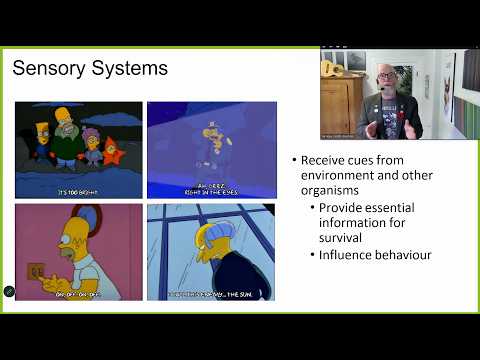
- The sensory systems chapter covers photoreception, chemoreception, and mechanoreception, with this lecture focused on light.
- Receptors selectively detect cues such as light, chemicals, and vibrations, then translate and amplify them into electrical signals for the nervous system.
- A simple pigment-lined eye cup can distinguish light from shadow without forming an image, helping an animal find food, avoid predators, or select habitat.
- Human-visible light spans roughly 400 to 700 nanometers, a small portion of the electromagnetic spectrum.
- Water filters wavelengths with depth, so animals at 5, 100, and 500 meters encounter different light environments.
- On land, activity time, moonlight, starlight, and shade also change the wavelengths and light intensity available to photoreceptors.
- A photon changes the configuration of a chromophore paired with an opsin protein in the cell membrane, initiating signal transduction.
- Rhabdomeric photoreceptors use microvilli, while ciliary photoreceptors use cilia; vertebrate rods and cones are ciliary photoreceptors.
- Light produces different membrane-potential responses in the two receptor types, and their distribution is not a simple vertebrate versus invertebrate split.
- R-type and C-type opsins occur across animal lineages whose common ancestors lived more than 500 million years ago.
- Brachiopods and echinoderms reach seven opsin types in the presented comparison, the highest diversity among the groups discussed.
- Brachiopod opsins may benefit swimming larvae that use light to orient in the water column, even if adults live inside shells.
- Simple pit eyes, lens eyes, reflector eyes, and compound eyes occur across groups including flatworms, annelids, molluscs, and arthropods.
- About 85 percent of invertebrate taxa are described as having simple eyes at some point in their life cycle.
- Cnidarians show pigment spots, pigment cups, and lens eyes; their distribution suggests multiple independent origins of eyes within the phylum.
- Arthropod compound eyes contain many individual units called ommatidia, while simple median ocelli can detect light at low intensities.
- A stonefly larva illustrates the combination of lateral compound eyes and simple ocelli as distinct visual tools.
- Compound eyes can detect edges and form images, while different ommatidia may serve different visual functions.
- Each ommatidium contributes a visual element, and ommatidial number, receptor type, and arrangement affect image resolution and acuity.
- Some rainforest beetles have protruding eyes with many ommatidia, while other beetles have flatter, smaller eyes suited to different conditions.
- Robber flies extend their eyes beyond the head, and some arthropods detect ultraviolet wavelengths from about 300 to 400 nanometers.
- An ommatidium includes a corneal lens, a crystalline cone, pigment cells, and a rhabdom containing microvilli with light-sensitive opsins.
- Superposition compound eyes allow light from multiple ommatidia to contribute to a signal, supporting vision in low-light conditions.
- Apposition eyes keep the ommatidial light paths more isolated, a configuration associated with brighter environments.
- Increasing the diameter of an ommatidium captures more photons and raises sensitivity, but leaves room for fewer ommatidia in a fixed-size eye.
- Fewer ommatidia increase the interommatidial angle and reduce spatial sampling, creating a tradeoff between sensitivity and acuity.
- Field and forest arthropod comparisons show larger eyes in darker habitats, consistent with prioritizing light capture over image detail.
- Dragonflies with tens of thousands of ommatidia can detect motion and track prey, even as image detail declines with distance.
- Robber flies can intercept moving prey by maintaining a constant bearing angle, enabling rapid pursuit with a very small nervous system.
- The lecture closes by noting that scallop and chiton eyes need more discussion and previewing later lectures on chemoreception and mechanoreception.
Transcript excerpt
0:00 All right. Good morning. Good morning. Good morning. Good morning. Welcome back to the time that you've defended in your life to think about the little things that run the world that they share with us. So, what are we talking about today? We're kind of changing chapters. Um, let me clear the drawings. Thank you for doing that. Um, oh, here's my first kind of off to the side. This is, um, your invert one, uh, invert R1 assignments are back, and you've had the kind of the weekend to reflect on them. I've reflected on the things that I saw, and there you did a great job in general. Uh, but there's a 10-minute
0:47 spiel um, and PDF that are up online now. the welcome page for course link kind of links you there with some suggestions uh and answers to some common questions that folks have had so you can check that out at your leisure. One of the common things in it is don't leave things till the end um because practice is practice is practice. So as I was saying we're kind of leaving one chapter the chapter about the myriad of ways that invertebrates eat. Uh and the last kind of category that we thought about or allocated time for was to think about parasites. So we talked about kind of classifications and some consequences both at an individual population and a community level to the world and ecosystem level to parasites
1:35 and parasitic relationships. We talked about evolutionary arms races and kind of link things back to thinking uh when we were thinking in our chapter about um life history evolution and life history theory. Where are we going now? So the next three lectures, the next chapter in this uh course of ours is thinking about
This is the start of the transcript. Save this video free for the whole transcript, searchable and time-coded.
Related notes
Summary, takeaways, and chapters were generated by AI from the video's transcript and may contain errors. The video belongs to its creator, Alex Smith.