Lecture 6: Quantum phase transitions of the Bose Hubbard model
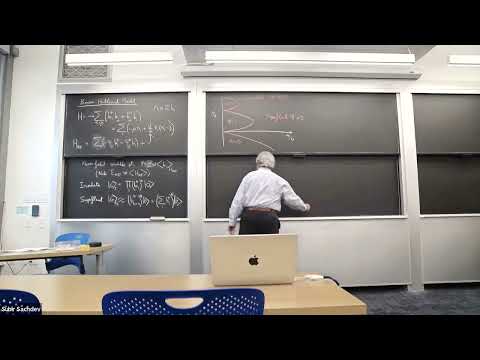
Overview
Subir Sachdev develops the Bose-Hubbard model’s phase diagram, showing how mean-field theory distinguishes integer-filled Mott insulators from superfluids and how the Mott-lobe tips host relativistic complex-scalar criticality in the XY universality class. He then maps hard-core bosons at half filling to the spin-1/2 XXZ model, connecting superfluid order to XY magnetism and checkerboard density order to antiferromagnetism.
Key takeaways
- In mean-field theory, the Bose-Hubbard order parameter separates integer-filled Mott insulators from superfluids, but the decoupled Hamiltonian energy is not a variational estimate because bond hopping is double-counted.
- The helicity modulus measures the energy cost of a phase gradient: it is nonzero in a superfluid and strictly zero in a Mott insulator.
- Away from Mott-lobe tips, particle or hole excitations produce dilute Bose-gas transitions; at the tips, particle-hole symmetry removes the first-order time derivative and yields relativistic complex-scalar criticality.
- For a two-dimensional lattice at a Mott-lobe tip, the critical behavior is in the three-dimensional classical XY universality class.
- Projecting bosons to zero or one particle per site maps hard-core bosons to spin-1/2 variables, with boson order corresponding to XY magnetic order and density order corresponding to Sz magnetic order.
- In the XXZ mapping, strong positive Jz favors Néel order and checkerboard boson density, whereas dominant Jx favors XY order and a superfluid.
Chapters
- The Bose-Hubbard model places bosons on a lattice with hopping amplitude W and repulsive on-site interaction U.
- At strong coupling, suppressing hopping leaves a solvable on-site problem whose ground states have integer boson number per site.
- Sachdev presents the model as a simple setting for studying quantum phases and transitions relevant to condensed matter and cold atoms.
- Decoupling neighboring hopping terms introduces a complex order parameter proportional to the expectation value of the boson operator.
- The resulting mean-field Hamiltonian is a single-site problem that can be solved numerically, then made self-consistent.
- Zero order parameter corresponds to a Mott insulator; nonzero order parameter indicates a superfluid with broken particle-number U(1) symmetry.
- The mean-field Hamiltonian energy is not itself a variational estimate of the original energy because the hopping decoupling double-counts bonds.
- A site-dependent phase rotation of a Mott-state wavefunction changes only its overall phase, while a phase gradient in a superfluid creates a flowing state.
- The energy cost of a slow phase twist is proportional to the square of the phase gradient, with coefficient called the helicity modulus or superfluid stiffness.
- The helicity modulus is nonzero in the superfluid and strictly zero in the Mott insulator, making it a direct phase diagnostic.
- For charged bosons, the stiffness is related to magnetic-field screening and the London penetration depth.
- Mott insulating regions occur at integer densities, including filling one and filling two, while the intervening superfluid is compressible.
- Equal-density contours in the superfluid bend around the integer-filling Mott lobes and meet at their tips.
- The dilute Bose-gas description applies near low-density boundaries, while the lobe tips require a distinct particle-hole-symmetric treatment.
- Just above density one, the excess particles move through a background with one boson on each site.
- Hopping onto an occupied site gains a bosonic enhancement factor, giving an effective hopping matrix element twice the bare value in the example.
- The transition along this lobe edge is therefore described by a dilute gas of particle excitations, with the background changing their effective mass.
- Just below integer filling, the mobile low-energy excitations are holes in the otherwise filled Mott state.
- The particle and hole boundaries have opposite signs for the first-order time-derivative term in their effective theories.
- At fixed density, the important transition occurs at the lobe tip, where particle and hole excitations become symmetric.
- Sachdev derives a Gaussian integral identity and uses it as the Hubbard-Stratonovich transformation for the hopping term.
- The transformation replaces boson hopping between sites with an auxiliary complex field coupled locally to the boson operator.
- Integrating over the original bosons factorizes into single-site problems, providing a route from mean field to fluctuation corrections.
- Near the phase boundary, the auxiliary field is small and varies slowly in space and imaginary time.
- These assumptions allow a gradient expansion of the effective action, retaining only low-energy, long-wavelength terms.
- Although the lattice hopping matrix has negative eigenvalues that complicate the formal integration contour, Sachdev notes that the low-energy theory is smooth.
- The effective action contains a quadratic mass term r times the squared field and a stabilizing quartic interaction.
- The condition r = 0 identifies the mean-field phase boundary; on the superfluid side, negative r favors a nonzero field.
- Spatial and temporal derivative terms encode the dispersion and distinguish generic lobe edges from the particle-hole-symmetric tip.
- A first-order time derivative is present along generic particle or hole boundaries, producing dilute Bose-gas critical behavior.
- At a Mott-lobe tip, the coefficient K1 of that term vanishes, leaving the second-order time derivative term K2.
- The resulting complex scalar field theory is relativistic and belongs to the XY universality class; in two spatial dimensions its critical behavior matches the three-dimensional classical XY model.
- The superfluid has a gapless phase mode, the Goldstone or Bogoliubov mode, whose energy vanishes linearly with momentum near the relativistic tip.
- The relativistic theory also supports a massive amplitude fluctuation, often called a Higgs mode or Higgs analogue.
- The amplitude mode has finite frequency at zero momentum and does not control the lowest-energy physics, but it can in principle be measured.
- Near density one-half in the relevant regime, Sachdev projects each lattice site onto only the zero- and one-boson states.
- The restriction to at most one boson per site is the hard-core condition, and the two allowed states form a spin-1/2 degree of freedom.
- Boson creation and annihilation map to spin raising and lowering operators, while density relative to one-half maps to Sz.
- The spin model has equal nearest-neighbor couplings Jx in the x and y directions and a separate coupling Jz along z.
- A sublattice-dependent phase choice maps the XY exchange term to boson hopping; the SzSz term becomes a nearest-neighbor density interaction.
- Within the hard-core projection, the on-site Hubbard interaction no longer acts because double occupancy has already been excluded.
- The Heisenberg point occurs when Jx equals Jz, while the XXZ model allows the two couplings to vary independently.
- Large positive Jz favors alternating up and down spins, the Néel antiferromagnet, which maps to checkerboard boson-density order.
- For sufficiently strong XY coupling Jx, spins order in the XY plane, corresponding to a boson superfluid with a gapless spin-wave mode.
- On the square lattice, numerical results indicate checkerboard order can persist to the Heisenberg point; the triangular-lattice case may be more complicated and could support a spin liquid.
- The lecture closes by previewing fractionalization and spin liquids as the next topic.
Transcript excerpt
0:06 Okay. Um, so let's continue then with the discussion of the post Hubard model. U I'm going to finish that today and then say a little bit about antiferomagnetism and magnetism in general. Um and then we're going on to uh more modern topic uh which is fractionalization and spin liquids right after that. Okay. So here's a summary of uh what we discussed last time. This is the Bose Hover model. You have bzons on some lattice in any dimension. That's usually the hyper cubic lattice. uh they're hopping with an amplitude W and then when they're on the same side uh there's a repulsive interaction Q
0:54 between any pair of Bzons. So you know this was introduced as a just as a co model as a such but uh since form realizations in cold atoms and but more importantly at least from my perspective uh it's one of the simplest places to study quantum phases and phase transitions because similar ideas will appear in many other places of more realistic systems for condensed matter. Okay. Um so this is the model we'd like to solve. And fortunately for this model at least there's a very simple meanfield theory um that really gives you almost a complete picture and the mean field theory uh the idea here u is to really think about the strong coupling effect if the if u was
1:43 zero then this is just Einstein condensation we have already studied the d gas and weak interactions we understand so let's try to do mfield theory which accounts for the strong interactions exactly And what we notice is that this growing interacting part uh is easily solvable if you didn't have any opin although it's quite non-trivial the the n uh you know must be an integer but it's a
This is the start of the transcript. Save this video free for the whole transcript, searchable and time-coded.
In this course
Related notes
Summary, takeaways, and chapters were generated by AI from the video's transcript and may contain errors. The video belongs to its creator, Subir Sachdev.